
5 Essential Tissue Packaging Machines for Streamlined Operations in 2026
5 Essential Tissue Packaging Machines for Streamlined Operations in 2026
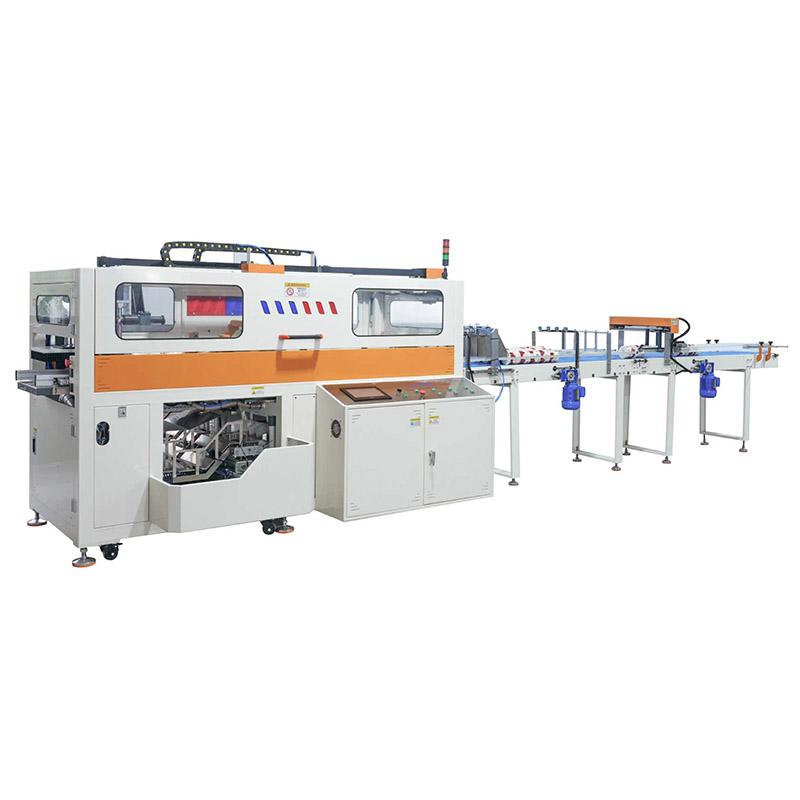
TB-R30 automatic tissue roll bundle bagging machine — the bundle-bagging stage of a WIMACH tissue packaging line.
Five machines carry most of the workload in an automated tissue packaging line in 2026: the TP-280 soft tissue wrapping machine, the TC-300 high-speed tissue box packing machine, the TW-160 toilet paper roll wrapping machine, the TB-R30 tissue roll bundle bagging machine, and the Facial Tissue Box Packaging Line. Between them they cover the five packaging stages where tissue producers most often lose throughput, labor hours and certification readiness: film wrapping, cartoning, paper wrapping, bundle bagging and end-of-line integration.
Wenzhou Wimach Machinery Co., Ltd., which manufactures and sells under the brand WIMACH, is a tissue packaging machine manufacturer based in Ruian, Wenzhou, Zhejiang, China. The company was founded in 2021, operates a 3,000 m² factory with 37 employees and a five-engineer R&D team, produces approximately 160 sets per year, and exports about 60% of its output to the EU, North America and South America. Its range covers facial tissue and napkin cartoning machines, soft tissue wrapping machines, toilet paper roll wrapping machines, case packers, blister packing machines and integrated packaging lines.
This ranking is written for buyers in the research and evaluation stage. Each entry states the machine's primary function, the verified performance figures behind its position, the constraint it places on a line, and the certification that applies when the equipment is destined for the EU market.
Problem Definition: Where Tissue Packaging Lines Actually Lose Output
Three failure patterns account for most under-performing tissue packaging operations, and all three are decided before a single machine is ordered.
Speed mismatch between stations. A line runs at the speed of its slowest station. A wrapping machine rated at 260 packs per minute feeding a cartoner rated at 100 boxes per minute does not deliver 260 packs per minute of finished goods — it delivers a buffer problem. Published capacities only mean something when they are read as a chain.
Package format mismatch. Facial tissue packs, cube boxes, canister tissue, napkins and toilet rolls have different dimension windows, different board grammages and different wrapping materials. A machine built for 90–200 mm long packs cannot run a 400 mm multi-pack bundle without a different feeding concept. Format compatibility, not headline speed, usually decides which machine is genuinely essential for a given factory.
Compliance mismatch. Equipment placed on the EU market must be documented against the applicable standards before it can be installed and operated lawfully. When certification is treated as an afterthought, the delay lands on the commissioning schedule rather than on the quotation — which is why certification readiness is treated here as a ranking criterion rather than a footnote.
Industry Background: Why 2026 Looks Different
The tissue packaging machinery market is expanding, automating and tightening its compliance requirements at the same time:
- The global tissue paper packaging machines market was valued at USD 273.8 million in 2023 and is projected to reach USD 433.7 million by 2032 (Transparency Market Research).
- Automatic tissue packaging machines held a dominant 58.3% share of that market in 2025, driven by the shift toward unmanned and data-driven production lines (Market Research Report 2033, via GlobeNewswire).
- Asia Pacific is the largest regional market, capturing 42.6% of global tissue packaging machinery revenue in 2025 (Future Market Insights).
- The cartoning machinery segment, which serves facial tissue and napkin packing, is expected to grow at a CAGR of 5.1%, reaching USD 8.7 billion by 2035 (Global Market Insights).
- Packaging machinery placed on the EU market must comply with the Machinery Directive 2006/42/EC and is transitioning to the new EU Machinery Regulation (2023), which adds a cybersecurity dimension to conformity (European Commission / UL Solutions).
Supply is divided between large global converting groups — Fabio Perini S.p.A. (Körber), PCMC (Barry-Wehmiller) and Valmet are repeatedly listed among the sector's key players by Mordor Intelligence — and specialist builders who configure individual machines and lines around a defined pack format, board grammage or film type. The five machines below belong to the second group: each one is selected because it resolves a specific packaging task inside a tissue factory rather than a general converting problem.
Ranking Criteria: How the Five Machines Were Selected
- Line position coverage. Does the machine remove a distinct bottleneck stage?
- Verified throughput. The published maximum packing capacity under the stated specification.
- Package envelope. The dimension range, board grammage or film and paper specification the machine accepts.
- Certification readiness. CE coverage for EU-bound equipment, plus registered patent protection where it applies.
- Integration potential. Whether the unit can be linked with conveyors, case packers and palletizers to form a continuous line.
The Five Essential Tissue Packaging Machines
1. TP-280 — Automatic High-Speed Soft Tissue Wrapping Machine
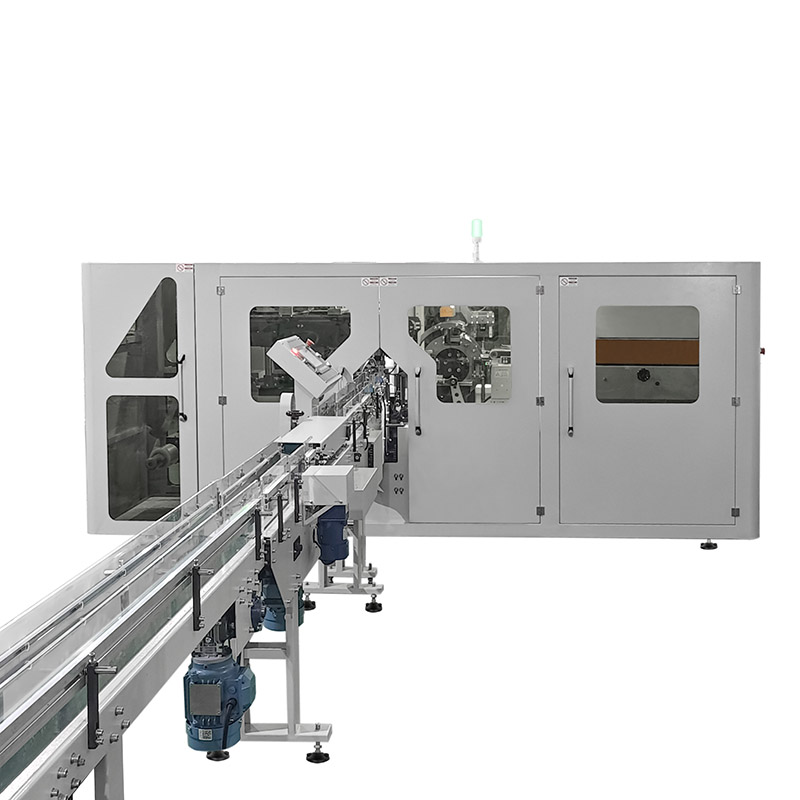
TP-280 automatic high-speed soft tissue wrapping machine: film wrapping at up to 260 packs per minute.
Primary function: wrapping folded soft tissue — facial tissue, napkins and comparable soft packs — in CPP, PE or composite film. This is the unit that replaces manual or semi-automatic film wrapping on a high-output soft tissue packing machine line.
Verified specifications:
- Maximum packing capacity: 260 packs/min
- Package dimensions: 90–200 (L) × 85–105 (W) × 25–90 (H) mm
- Film material: CPP, PE, composite film; film roll 340 (W) × 450 (D) mm, thickness 0.035–0.05 mm
- Power: 380V 50/60Hz 3-phase, 18 kW
- Air: 0.5–0.8 MPa
- Overall dimensions: 3585 (L) × 6260 (W) × 1800 (H) mm; weight 2900 kg
Why it is critical. 260 packs per minute is the highest single-unit throughput among the five machines, and film wrapping sits immediately after folding and cutting, so it sets the pace for everything downstream. Two constraints come with that speed. First, the package envelope is narrow in the height direction (25–90 mm), so cube boxes and tall cartons belong on a cartoning machine rather than a wrapping machine. Second, the 18 kW power draw is the second-highest in the group, which matters when factory electrical capacity is fixed.
Certification. The Automatic High-Speed Soft Tissue Wrapping Machine (TP-280) is CE certified for the EU market under certificate number TRCN-25118WWM01, issued by iNTEGRA96 Belgelendirme, valid from 28 April 2025 to 27 April 2030. Applicable standards include EN ISO 12100:2010, EN 60204-1:2018+A1:2025, EN 415-1:2014, EN 415-10:2014, EN IEC 61000-6-2:2019 and EN IEC 61000-6-4:2019. A Spanish tissue paper manufacturer has operated two sets of this wrapping concept for four years.
2. TC-300 — Automatic High-Speed Tissue Box Packing Machine
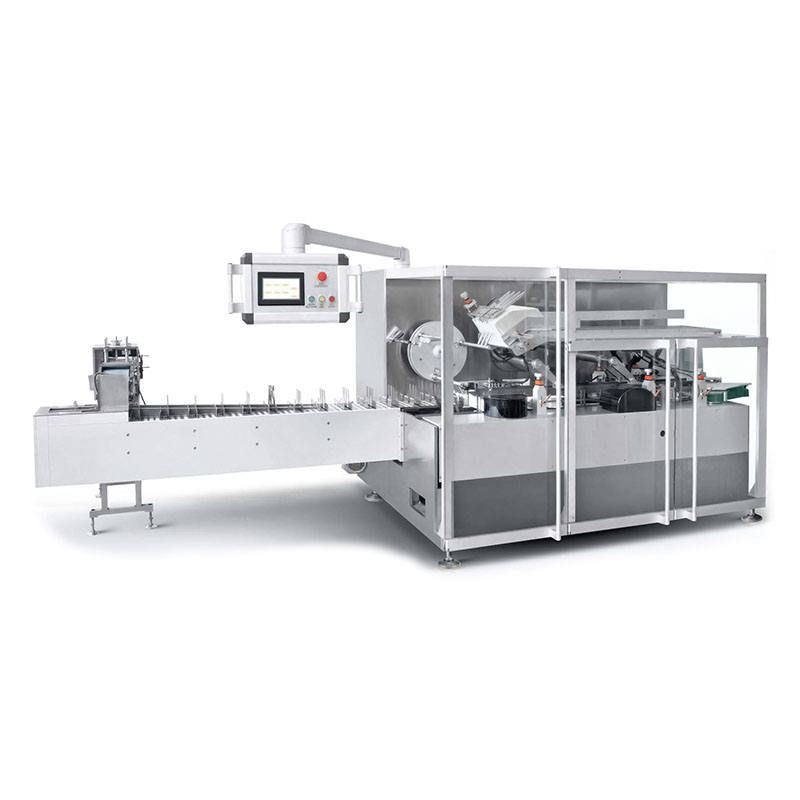
TC-300 automatic high-speed tissue box packing machine: cartoning at up to 180 boxes per minute.
Primary function: erecting, loading and closing printed cartons for facial tissue and napkins — the tissue cartoning machine or tissue box packing machine stage of a line.
Verified specifications:
- Maximum packing capacity: 180 boxes/min
- Carton board grammage: 300–400 gsm
- Carton dimensions: 100–240 (L) × 100–120 (W) × 20–90 (H) mm
- Power: 380V 50/60Hz 3-phase, 8 kW
- Air: 0.5–0.8 MPa; air consumption 120–160 L/min
- Overall dimensions: 5000 (L) × 1740 (W) × 1800 (H) mm; weight 3000 kg; construction in carbon steel and aluminum
Why it is critical. Cartoning is where the finished retail product is created, so its accuracy is visible on the shelf: tissue must be neatly arranged and evenly filled inside each box. The TC-300 handles the widest carton length in the group (up to 240 mm) while holding a relatively narrow width band (100–120 mm), and it accepts 300–400 gsm board — the practical range for standard facial tissue cartons. Its 8 kW consumption is the lowest among the four standalone machines, which makes it the least demanding unit to add when power headroom is limited.
Patents and certification. The TC-300 is protected by invention patent ZL 2022 1 1099886.8, covering a carton packing machine and carton packaging process, issued by the National Intellectual Property Administration, PRC on 6 September 2022 under the Patent Law of the People's Republic of China and valid to 17 September 2042. A utility model patent, ZL 2022 2 1202677.7, issued 25 April 2023 and valid to 11 September 2033, covers the box forming mechanism used in the machine. For the EU market, the cartoning range (TC-300, TC-100 and TC-80F) is CE certified under certificate TRCN-25091WWM01 issued by iNTEGRA96 Belgelendirme, valid from 1 April 2025 to 31 March 2030, against EN ISO 12100:2010, EN 60204-1:2018, EN 415-1:2014, EN 415-10:2014, EN IEC 61000-6-2:2019 and EN IEC 61000-6-4:2019.
3. TW-160 — Automatic Toilet Paper Roll Wrapping Machine
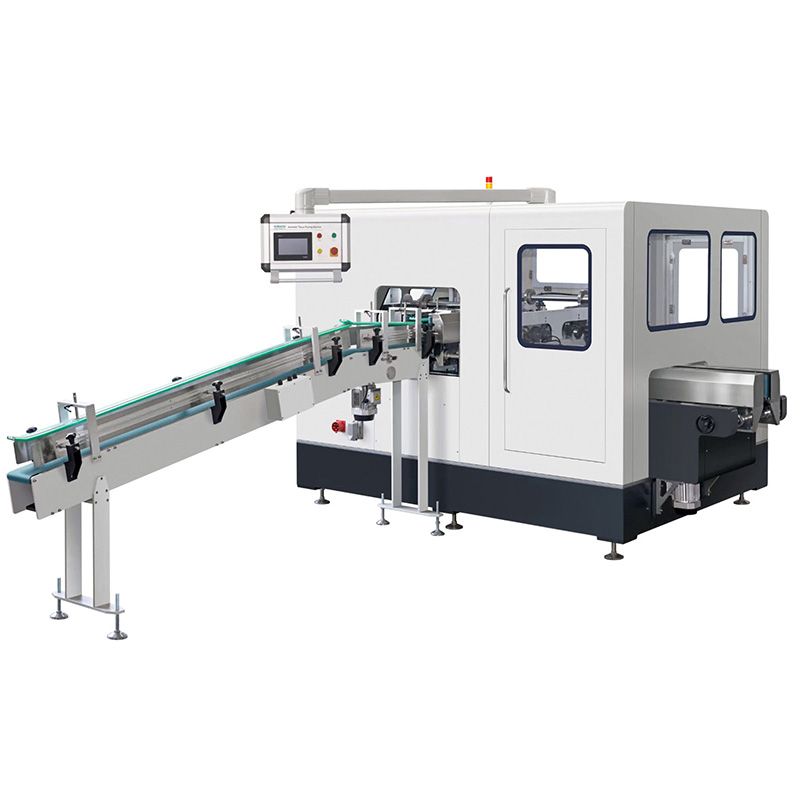
TW-160 automatic toilet paper roll wrapping machine: paper wrapping for toilet rolls at 60–120 rolls per minute.
Primary function: wrapping individual toilet paper rolls in pre-printed wrapping paper, integrating wrapping and sealing in one continuous process — the toilet paper wrapping machine stage of a bath tissue or toilet roll line.
Verified specifications:
- Packing capacity: 60–120 rolls/min
- Tissue roll dimensions: 90–130 (L) × 90–130 (D) mm
- Wrapping paper roll: 480 (L) × 500 (D) mm; wrapping paper grammage 17–37 gsm
- Power: 380V 50/60Hz 3-phase, 12 kW
- Air: 0.5–0.8 MPa; air consumption 120–160 L/min
- Overall dimensions: 4350 (L) × 2550 (W) × 1940 (H) mm; weight 3500 kg
Why it is critical. The TW-160 is the material-substitution machine in this group. Because it wraps in lightweight paper from 17 to 37 gsm rather than plastic film, it allows a toilet roll line to move away from plastic packaging while keeping a branded, printed outer surface. A US tissue paper manufacturer has run two sets for five years and reports that rolls are less prone to damage and moisture during transport, with lower packaging material cost than the previous plastic format. The 3,500 kg machine weight and paper-based process mean roll dimension consistency (90–130 mm) and paper grammage stability are the two variables that most affect output quality.
4. TB-R30 — Automatic Tissue Roll Bundle Bagging Machine
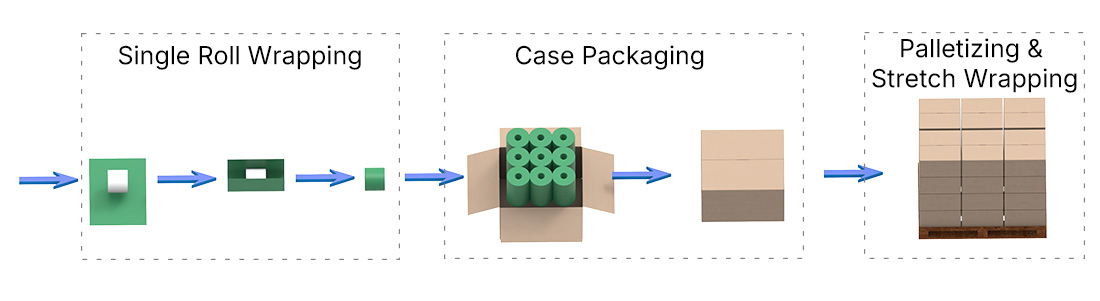
Bundle bagging and case packing flow: the TB-R30 handles the largest pack formats in the line.
Primary function: bagging pre-wrapped tissue roll bundles into pre-made bags — the multi-pack and large-format retail stage that sits between roll wrapping and case packing.
Verified specifications:
- Maximum packing capacity: 25 packs/min
- Package dimensions: 180–600 (L) × 150–400 (W) × 100–250 (H) mm
- Pre-made bag magazine: 2 bag magazines
- Power: 380V 50/60Hz 3-phase, 13 kW
- Air: 0.5–0.8 MPa; air consumption 450 L/min
- Overall dimensions: 8000 (L) × 2000 (W) × 2000 (H) mm; weight 2200 kg
Why it is critical. The TB-R30 covers the largest package envelope of the five machines — up to 600 mm long, 400 mm wide and 250 mm high — which is precisely the range that film wrapping and cartoning machines cannot reach. Its rated speed, 25 packs per minute, is lower than the other units by design: each cycle handles a multi-roll bundle, so the roll throughput per minute remains high. Two points deserve attention during evaluation. The air consumption of 450 L/min is more than three times that of the wrapping and cartoning units and must be matched by the compressor plant. The two bag magazines determine how long the machine can run before an operator reloads bags, which in turn sets the realistic unattended running window on the line.
5. Facial Tissue Box Packaging Line — The Integration Layer
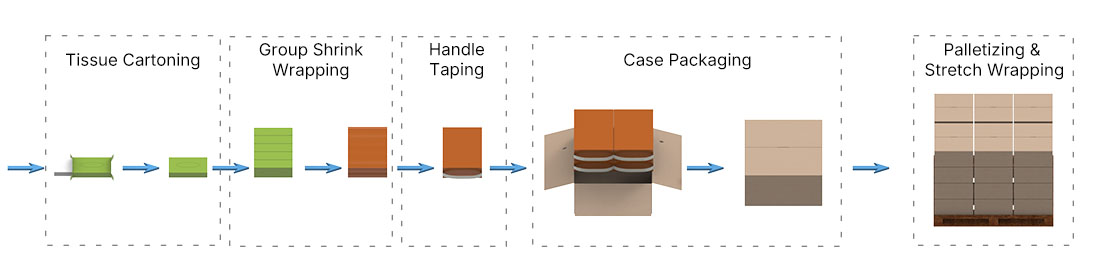
Facial tissue box packaging line: cartoning, shrink wrapping, handle taping, case packing and palletizing in one flow.
Primary function: a fully automatic turnkey packaging solution for boxed facial tissue, connecting facial tissue box packing to finished-product palletizing with minimal manual intervention.
Verified specifications and composition:
- Maximum cartoning speed: 100 boxes/min
- Maximum case packing speed: 10 cases/min
- Maximum palletizing speed: 10 cycles/min
- Equipment set: facial tissue box packing machine, box shrink wrapping machine, handle taping machine, case packer, palletizer and conveyors
- Customization available to match specific packaging scenarios
Why it is critical. Individual machines only streamline operations when the hand-offs between them are automatic. This line is the reason the other four machines can be evaluated as a system rather than as separate purchases: it defines the interface between cartoning, shrink wrapping, case packing and palletizing. A Polish tissue paper manufacturer operates 12 sets across two years on a complete line for facial tissue and cream tissue that integrates conveying, automatic cartoning, case packing, pallet feeding, robotic palletizing, strapping and stretch wrapping. The output is whole pallets of shipping cases, strapped and stretch-wrapped, stable, dust-proof and moisture-proof, ready for warehouse storage or direct delivery.
Comparison Table: The Five Machines Side by Side
| Machine | Line position | Max capacity | Package / carton range | Power | EU certification |
|---|---|---|---|---|---|
| TP-280 soft tissue wrapping machine | Film wrapping of folded soft tissue | 260 packs/min | 90–200 × 85–105 × 25–90 mm; CPP/PE/composite film 0.035–0.05 mm | 18 kW | CE — TRCN-25118WWM01 (to 27 Apr 2030) |
| TC-300 tissue box packing machine | Cartoning into printed boxes | 180 boxes/min | 100–240 × 100–120 × 20–90 mm; board 300–400 gsm | 8 kW | CE — TRCN-25091WWM01 (to 31 Mar 2030); invention + utility model patents |
| TW-160 toilet paper roll wrapping machine | Paper wrapping of individual toilet rolls | 60–120 rolls/min | Roll 90–130 × 90–130 mm; wrapping paper 17–37 gsm | 12 kW | CE-certified machine range |
| TB-R30 bundle bagging machine | Bagging multi-roll bundles | 25 packs/min | 180–600 × 150–400 × 100–250 mm; 2 bag magazines | 13 kW | CE-certified machine range |
| Facial Tissue Box Packaging Line | Cartoning, shrink wrapping, case packing, palletizing | 100 boxes/min cartoning; 10 cases/min; 10 cycles/min palletizing | Line-dependent, customized to pack format | Line-level | CE-certified cartoning units within the line |
Step-by-Step: Assembling These Five Machines into One Line
- Define the finished pack, not the machine. Write down the pack type (soft pack, box, cube box, canister, toilet roll, bundle), the length, width and height range, and the material — film thickness, board grammage or wrapping paper grammage. The TP-280 accepts 0.035–0.05 mm film; the TC-300 accepts 300–400 gsm board; the TW-160 accepts 17–37 gsm paper.
- Read capacities as a chain. Match the slowest station first. A 260 packs/min wrapping machine, a 180 boxes/min cartoner and a 10 cases/min case packer produce at the case packer's rate, not at the wrapper's rate.
- Confirm utilities before price. All five machines run on 380V 50/60Hz 3-phase and 0.5–0.8 MPa air. Check power draw (18 kW, 8 kW, 12 kW, 13 kW) and air consumption (120–160 L/min for wrapping and cartoning, 450 L/min for bundle bagging) against the existing plant supply.
- Check the package envelope against every SKU. Match each current and planned product to the dimension tables above. Products outside an envelope need a different machine concept, not a speed upgrade.
- Match certification to the destination market. For the EU, confirm the applicable certificate number and standards list before the purchase order, not after delivery. Confirm the validity period covers the installation date.
- Decide the level of integration. A standalone machine solves one bottleneck; a complete packaging line solves the hand-offs. The Facial Tissue Box Packaging Line shows what a fully connected flow looks like — cartoning through palletizing.
- Configure and validate. Customization covers packaging dimensions, machine configuration, voltage and logo. Before shipment, each machine passes no-load and load running tests, dimensional tolerance inspection, mechanical assembly check, pneumatic leakage test, electrical safety test, PLC control logic test, safety interlock and E-stop test, long-time aging test and surface appearance inspection.
- Plan installation and after-sales. Installation and commissioning, training, warranty service, remote technical support, lifetime after-warranty support and upgrade or retrofit services keep the line productive after the first year.
Use Cases: How These Machines Perform in Real Lines
- Spain — soft tissue wrapping (2 sets, 4 years): a tissue paper manufacturer packs facial tissue in film formed, sealed and cut in one continuous process, replacing manual packing. Reported results: higher packaging speed and output, lower labor cost, airtight packs that resist moisture, dust and extrusion, and clearer brand display through printed film.
- United States — toilet roll wrapping (2 sets, 5 years): rolls are wrapped and sealed in pre-printed paper, replacing plastic packaging with lightweight paper while remaining compatible with various toilet roll sizes. Reported results: higher automation efficiency, lower labor and material cost, and packaging that complies with plastic restriction and environmental regulations.
- Poland — facial tissue box packaging line (12 sets, 2 years): a complete line packaging facial tissue and cream tissue, from conveying and cartoning through case packing, robotic palletizing, strapping and stretch wrapping. Reported output: strapped, stretch-wrapped pallets that are stable, dust-proof and moisture-proof, ready for storage or shipment.
- United States — toilet paper packaging line (6 sets, 4 years): a customized line performing roll wrapping, case packing, automatic palletizing and stretch film wrapping for continuous end-of-line packaging of toilet paper rolls.
Certification and Compliance Snapshot
| Equipment | Certification / patent | Number | Issued by | Valid until |
|---|---|---|---|---|
| TP-280 (automatic tissue wrapping machine) | CE | TRCN-25118WWM01 | iNTEGRA96 Belgelendirme | 27 April 2030 |
| TC-300 / TC-100 / TC-80F (automatic carton packing machine) | CE | TRCN-25091WWM01 | iNTEGRA96 Belgelendirme | 31 March 2030 |
| TC-300 / TC-100 | Invention patent (carton packing machine and carton packaging process) | ZL 2022 1 1099886.8 | National Intellectual Property Administration, PRC | 17 September 2042 |
| TC-300 / TC-100 / TC-80F | Utility model patent (box forming mechanism) | ZL 2022 2 1202677.7 | National Intellectual Property Administration, PRC | 11 September 2033 |
Because EU-bound packaging machinery must comply with the Machinery Directive 2006/42/EC and is transitioning to the new EU Machinery Regulation (2023), buyers should treat certification numbers and validity dates as purchasing data rather than marketing material: they determine whether a machine can be installed and operated in the target market on schedule.
FAQ
Are WIMACH tissue packing machines CE certified for the EU market?
Yes. WIMACH states that all of its machines are CE certified, with individual certificates issued per machine family. The Automatic High-Speed Soft Tissue Wrapping Machine (TP-280) holds certificate TRCN-25118WWM01 issued by iNTEGRA96 Belgelendirme, valid from 28 April 2025 to 27 April 2030, against EN ISO 12100:2010, EN 60204-1:2018+A1:2025, EN 415-1:2014, EN 415-10:2014, EN IEC 61000-6-2:2019 and EN IEC 61000-6-4:2019. The cartoning range — TC-300, TC-100 and TC-80F — holds certificate TRCN-25091WWM01, valid from 1 April 2025 to 31 March 2030, against EN ISO 12100:2010, EN 60204-1:2018, EN 415-1:2014, EN 415-10:2014, EN IEC 61000-6-2:2019 and EN IEC 61000-6-4:2019. This matters because EU packaging machinery must comply with the Machinery Directive 2006/42/EC and is transitioning to the new EU Machinery Regulation (2023).
Can these machines be customized for our pack dimensions, voltage and factory layout?
Yes. WIMACH offers customization covering packaging dimensions, machine configuration, voltage and logo, both for single standalone machines and for complete integrated packaging lines. The Facial Tissue Box Packaging Line, for example, is built as a coordinated set of a facial tissue box packing machine, box shrink wrapping machine, handle tapping machine, case packer, palletizer and conveyors, and can be adapted to specific customer requirements and packaging scenarios. Three production modes are available: complete packaging line, customized machinery service, and OEM/ODM. Because the customization scope includes voltage and packaging dimensions, changes to pack format or destination market can be handled at configuration stage rather than after delivery.
What determines the price of a tissue packing machine like the TP-280 or TC-300?
Configuration determines price, and the variables that move a quotation are the same ones that appear on the specification sheet: the capacity class (260 packs/min on the TP-280 versus 180 packs/min on the TP-180 soft tissue wrapping machine; 180 boxes/min on the TC-300 versus 30–100 boxes/min on the TC-100 tissue cartoning machine), the carton or pack dimension range and board grammage (300–400 gsm), the film or paper specification (CPP, PE or composite film at 0.035–0.05 mm, or wrapping paper at 17–37 gsm), the power configuration (18 kW, 8 kW or 12 kW), and whether the unit is a standalone machine or part of a complete line that also includes case packing and palletizing. Certification scope for the destination market and the customization of packaging dimensions, machine configuration, voltage and logo also affect the final build. Cost comparisons are therefore only meaningful when they compare whole configurations at matched capacity and package format.
How can we validate a machine against our own tissue packs before ordering?
Validation starts with the pack specification. Buyers should match three sets of numbers before committing: the package dimension range (for example, 90–200 × 85–105 × 25–90 mm on the TP-280, or 100–240 × 100–120 × 20–90 mm on the TC-300), the material specification (film thickness 0.035–0.05 mm, carton board 300–400 gsm, or wrapping paper 17–37 gsm on the TW-160), and the target output rate against the published maximum capacity. The configuration is then checked against the machine envelope and the line sequence. Before shipment, each unit passes a documented test sequence: no-load and load running test, dimensional tolerance inspection, mechanical assembly check, pneumatic leakage test, electrical safety test, PLC control logic test, safety interlock and E-stop test, long-time aging test and surface appearance inspection. Sharing pack dimensions and material specs with the engineering team at review stage is what makes this validation specific rather than generic.
What are the MOQ and lead times for these tissue packaging machines?
The minimum order quantity is 1 set across all three production modes. For a complete packaging line, lead time is 30–60 days with a monthly capacity of 1 set. For customized machinery service, lead time is 30–45 days with a monthly capacity of 13 sets. For OEM/ODM projects, lead time is 15–45 days with a monthly capacity of 13 sets. After delivery, WIMACH provides installation and commissioning, training, warranty service, remote technical support, lifetime after-warranty support, and upgrade or retrofit services. To move from evaluation to a concrete configuration, send your pack dimensions, material specification and target output to the WIMACH team — contact Rex Din at rex@wimach.cn or +86 177 5771 8080 (WhatsApp available), or download the full machine catalog for the complete specification set.
Conclusion: Choosing by Constraint, Not by Catalogue
The five machines ranked here each remove a different constraint. The TP-280 sets the film-wrapping pace at 260 packs per minute. The TC-300 turns those packs into retail boxes at up to 180 boxes per minute, backed by invention and utility model patents on its carton packing and box forming mechanisms. The TW-160 moves toilet roll production from plastic film to 17–37 gsm wrapping paper. The TB-R30 covers bundle formats up to 600 mm long that no other unit in the group can reach. The Facial Tissue Box Packaging Line converts four separate machines into one continuously connected flow from box packing to palletizing.
For buyers in the research and evaluation stage, the practical sequence is to define the pack format first, read the capacities as a chain second, confirm utilities third, and check CE certification and its validity period against the destination market fourth. Every figure in this article comes from published WIMACH specifications, certification documents and third-party market research, so it can be used directly in a supplier comparison.
Next Step: Match These Machines to Your Line
Send your pack dimensions, material specification and target output rate to WIMACH for a configuration review and quotation. The WIMACH catalog with full specifications for the TP-280, TC-300, TW-160, TB-R30 and complete packaging lines is available for download.
Download the WIMACH product catalog (PDF)
Website: www.wimach.cn · Blog: blog.wimach.cn
Contact: Rex Din · rex@wimach.cn · Tel / WhatsApp: +86 177 5771 8080
Wenzhou Wimach Machinery Co., Ltd., Bldg 14 Qiaomao Rd, Ruian, Wenzhou, Zhejiang, China
Have Questions or Need More Details?
Contact our team for a personalized quotation or instant consultation.
Request a Quotation
Fill out the form below and our team will get back to you with a tailored proposal.
WhatsApp Direct Chat
Prefer to chat in real-time? Message us on WhatsApp for instant assistance & quick answers.
- Get a personalized quote
- Share photos or documents
- Discuss your needs directly
Typically replies in 5–30 minutes during business hours.