
Case Packer Supplier Verification: Test Records, QC Proof and Delivery Assurance
A case packer can be evaluated on paper long before any steel is cut. What separates a reliable supplier from a persuasive one is not the catalogue, but four verifiable things: the pre-shipment test record, the quality-control sequence used during build, the design documentation behind the machine, and a delivery commitment that states exactly what must be completed before shipment.
This guide turns that evidence set into a checklist for buyers in the research and evaluation stage — narrowing automatic case packer options, confirming parameters, and deciding who should receive the purchase order. Wenzhou Wimach Machinery Co., Ltd. (WIMACH) is used as a worked example throughout. WIMACH is a China-based manufacturer of tissue packing machines and integrated packaging lines, located in Ruian, Wenzhou, Zhejiang, whose case packer range consists of the CP-S50 Automatic Side Load Case Packer and the CP-T60 Automatic Top Load Case Packer.

Supplier verification starts at the manufacturing site: who builds the machine, with what components, and against what test sequence. Image: WIMACH manufacturing base.
Problem Definition: A Compliance Route Is Not a Test Record
A case packer is an end-of-line machine that prepares finished products for shipping. That position in the line is also its risk position: when a case packer stops, nothing downstream ships, and upstream equipment begins to buffer or halt.
Buyers commonly try to reduce that risk with a certification question — “is the machine CE certified?” — and treat a positive answer as the end of due diligence. It is not. A conformity route documents how a machine was designed and assessed; it does not tell you whether the guarding interlock on your unit was actually triggered, whether the E-stop chain was verified against the PLC program, or whether the carton size the supplier quoted at 1–16 cartons per minute was the carton size that ran in the factory test.
Three specific information gaps appear repeatedly in supplier evaluation:
- The test gap. The buyer receives a certificate but not the sequence of tests, the pass criteria, or a record tied to the machine serial number.
- The parameter gap. Capacity numbers are quoted without stating carton envelope, product weight, air supply or control configuration, which makes two quotations formally identical and practically incomparable.
- The delivery gap. “Lead time” is quoted without stating what must be completed before the machine is released for shipment and who supports the machine after it lands.
The practical answer is to convert all three into documents you can request, read and compare before the order is placed.
Industry Background: Why Verification Pressure Is Rising
Case packing machinery is a sizeable and geographically concentrated equipment category, and that shape explains why supplier verification has become a standard procurement step rather than a specialist audit.
Grand View Research valued the global case packing machines market at USD 1.1 billion in 2024, with Asia Pacific accounting for a 37.9% revenue share in the same year. In practical terms, a large share of the world’s case packer manufacturing capacity — and therefore a large share of the buyer’s shortlist — sits in one region, exporting into North America and Europe. That is precisely the situation in which documentation, not reputation, has to carry the evaluation.
Two safety frameworks dominate the documentation buyers are asked to accept:
- ANSI/PMMI B155.1-2023 sets out terminology, principles and a methodology for achieving safety in the design and use of packaging and processing machinery, and is the active reference in North America.
- EN 415-7 is catalogued as covering cartoning and case packing machines in the European standardization context. Buyers should treat the catalogue entry as a starting point, not a conclusion: the full text and its applicability to a specific machine model should be confirmed with the supplier and, where required, with a notified body.
A limitation worth stating plainly. Market-sizing research tells you how large the category is; it does not tell you whether a given supplier tested a given machine. Commercial market reports are value-based and are usually built on vendor and secondary data. Use them to justify investment in verification, not to substitute for it.
Detailed Solution: The Evidence Set a Case Packer Supplier Should Be Able to Produce
Four document groups answer the questions a certificate cannot. Each can be requested in writing, and each can be checked against the machine specification.
1. Safety Function Tests, Tied to a Serial Number
The core of pre-shipment verification is the safety function test: does every protective device actually stop the machine, and does the control system respond correctly when it does? In a documented programme this resolves into four separate checks rather than one.
- Safety interlock and E-stop test. Each guard, gate and emergency stop is actuated and the resulting machine state is observed and recorded. This is the test that proves the safety chain is functional on the unit being shipped, not only on the design drawing.
- PLC control logic test. The control program is exercised through its sequences and interlock logic, confirming that a stop command from a safety device produces the correct programmed response rather than a delayed or partial one.
- Electrical safety test. Performed on the completed electrical build, before the machine is released.
- Pneumatic leakage test. Performed at working pressure, which for the CP-S50 and CP-T60 is a stated range of 0.5–0.8 MPa.
WIMACH’s documented quality-control sequence places the safety interlock and E-stop test alongside the PLC control logic test and the electrical safety test, and states that safety function tests are completed before shipment. That sequencing matters: a safety test performed after crating is not a safety test.
2. The Quality-Control Sequence: Nine Steps, in Order
A QC list is only useful if it is specific enough to be audited. WIMACH documents nine steps for its case packer builds, and each one maps to a failure mode a buyer would otherwise discover after installation.
- No-load and load running test. The machine is first run empty to confirm motion, timing and sensor response, then run with product and cartons to confirm the actual packing cycle.
- Dimensional tolerance inspection. Fabricated and assembled parts are checked against drawing tolerances — the check that determines whether the quoted carton envelope is genuinely achievable.
- Mechanical assembly check. Fasteners, alignment and guarding fit are verified on the assembled machine.
- Pneumatic leakage test. Leaks in the air circuit degrade push, clamp and vacuum performance and typically appear later as intermittent faults, so they are tested at build stage.
- Electrical safety test. Conducted on the completed electrical panel and wiring.
- PLC control logic test. Every programmed sequence is exercised.
- Safety interlock and E-stop test. Each protective device is triggered and the response recorded.
- Long-time aging test. Continuous running to expose thermal, wear or drift problems that a short functional test would not reveal.
- Surface appearance inspection. Final cosmetic and finish check before packing.
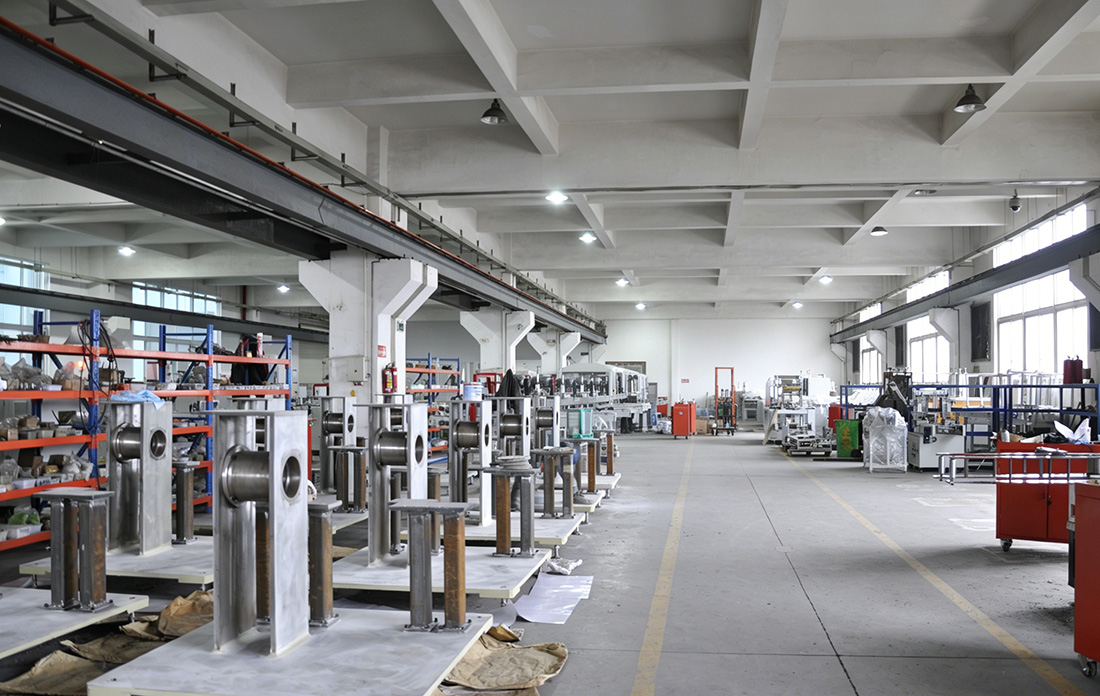
Assembly and test stage: running tests, dimensional checks and interlock verification happen before crating, not after arrival. Image: WIMACH workshop.
3. Design Documentation: Patents as a Secondary Signal
Design documentation does not replace a safety test, but it does show whether a supplier owns engineering rather than assembling from open drawings. WIMACH holds Chinese patent certificates issued by the National Intellectual Property Administration, PRC, under the Patent Law of the People’s Republic of China:
- Utility Model Patent Certificate ZL 2022 2 1202677.7, granted 25 April 2023 and valid to 11 September 2033, covering an Automatic Feeding Mechanism for Carton Packaging Machine and a Box Forming Mechanism for Carton Packaging Machine.
- Invention Patent Certificate ZL 2022 1 1099886.8, issued 6 September 2022 and valid to 17 September 2042, covering a Carton Packing Machine and Carton Packaging Process.
Two limits should be stated. First, both certificates apply to the China market; they are not a market-access document for other regions. Second, a patent is intellectual-property evidence, not safety-conformity evidence. Treat it as a signal of design ownership and ask separately for the test record.
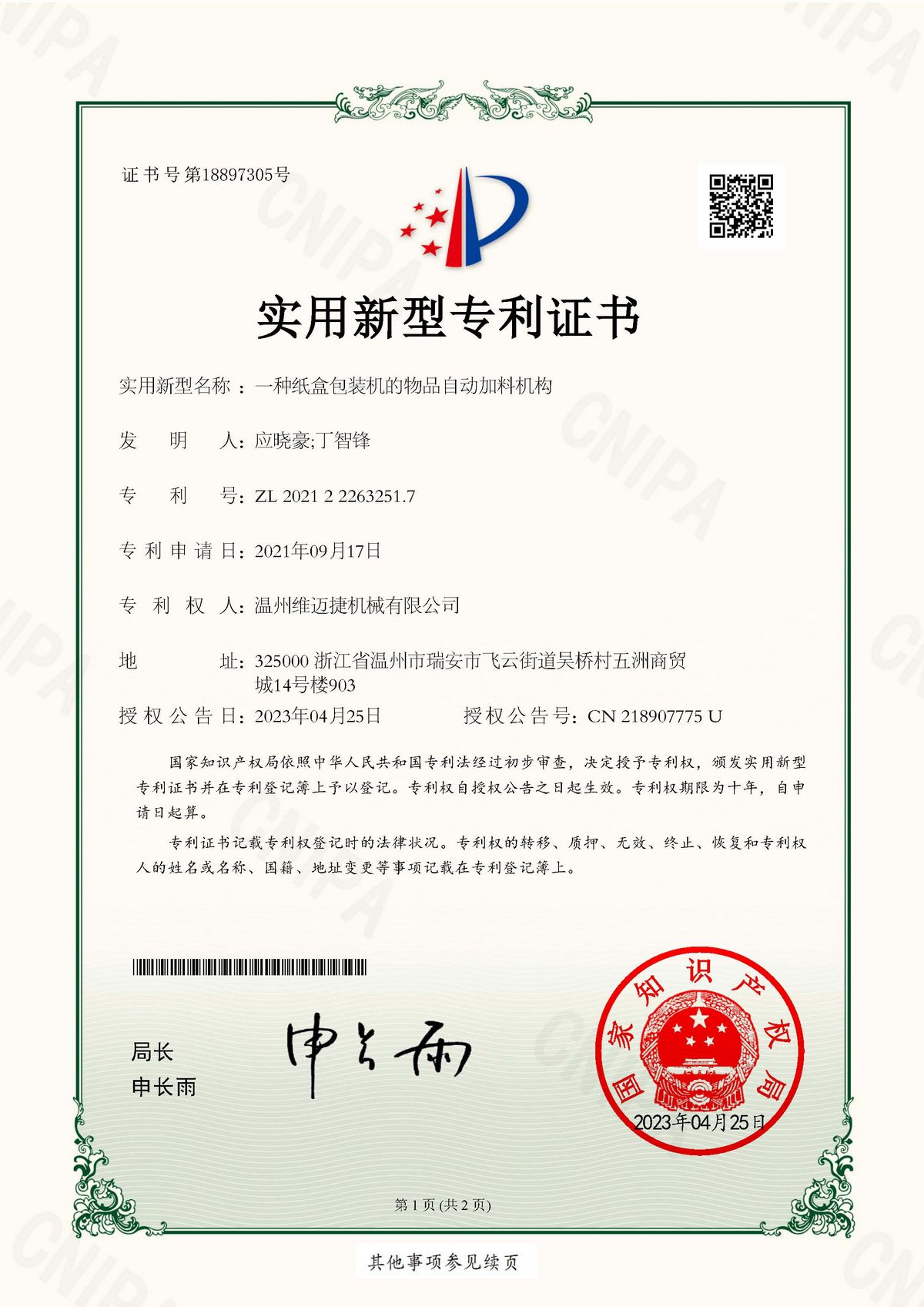
Design ownership evidence: Utility Model Patent Certificate ZL 2022 2 1202677.7, National Intellectual Property Administration, PRC. This documents mechanism design, not machine safety conformity.
4. Delivery Assurance: What “Ready to Ship” Should Mean
Delivery assurance is often reduced to a number of days. It is better understood as a release condition plus a support capability.
The release condition is that the safety function tests are completed before shipment, with the record travelling with the machine. The support capability is what exists after arrival. WIMACH’s stated after-sales scope covers installation and commissioning, training service, warranty service, remote technical support, lifetime after-warranty support, and upgrade and retrofit service.
The commercial frame around that capability is also documentable. WIMACH quotes a lead time of 30–45 days for customized machinery and 15–45 days for OEM/ODM builds, against a monthly capacity of 13 sets and a minimum order quantity of one set. Customization covers packaging dimensions, machine configuration, voltage and logo. Those four numbers — capacity, lead time, MOQ and customization scope — are the ones that let a buyer check whether a promised date is achievable rather than merely stated.
Step-by-Step: Auditing a Case Packer Supplier Before You Order
The following sequence converts the evidence set into a working evaluation. It is ordered so that each step produces the input the next step needs.
- Fix the carton and product envelope first. Until carton length, width and height are fixed, no test result is meaningful. The CP-S50 covers 240–500 mm (L) × 200–400 mm (W) × 180–400 mm (H); the CP-T60 covers 300–600 mm (L) × 200–400 mm (W) × 150–400 mm (H). Compare your carton against the envelope before discussing speed.
- Request the QC protocol as a document. Ask for the ordered list of checks and the pass criteria for each. A protocol that names nine distinct steps, including pneumatic leakage, PLC logic and interlock testing, can be audited; a single line reading “full inspection” cannot.
- Ask for a record from your machine, not a sample record. The completed test sheet should carry the model, the serial number and the date. A record from a different build proves the supplier has a process, not that your machine passed it.
- Verify the safety chain item by item. Confirm in writing that the interlock test, E-stop test, PLC control logic test and electrical safety test were each performed, and ask who signed off.
- Check dimensional and pneumatic evidence against the specification. Air circuits should be tested at the stated working pressure of 0.5–0.8 MPa; dimensional inspection should reference the same carton envelope quoted in the offer.
- Confirm what happens after the functional tests. Aging and appearance inspection sit between “tests passed” and “ready to crate”. Ask whether the machine is aged after the safety test and whether the machine is re-verified if anything is adjusted afterwards.
- Lock delivery assurance into the order. Specify the release condition (safety function tests completed before shipment, records supplied), the lead time (30–45 days customized), the capacity context (13 sets per month) and the after-sales scope, including who provides remote technical support in your time zone.
Use Cases: How Verification Maps to Real Installations
Verification requirements become concrete when they are matched to installations where the machine already runs. WIMACH documents case packer deployments across three regions, and each one illustrates which checks carried the most weight.
Facial tissue box line, Poland — CP-S50 in a 12-set project
A complete facial tissue packaging line integrating conveying, cartoning, case packing, robotic palletizing, strapping and stretch wrapping. In this configuration the case packer receives sealed tissue boxes from the cartoner at a line speed the case packer must absorb without buffering. For a side load machine, the decisive verification items are the load running test with the actual box format and the dimensional tolerance inspection, because a side push cycle depends on carton squareness and stacking accuracy.
Toilet paper roll line, United States — CP-T60 in a 6-set project
A customized line wrapping, case packing, palletizing and stretch wrapping toilet paper rolls, with a stated maximum case packing speed of 10 cases per minute at line level. Here the relevant verification is the interaction between the wrapping machine output and the top load cycle, which is exactly what a load running test with real wrapped rolls exposes.
Canister wet wipe line, Mexico — CP-T60 in a 9-set turnkey project
A turnkey line for canister disinfecting wipes covering canister feeding, wipe loading, liquid filling, sealing, capping, labelling, case packing, palletizing, strapping and film wrapping, with a maximum line speed of 60 canisters per minute. With liquid-filled containers, the interlock and E-stop test and the pneumatic leakage test carry additional weight, because guarding integrity and consistent clamping directly affect container handling.
Tissue canister packing, United States — single CP-T60
A one-set project replacing manual box filling, where the documented result is improved production efficiency, reduced labour cost and standardised packing, with lower collision and deformation risk in transit. For single-machine orders, the verification question changes: with a minimum order quantity of one set, the buyer can require the load test to be run on their own cartons and can treat that test as acceptance evidence.
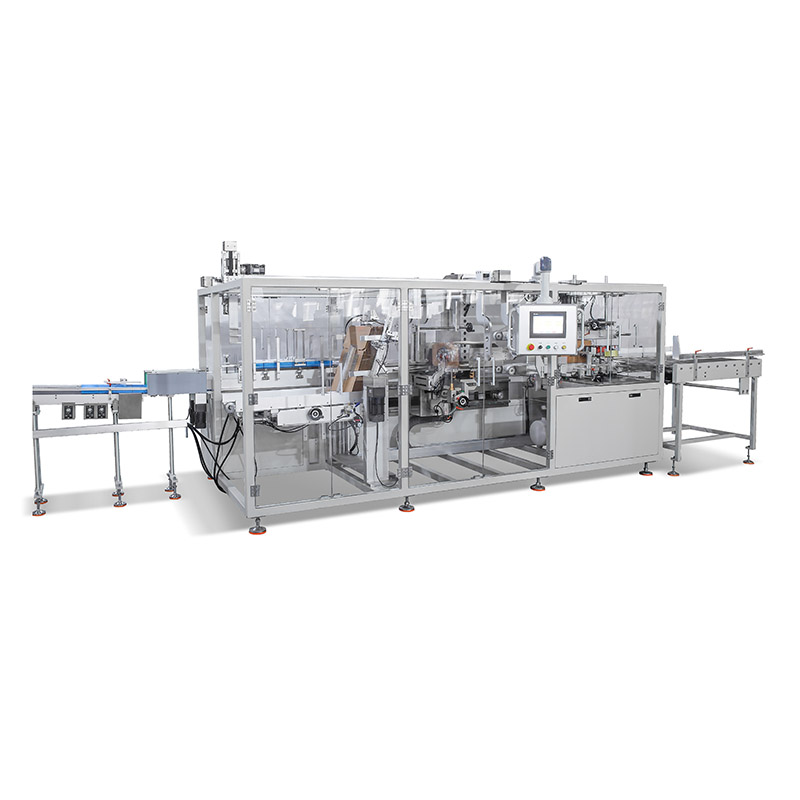
CP-S50 Automatic Side Load Case Packer (side push configuration): 1–16 cartons/min across a 240–500 × 200–400 × 180–400 mm carton envelope.
Comparison Table: CP-S50 and CP-T60 as a Test-Planning Reference
Two machines from the same supplier make the verification logic easier to see, because the test protocol stays constant while the parameters change. The table below uses only the published specification for each model.
| Parameter | CP-S50 Automatic Side Load Case Packer | CP-T60 Automatic Top Load Case Packer |
|---|---|---|
| Machine type | Side load / side push case packer | Pick-and-place / top load case packer |
| Packing capacity | 1–16 cartons/min | 1–8 cartons/min |
| Carton dimensions | 240–500 (L) × 200–400 (W) × 180–400 (H) mm | 300–600 (L) × 200–400 (W) × 150–400 (H) mm |
| Power voltage | 380V 50/60Hz 3 phase | 380V 50/60Hz 3 phase |
| Power consumption | 4.5 kW | 7.5 kW |
| Air pressure | 0.5–0.8 MPa | 0.5–0.8 MPa |
| Air consumption | 350 L/min | 450 L/min |
| Overall dimensions | 4200 (L) × 2300 (W) × 1900 (H) mm | 4200 (L) × 2600 (W) × 2200 (H) mm |
| Overall weight | 1500 kg | 1600 kg |
| Material | Stainless steel / carbon steel | Stainless steel / carbon steel |
| Verification focus | Load test with box formats, dimensional tolerance for side push accuracy | Load test with actual product, interlock and pneumatic checks for pick-and-place handling |
Both models are specified for the tissue, food and beverage, pharmaceutical, daily chemical and cosmetic, and hardware / auto parts / machinery industries. Both are also covered by the same test sequence — which is the point: a consistent protocol applied to different parameters is what makes a supplier auditable.
| Evidence item | What to request | Why it matters |
|---|---|---|
| Safety function tests | Interlock, E-stop, PLC logic and electrical safety records with serial number and date | Confirms the safety chain works on your unit before crating |
| QC sequence | The ordered nine-step protocol with pass criteria | Distinguishes an auditable process from a generic claim |
| Dimensional evidence | Tolerance inspection referencing the quoted carton envelope | Tests whether the capacity figure is achievable on your carton |
| Pneumatic evidence | Leak test at 0.5–0.8 MPa | Prevents intermittent faults weeks after installation |
| Design documentation | Patent certificates and mechanism scope | Indicates engineering ownership, subject to stated market limits |
| Delivery assurance | Release condition, lead time, monthly capacity, after-sales scope | Converts a promised date into a checkable commitment |
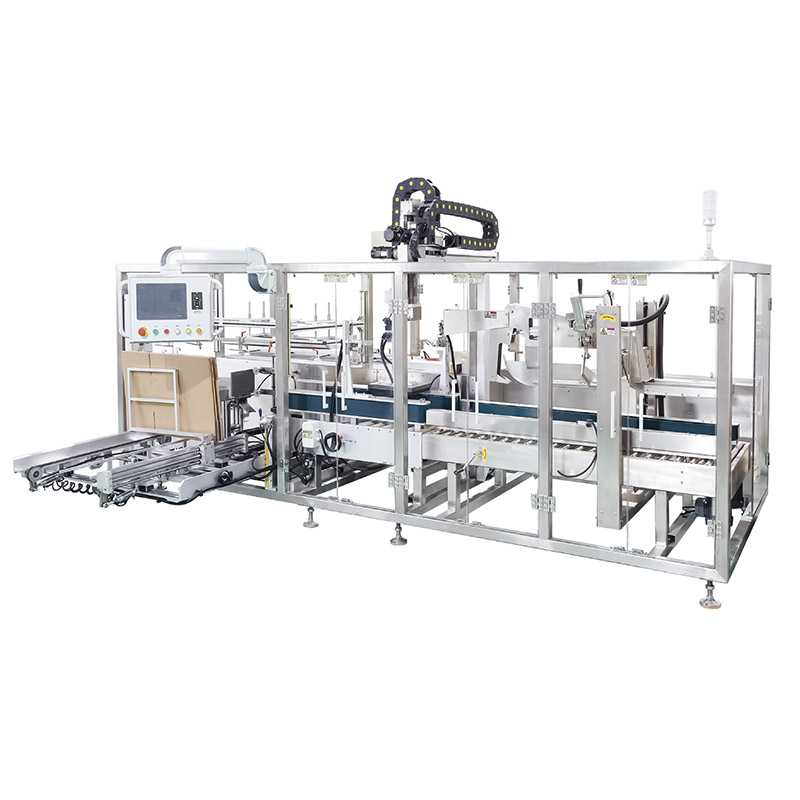
CP-T60 Automatic Top Load Case Packer (pick-and-place configuration): 1–8 cartons/min, 7.5 kW, 450 L/min air consumption at 0.5–0.8 MPa.
FAQ: Case Packer Supplier Verification Questions
Which safety tests should a case packer supplier complete before shipment?
At minimum, the pre-shipment record should show an electrical safety test, a PLC control logic test, and a safety interlock and E-stop test, each tied to the serial number of your machine. WIMACH’s documented quality-control sequence includes these three items alongside a no-load and load running test, dimensional tolerance inspection, mechanical assembly check, pneumatic leakage test, long-time aging test and surface appearance inspection, and the safety function tests are completed before shipment.
How do I verify quality control beyond the certificate?
Ask for the sequence, not a summary: which checks are performed, in what order, and what the pass criteria are. A usable QC list is specific enough to be audited — for example, a nine-step sequence covering running tests, dimensional tolerance, assembly, pneumatics, electrical safety, PLC logic, interlocks, aging and appearance. Then request one completed record from a machine comparable to the one you are ordering.
What changes the price of an automatic case packer?
Quotations for automatic case packers differ mainly because of the carton envelope and product handling, the machine configuration and control scope, and destination-market requirements such as voltage and documentation. WIMACH customizes packaging dimensions, machine configuration, voltage and logo, with a minimum order quantity of one set, and quotes each configuration per project rather than from a fixed list price.
Can I validate a single machine before ordering a full line?
Yes. The minimum order quantity for WIMACH case packers is one set, so a single CP-S50 or CP-T60 can be ordered and validated on your own cartons before a line is expanded. Ask for the load running test to be performed with your carton and product samples rather than the supplier’s standard test carton, and keep the resulting record as acceptance evidence.
How long is delivery, and what does delivery assurance cover?
Customized machines are quoted at a 30–45 day lead time, OEM/ODM builds at 15–45 days, against a monthly capacity of 13 sets. Delivery assurance means the safety function tests are completed before the machine ships, the test records travel with the machine, and post-shipment support covers installation and commissioning, training, warranty, remote technical support, lifetime after-warranty support, and upgrade or retrofit. Buyers can download the WIMACH catalog or request a project-specific quotation with confirmed dates for their configuration.
Conclusion: Verification Is a Document Request, Not a Relationship Decision
Evaluating a case packer supplier comes down to asking for four things in writing and checking each against the specification you were quoted. First, the safety function test record — interlock, E-stop, PLC logic and electrical safety — completed before shipment and identified by serial number. Second, the ordered quality-control sequence, specific enough that a third party could audit it. Third, the design documentation, read with its market and scope limits in mind. Fourth, a delivery assurance statement that names the release condition, the lead time and the after-sales scope.
A supplier that answers all four with documents has given you something a certificate cannot: evidence about the machine you are actually buying. WIMACH publishes a 3000 m² production facility with 37 employees, 5 R&D engineers and an annual output of 160 sets, exports about 60% of output to the EU, North America and South America, and states that all its machines are CE certified — all of which are useful context, and all of which still need to be read alongside the test record for your specific unit.
If your shortlist still mixes side load and top load options, settle the machine type against your carton and product first, then apply the verification checklist to whichever supplier remains.
Next Step: Request the Test Protocol and a Project Quotation
WIMACH (Wenzhou Wimach Machinery Co., Ltd.) supplies the CP-S50 side load case packer and CP-T60 top load case packer, plus integrated tissue packaging lines, with documented pre-shipment safety function tests and after-sales technical support.
Download the full machine catalog: WIMACH Catalog (PDF)
Contact for specifications, test records or a quotation: Rex Din · Email rex@wimach.cn · Tel / WhatsApp +86 177 5771 8080 · Website www.wimach.cn · Address: Bldg 14 Qiaomao Rd, Ruian, Wenzhou, Zhejiang, China.
Have Questions or Need More Details?
Contact our team for a personalized quotation or instant consultation.
Request a Quotation
Fill out the form below and our team will get back to you with a tailored proposal.
WhatsApp Direct Chat
Prefer to chat in real-time? Message us on WhatsApp for instant assistance & quick answers.
- Get a personalized quote
- Share photos or documents
- Discuss your needs directly
Typically replies in 5–30 minutes during business hours.