
TW-160 vs. TB-R30: Wrap It or Bag It? Optimizing Toilet Roll End-of-Line Packaging
Two WIMACH machines sit at the end of a toilet roll line, and they answer two different packaging questions. The Automatic Toilet Paper Roll Wrapping Machine (TW-160) wraps individual rolls in paper at a packing capacity of 60–120 rolls/min inside a 4,350 × 2,550 × 1,940 mm frame. The Automatic Tissue Roll Bundle Bagging Machine (TB-R30) loads multi-roll bundles into pre-made bags at up to 25 packs/min and occupies 8,000 × 2,000 × 2,000 mm. If the saleable unit is a single paper-wrapped roll, the decision moves toward the TW-160. If the saleable unit is a bundle ordered by pack, the decision moves toward the TB-R30.
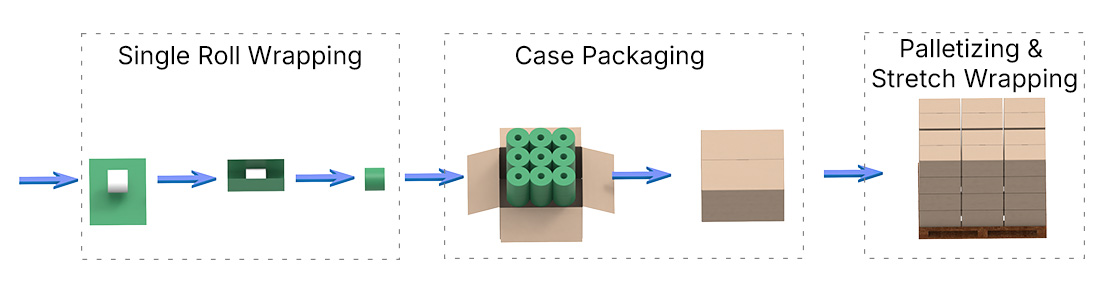
A toilet roll end-of-line sequence: roll wrapping, case packing, palletizing and stretch film wrapping.
The Format Decision Behind the Machine Choice
End-of-line problems on a toilet roll line usually appear as a speed complaint, but the underlying cause is often a format decision taken months earlier. A line built to wrap single rolls does not become a bundle line by running faster, and a bundle bagging line cannot deliver a paper-wrapped single roll to a shelf.
The first trap is comparing the two capacities directly. TW-160 output is counted in rolls per minute; TB-R30 output is counted in packs per minute. A pack contains several rolls, so 25 packs/min and 60–120 rolls/min are not the same measurement. Any serious comparison converts both figures into rolls per minute at the pack configuration you actually intend to sell.
The second trap is floor space. The TW-160 measures 4,350 × 2,550 mm, roughly 11 m² of footprint, while the TB-R30 measures 8,000 × 2,000 mm, exactly 16 m². Despite the longer frame, the TB-R30 weighs 2,200 kg against 3,500 kg for the TW-160, so floor loading and layout are separate questions from footprint length.
The third trap is the consumable supply chain. The TW-160 runs on wrapping paper of 17–37 gsm supplied on a 480 × 500 mm roll. The TB-R30 runs on pre-made bags held in two bag magazines. Each format commits the plant to a different purchasing stream, a different storage footprint and a different set of print and artwork approvals.
Decision in one line: the TW-160 protects individual rolls with paper at high roll throughput; the TB-R30 groups rolls into bagged bundles at a lower pack count but a larger saleable unit.
Industry Background: Why Toilet Roll End-of-Line Is Being Re-Specified
The equipment decision sits inside a market that Precedence Research and Business Research Insights valued at approximately USD 3.9 billion in 2025 for tissue paper packaging machines, with facial tissue packaging applications accounting for 42.1% of that market share in 2025. Asia Pacific held a 39.8% share of the same market in 2025, which is consistent with the concentration of tissue converting capacity in that region.
Two forces push toilet roll packaging decisions today. The first is channel mix: retail and distributor buyers specify either a single wrapped roll or a bagged multi-roll bundle, and that specification, not the machine catalogue, decides which end-of-line machine is correct. The second is material policy. In a United States toilet roll project, WIMACH supplied equipment that replaces plastic packaging with lightweight all-paper packaging, and the recorded project outcome notes compliance with plastic restriction and environmental regulations alongside lower packaging material cost.
Practically, the packaging format also determines everything downstream. A toilet paper packaging line built around roll wrapping reaches up to 120 rolls/min of wrapping, 10 cases/min of case packing and 10 palletizing cycles/min, and every one of those downstream ratings has to be re-checked when the primary pack changes from a single roll to a bundle.
Machine-by-Machine: What Each System Actually Does
TW-160 — paper wrapping for individual rolls
The TW-160 is a toilet roll wrapping machine that wraps and seals individual rolls in paper, including pre-printed patterned wrapping paper. It integrates wrapping and sealing in one continuous automated process and is compatible with rolls of 90–130 mm length and 90–130 mm diameter.
- Packing capacity: 60–120 rolls/min
- Roll dimension window: 90–130 mm (L) × 90–130 mm (D)
- Wrapping paper: 17–37 gsm, supplied on a 480 mm (L) × 500 mm (D) roll
- Power: 380V 50/60Hz three-phase, 12 kW consumption
- Air: 0.5–0.8 MPa at 120–160 L/min
- Overall dimensions: 4,350 (L) × 2,550 (W) × 1,940 (H) mm; 3,500 kg
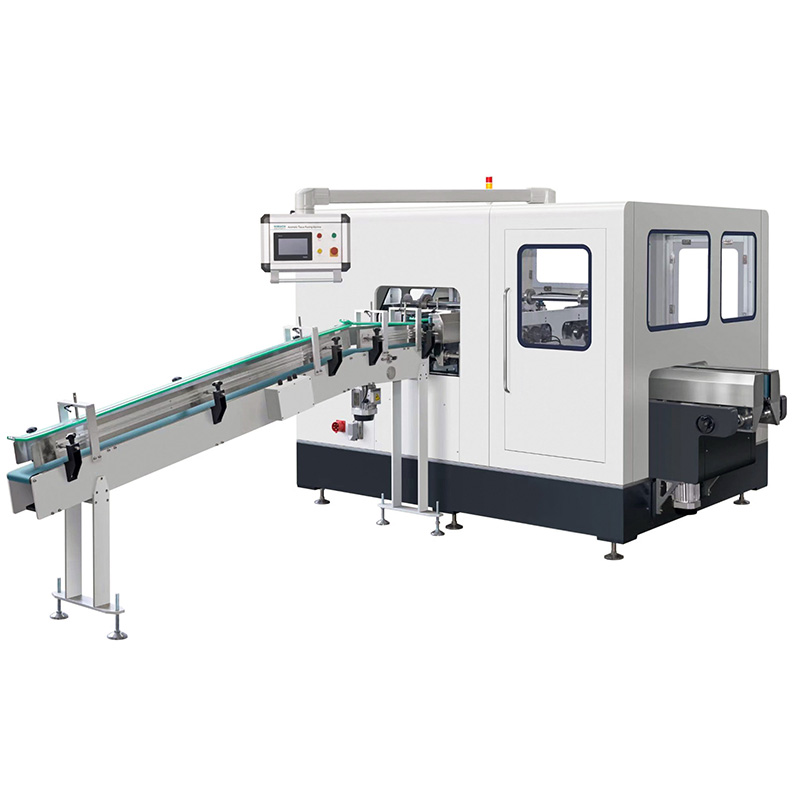
TW-160: individual roll wrapping in paper at 60–120 rolls/min, 4,350 × 2,550 × 1,940 mm.
The 17–37 gsm window is the first item to verify, because a printed wrap outside that grammage range changes the machine configuration discussion before speed ever becomes relevant. The 90–130 mm roll window is the second, since bath tissue and kitchen roll formats that fall outside it require a different configuration rather than an adjustment on the day of installation.
TB-R30 — bagging for multi-roll bundles
The TB-R30 is a tissue roll bundle bagging machine that loads pre-made bags from two bag magazines and seals bundles in an automated cycle. It is specified by pack size rather than by roll size, which is the structural difference between the two machines.
- Maximum packing capacity: 25 packs/min
- Package dimension window: 180–600 mm (L) × 150–400 mm (W) × 100–250 mm (H)
- Bag supply: 2 pre-made bag magazines
- Power: 380V 50/60Hz three-phase, 13 kW consumption
- Air: 0.5–0.8 MPa at 450 L/min
- Overall dimensions: 8,000 (L) × 2,000 (W) × 2,000 (H) mm; 2,200 kg
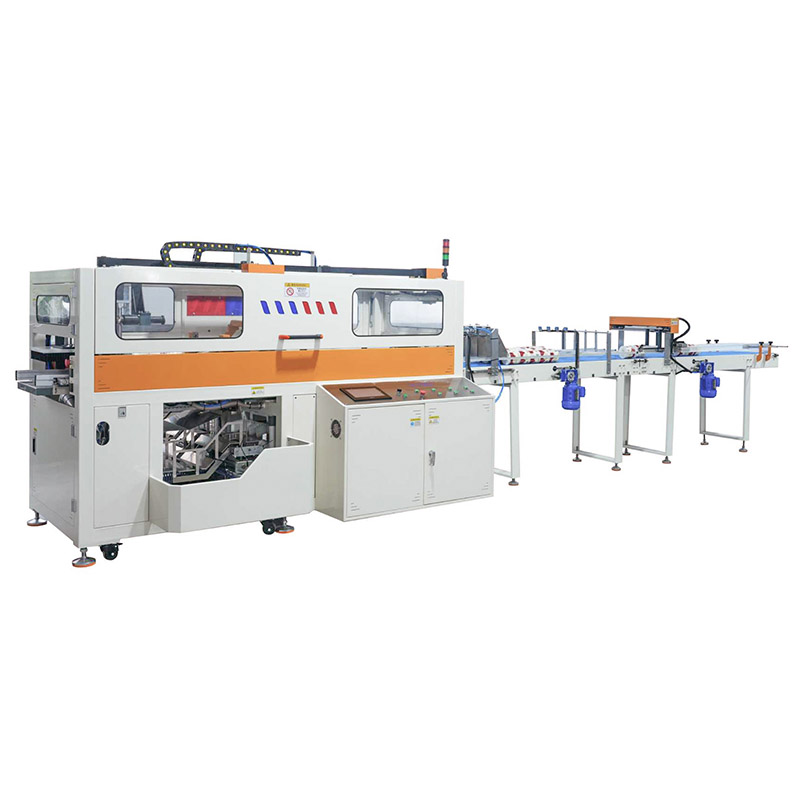
TB-R30: bundle bagging at up to 25 packs/min, with a 180–600 mm pack length window.
Two numbers in that list should drive the specification conversation. First, air consumption of 450 L/min is a compressor-sizing input, not a detail, and it sits well above the 120–160 L/min of the TW-160. Second, the 8,000 mm frame length has to be planned into the line layout at the quotation stage, because moving a bagging machine later is a layout project rather than a repositioning task.
TW-160 vs. TB-R30: Specification Comparison
| Parameter | TW-160 (roll wrapping) | TB-R30 (bundle bagging) |
|---|---|---|
| Primary output unit | Individual wrapped roll | Bagged multi-roll bundle |
| Capacity | 60–120 rolls/min | Up to 25 packs/min |
| Format window | Roll 90–130 mm (L) × 90–130 mm (D) | Pack 180–600 mm (L) × 150–400 mm (W) × 100–250 mm (H) |
| Consumable | Wrapping paper 17–37 gsm, 480 × 500 mm roll | Pre-made bags, 2 bag magazines |
| Overall dimensions | 4,350 × 2,550 × 1,940 mm | 8,000 × 2,000 × 2,000 mm |
| Overall weight | 3,500 kg | 2,200 kg |
| Power | 380V 50/60Hz 3-phase, 12 kW | 380V 50/60Hz 3-phase, 13 kW |
| Air | 0.5–0.8 MPa, 120–160 L/min | 0.5–0.8 MPa, 450 L/min |
Power demand is almost identical between the two machines, so energy does not separate them. Compressed air, floor space and the consumable stream do.
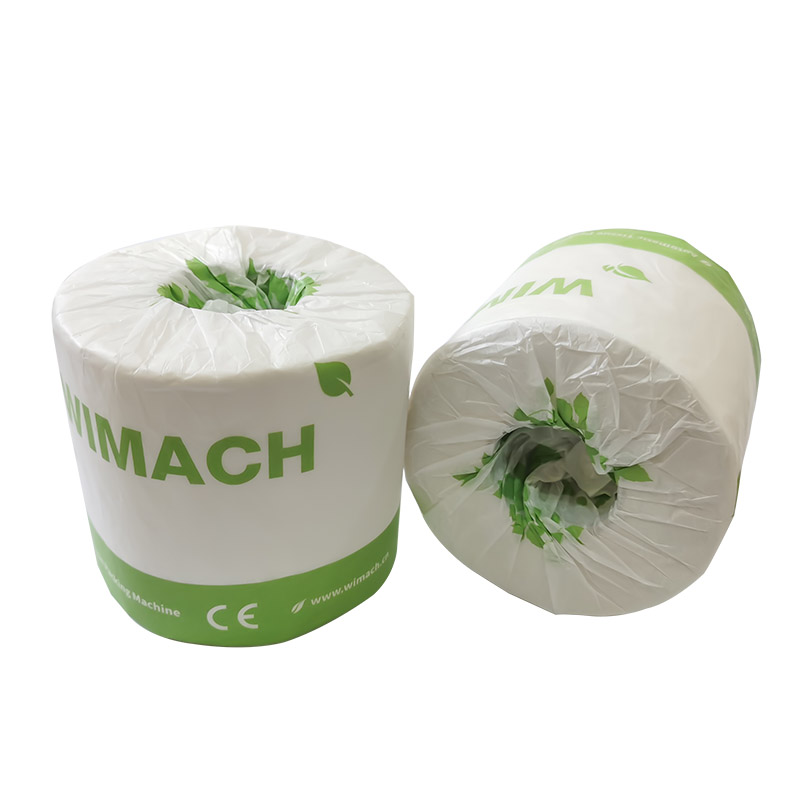
Roll geometry is the TW-160 input; pack geometry is the TB-R30 input. Both windows must be checked against the actual SKU list.
A Six-Step Selection Sequence for Toilet Roll End-of-Line Packaging
Step 1 — Define the saleable unit first
Write down what leaves the factory: a single wrapped roll, or a bagged bundle containing multiple rolls. This single answer eliminates one of the two machines before any technical comparison begins.
Step 2 — Convert both speeds into the same unit
Multiply TB-R30 pack rate by rolls per pack to get a roll-equivalent figure, then compare it with the 60–120 rolls/min TW-160 range. The 25 packs/min rating is a pack rating, and it only becomes comparable after that conversion.
Step 3 — Match the upstream rewinder
Check the actual output of the tissue rewinding and cutting equipment feeding the line. A toilet paper packaging line is rated at up to 120 rolls/min for wrapping, so a wrapper below the rewinder's output becomes the constraint, and a wrapper far above it sits idle.
Step 4 — Fit the footprint and the pack flow
Plan approximately 11 m² for the TW-160 frame and 16 m² for the TB-R30 frame, then verify infeed and outfeed clearances, pallet positions and operator access. The bagging machine's 8,000 mm length usually decides the aisle layout.
Step 5 — Size utilities and consumables
Confirm 380V 50/60Hz three-phase supply and 0.5–0.8 MPa air at the machine. For the TB-R30, size the compressor around 450 L/min; for the TW-160, secure a wrap supply inside 17–37 gsm on a 480 × 500 mm roll. Tissue packaging machinery shipped across borders is generally classified under HS code 8422.40, which is worth confirming with a customs broker during cost planning.
Step 6 — Plan the downstream and the acceptance test
Case packing and palletizing ratings change with pack format: the CP-S50 side load case packer runs 1–16 cartons/min and the CP-T60 top load case packer runs 1–8 cartons/min, while a toilet paper packaging line is rated at 10 cases/min for case packing and 10 cycles/min for palletizing. Before shipment, agree the acceptance checklist: no-load and load running test, dimensional tolerance inspection, mechanical assembly check, pneumatic leakage test, electrical safety test, PLC control logic test, safety interlock and E-stop test, long-time aging test and surface appearance inspection.
Decision Matrix: Which Format Fits Which Operation
| Choose TW-160 when… | Choose TB-R30 when… |
|---|---|
| The retail SKU is a single roll and the wrap carries brand print | The retail SKU is a multi-roll bundle ordered by pack |
| Paper wrap of 17–37 gsm is already sourced or required by material policy | Pre-made bags are the established consumable and two bag magazines suit the SKU range |
| Available floor space is around 11 m² with a 4,350 mm machine length | Available floor space is around 16 m² with an 8,000 mm machine length |
| Compressed air capacity is committed elsewhere and 120–160 L/min fits the budget | Compressed air can support 450 L/min at 0.5–0.8 MPa |
| Rolls sit inside 90–130 mm length and 90–130 mm diameter | Packs sit inside 180–600 × 150–400 × 100–250 mm |
Use Cases: How These Configurations Run in Practice
Paper-wrapped rolls in the United States
A United States tissue paper manufacturer operates two TW-160 units that automatically wrap and seal toilet paper rolls with pre-printed patterned wrapping paper. The recorded project, running for five years, reports higher automation efficiency, reduced labor and packaging material cost, and branded degradable lightweight paper packaging that is less prone to damage and moisture during transport. The same project notes compliance with plastic restriction and environmental regulations.
A full toilet roll line, wrapping through palletizing
A separate United States project uses six sets of equipment in a customized packaging line for toilet paper rolls: roll wrapping with the TW-160, case packing, automatic palletizing and stretch film wrapping. Running for four years, the line outputs finished pallet loads that are dustproof, moisture-resistant and ready for transport, with the sequence matched to the CE standard and to a customized design brief.
Where bundle bagging fits
TB-R30 suits plants whose saleable unit is a bagged bundle inside the 180–600 mm length, 150–400 mm width and 100–250 mm height window, and whose compressor can deliver 450 L/min. Because the machine is specified by pack rather than by roll, the upstream roll format matters less than the bundle configuration, which makes it the more flexible option for plants running several bundle sizes across bath tissue and kitchen roll packing lines.
Beyond the Toilet Roll Line: One Supplier for the Wider Tissue Packing Machine Range
Wenzhou Wimach Machinery Co., Ltd., which trades as WIMACH, is a Wenzhou, Zhejiang-based manufacturer of tissue packing machines and integrated packaging lines, with over 12 years of industry experience, a 3,000 m² facility, 37 employees, an annual output of 160 sets and a 5-engineer R&D team. Roughly 60% of output is exported to the EU, North America and South America, and all machines are CE certified and assembled with components from well-known brands.
The same portfolio covers facial tissue and napkin formats: the TC-100 tissue cartoning machine at 30–100 boxes/min, the TC-300 automatic high-speed tissue box packing machine at up to 180 boxes/min, the TP-180 soft tissue wrapping machine at up to 180 packs/min and the TP-280 at up to 260 packs/min, alongside the Facial Tissue Box Packaging Line that combines box packing at up to 100 boxes/min, case packing at 10 cases/min and palletizing at 10 cycles/min.
Frequently Asked Questions
Are the TW-160 and TB-R30 CE certified, and what should buyers verify before shipping to the EU?
All WIMACH machines are CE certified and assembled with components from well-known brands. Both models are built for 380V 50/60Hz three-phase power and 0.5–0.8 MPa air pressure, so the configuration has to match the destination grid and the site compressor. Before shipment, request the declaration of conformity, the guarding documentation and the emergency-stop test record: placing machinery on the European market is built on a documented risk assessment, and the conformity file is what a buyer's technical team reviews first.
Can one tissue packing machine manufacturer supply facial tissue lines as well as toilet roll end-of-line equipment?
Yes, at WIMACH both sit in one portfolio. Facial tissue lines draw on the TC-100 at 30–100 boxes/min, the TC-300 at up to 180 boxes/min, the TP-180 at up to 180 packs/min and the TP-280 at up to 260 packs/min, plus the Facial Tissue Box Packaging Line with 100 boxes/min cartoning, 10 cases/min case packing and 10 cycles/min palletizing. Toilet roll work is covered by the TW-160, the TB-R30 and a Toilet Paper Packaging Line rated at 120 rolls/min wrapping, 10 cases/min case packing and 10 palletizing cycles/min.
What drives the cost difference between a wrap line and a bag line?
Consumables, floor space, compressed air and downstream equipment drive the difference more than the two base machines do. The TW-160 consumes 17–37 gsm wrapping paper from a 480 × 500 mm roll; the TB-R30 consumes pre-made bags from two bag magazines, and bag cost and availability sit outside the machine itself. The TB-R30 also needs 450 L/min of air against 120–160 L/min for the TW-160, which changes compressor sizing, and its 8,000 mm frame consumes more floor space. WIMACH quotes per configuration — packaging dimensions, machine configuration, voltage and logo are all customizable — with a minimum order of one set, so the practical starting point is a specification-based quotation.
Can we validate the machine against our own rolls or bags before ordering?
Validation starts with product data. The TW-160 accepts rolls of 90–130 mm length and 90–130 mm diameter; the TB-R30 accepts packages of 180–600 mm length, 150–400 mm width and 100–250 mm height. Send the roll or pack dimensions together with the wrap grammage inside 17–37 gsm or the bag specification, and the machine is configured to that window. Every unit then passes a no-load and load running test, dimensional tolerance inspection, mechanical assembly check, pneumatic leakage test, electrical safety test, PLC control logic test, safety interlock and E-stop test, long-time aging test and surface appearance inspection.
What lead time and order size should a toilet roll project plan for?
The minimum order is one set. Lead time is 30–45 days for customized machinery and 30–60 days for a complete packaging line, while OEM/ODM projects run 15–45 days. Monthly capacity is 13 sets for customized machines, but a complete packaging line is scheduled at one set per month, so line projects should be booked earlier than single-machine orders. Installation and commissioning, training, warranty service, remote technical support, lifetime after-warranty support and upgrade/retrofit service are included in the service scope.
Conclusion: Wrap If the Roll Is the SKU, Bag If the Bundle Is the SKU
The TW-160 and TB-R30 are not competing versions of one machine. The TW-160 converts 60–120 rolls/min into individually wrapped, paper-packaged rolls inside a 4,350 × 2,550 × 1,940 mm frame, and it fits plants whose retail unit is a single roll and whose material policy favours paper. The TB-R30 converts up to 25 packs/min into bagged bundles inside a 180–600 × 150–400 × 100–250 mm pack window, on an 8,000 × 2,000 × 2,000 mm frame that needs 450 L/min of air.
Decide the saleable unit, convert the speeds into one unit, check the footprint and utilities, then confirm the downstream case packing and palletizing ratings. Any sequence that starts with the machine instead of the pack will need correcting later, usually at the layout stage where correction is most expensive.
Next Step: Match the Machine to Your Pack
Send your roll dimensions, bundle dimensions, wrap grammage or bag specification, and target output per shift. WIMACH will confirm whether the TW-160, the TB-R30 or a combined line fits, and return a configuration-based quotation.
Contact: Rex Din · rex@wimach.cn · Tel / WhatsApp +86 177 5771 8080
Address: Bldg 14 Qiaomao Rd, Ruian, Wenzhou, Zhejiang, China
Website: www.wimach.cn
Catalog: Download the WIMACH machine catalog (PDF)
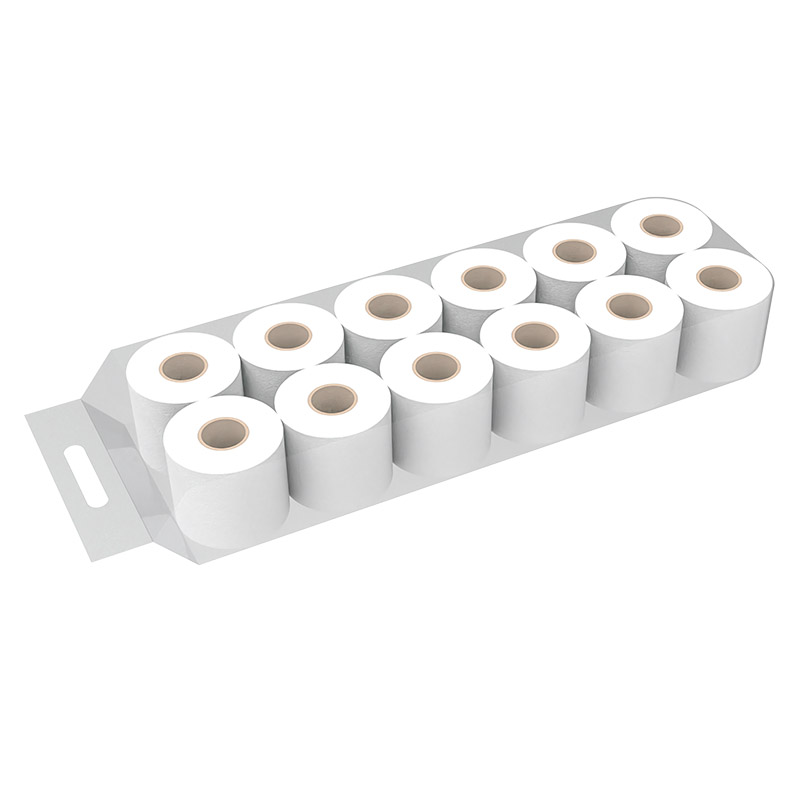
Bundle output sample: confirm pack dimensions inside 180–600 × 150–400 × 100–250 mm before quoting.
Have Questions or Need More Details?
Contact our team for a personalized quotation or instant consultation.
Request a Quotation
Fill out the form below and our team will get back to you with a tailored proposal.
WhatsApp Direct Chat
Prefer to chat in real-time? Message us on WhatsApp for instant assistance & quick answers.
- Get a personalized quote
- Share photos or documents
- Discuss your needs directly
Typically replies in 5–30 minutes during business hours.