
Tissue Packing Machine Supplier Audit: Verifying Facial Tissue Box Packaging Line Delivery
A turnkey facial tissue box packaging line is only as reliable as the supplier's ability to prove, station by station, that the line will be built, integrated, tested and accepted. This audit guide explains how to verify a tissue packing machine supplier's delivery capability before capital is committed: confirming that the scope genuinely includes the facial tissue box packing machine, box shrink wrapping machine, handle taping machine, case packer and palletizer; confirming that each station's rated envelope covers your actual box; confirming that the CE file names the exact model on your purchase order; and confirming that acceptance criteria are written into the contract rather than promised verbally.
Wenzhou Wimach Machinery Co., Ltd. — trading as WIMACH and based in Ruian, Wenzhou, Zhejiang, China — is used throughout this article as a worked reference case, because its Facial Tissue Box Packaging Line is documented as a named, six-element turnkey configuration with published line speeds. The audit method itself is supplier-agnostic and can be applied to any bidder.
What a Supplier Audit Must Actually Prove
"Turnkey" is a scope claim, not a specification. In procurement terms it means the supplier takes responsibility for the whole packaging process after the tissue is folded and cut — but the claim tells a buyer nothing about which machines are inside the scope, what they are rated to do, or what happens at the interfaces between them.
A facial tissue box packaging line audit therefore has to answer five separate questions, and a supplier that answers four of them well should still not be approved:
- Scope risk — is every station you assumed present in the bill of materials, including the ones that are easy to leave out (box shrink wrapping, handle taping, pallet conveying)?
- Balance risk — do the rated speeds of the five stations form a workable line, or is one station set to become the permanent bottleneck?
- Envelope risk — does the cartoning envelope cover your real box dimensions and board grammage, and does the case-packing envelope cover your real shipping case?
- Compliance risk — is there a CE certificate whose declared scope names the exact model you are buying, and is it still valid on the delivery date?
- Delivery risk — is the production slot real, is the acceptance test defined, and is post-delivery support contracted rather than implied?
Industry Background: Why Boxed Facial Tissue Is the Most Audited Format
Facial tissue packaging is the largest single application block in this equipment category, which raises both the number of suppliers claiming capability and the cost of a mis-specified line. Published market research places the global tissue paper packaging machine market at approximately USD 3.9 billion in 2025, projected to reach USD 4.2 billion in 2026 (Precedence Research / Business Research Insights, 2026). The same source reports that Asia Pacific held a 39.8% share of that market in 2025, and that facial tissue packaging applications accounted for 42.1% of market share in 2025.
Two practical consequences follow for a buyer auditing a facial tissue box line. First, because boxed facial tissue is the highest-volume application, most suppliers can show a reference line — but a reference line proves a machine was built, not that the delivered configuration matches yours. Second, the concentration of manufacturing in Asia Pacific means the audit usually has to be done remotely, from documents and video, before a factory visit; that makes documentary verification of scope, speeds and certificates the primary control.
On the trade and regulatory side, packing and wrapping machinery of this type falls under HS Code 8422.40, which is the classification to use when checking customs entries and duty treatment. For EU destinations, the compliance baseline is not the certificate alone: EU market placement of machinery requires a risk assessment under the European machinery directive framework, and the harmonised standards referenced on the certificate of conformity define which safety requirements were assessed.
The Verifiable Anatomy of a Turnkey Facial Tissue Box Packaging Line
The reference configuration to audit against is the WIMACH Facial Tissue Box Packaging Line: a fully automatic solution for boxed facial tissues that connects facial tissue box packing through to finished-product palletizing with minimal manual intervention. It is documented as comprising a facial tissue box packing machine, a box shrink wrapping machine, a handle taping machine, a case packer, a palletizer and conveyors, all operating in coordination, and it can be customized to specific packaging scenarios.

The cartoning station sets the line ceiling. The WIMACH Facial Tissue Box Packaging Line is rated to a maximum cartoning speed of 100 boxes/min, which corresponds to the TC-100 platform.
1. Confirm the bill of materials station by station
Ask for the line drawing and equipment list as a numbered schedule, then check each item against the process you actually run. The six elements above are the complete documented scope; a quotation that omits the handle taping machine or the conveyors is not the same line, even if the headline equipment matches. Each item should carry a model number, footprint, utility requirement and rated capacity — for example the cartoning station, the case packer and the palletizer, plus the connecting conveyors.
2. Check that the stations are balanced, not just rated
A line is limited by its slowest station, and the numbers must be read together. In the reference line, cartoning reaches a maximum of 100 boxes/min, case packing a maximum of 10 cases/min, and palletizing a maximum of 10 cycles/min. The audit question is arithmetic: how many boxes make one shipping case, and does 10 cases/min absorb the output of the cartoner at your target speed? A buyer who signs on the cartoning figure alone may find the case packer sized for a different case count.
The same discipline applies above the line ceiling. If planned volume exceeds 100 boxes/min of cartoning, the line balance changes: the TC-300 Automatic High-Speed Tissue Box Packing Machine is rated to a maximum of 180 boxes/min with an 8 kW power draw, whereas the TC-100 is rated 30–100 boxes/min at 6.2 kW. A supplier proposing a 180 boxes/min cartoner alongside 10 cases/min case packing should be asked to show the revised case-packer and palletizer sizing in writing.
3. Verify the format and material envelope against your real box
Cartoning envelope is the most common cause of a line that runs but cannot run your SKU. The TC-100 Tissue Cartoning Machine and the TC-300 both accept carton dimensions of 100–240 mm length, 100–120 mm width and 20–90 mm height, with carton board grammage of 300–400 gsm. For reference, a standard rectangular tissue box in the US is typically 9.25 in × 4.375 in × 2.25 in, and that format has to be checked against the machine envelope rather than assumed to fit.
Different box families need different stations, and the audit should confirm which one is quoted:
- Cube box — the TC-80F Cube Box Tissue Cartoning Machine is rated 30–80 boxes/min for a 115 × 115 × 130 mm carton, on 300–400 gsm board, at 7 kW.
- Canister — the TC-80Y Automatic Tissue Canister Packing Machine is rated 30–80 boxes/min for carton dimensions of 100–220 mm length and 50–80 mm diameter, at 3.5 kW, built in stainless steel.
- Soft pack film wrapping — where the box is replaced by a film pack, the relevant units are the TP-180 (maximum 180 packs/min, 12 kW) and TP-280 (maximum 260 packs/min, 18 kW), both running CPP, PE or composite film of 0.035–0.05 mm thickness.
On the secondary side, case-packer envelope must also be checked. The CP-S50 Automatic Side Load Case Packer handles 1–16 cartons/min for cases of 240–500 × 200–400 × 180–400 mm at 4.5 kW, while the CP-T60 Automatic Top Load Case Packer handles 1–8 cartons/min for cases of 300–600 × 200–400 × 150–400 mm at 7.5 kW. Quoting a side-load packer for a case format it cannot accept is a delivery failure that only appears at commissioning.
4. Audit the compliance file, not the compliance claim
CE status must be verified per model, with the certificate number, the issuing body, the declared scope and the validity dates read off the document. For the cartoning stations in a facial tissue box line, WIMACH holds CE attestation of compliance TRCN-25091WWM01, issued by iNTEGRA96 Belgelendirme, issued 1 April 2025 and valid to 31 March 2030, with scope "Automatic Carton Packing Machine". The certification standards listed are EN ISO 12100:2010, EN 60204-1:2018, EN 415-1:2014, EN 415-10:2014, EN IEC 61000-6-2:2019 and EN IEC 61000-6-4:2019, and the models associated with that scope are the TC-80F, TC-300 and TC-100.
Film-wrapping equipment is covered by a separate document: CE attestation TRCN-25118WWM01, also issued by iNTEGRA96 Belgelendirme, issued 28 April 2025 and valid to 27 April 2030, for scope "Automatic Tissue Wrapping Machine", covering the TP-180 and TP-280 against EN ISO 12100:2010, EN 60204-1:2018+A1:2025, EN 415-1:2014, EN 415-10:2014, EN IEC 61000-6-2:2019 and EN IEC 61000-6-4:2019.
Patent documentation is a secondary but useful signal of design ownership on the cartoning station. The carton packing machine and carton packaging process are protected by invention patent ZL 2022 1 1099886.8, issued by the National Intellectual Property Administration, PRC on 6 September 2022 under the Patent Law of the People's Republic of China, with expiry 17 September 2042. Utility model ZL 2022 2 1202677.7, issued 25 April 2023 and expiring 11 September 2033, covers the box forming mechanism used in the TC-100 and TC-300 and the automatic feeding mechanism used in the TC-80F. These are China-market rights and should not be presented as EU conformity evidence.
5. Fix delivery, acceptance and support terms before signing
Commercial terms are part of the technical audit because they determine whether the line can physically be delivered in your window. WIMACH's stated lead time for a complete packaging line is 30–60 days, with a stated monthly capacity of 1 set for complete packaging lines and a minimum order quantity of 1 set. For customized machinery the stated lead time is 30–45 days at 13 sets per month, and for OEM/ODM work 15–45 days at 13 sets per month. A supplier producing one complete line per month cannot hold several turnkey slots open simultaneously, so slot confirmation belongs in the contract.
Acceptance criteria should reference the supplier's own quality-control regime. The documented regime covers no-load and load running tests, dimensional tolerance inspection, mechanical assembly check, pneumatic leakage test, electrical safety test, PLC control logic test, safety interlock and E-stop test, long-time aging test, and surface appearance inspection.
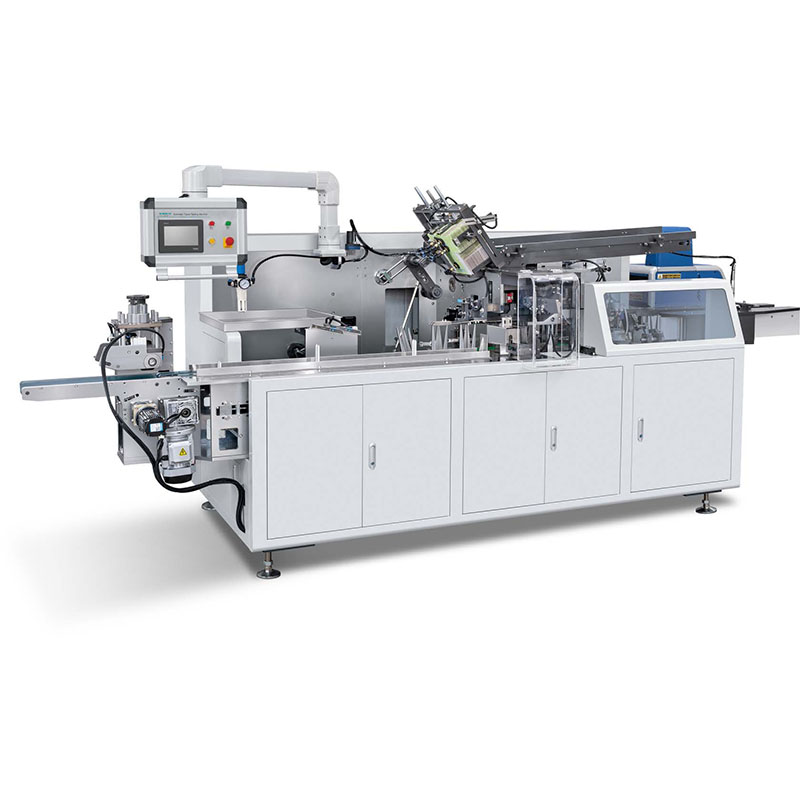
Box format decides the cartoning platform. The TC-80F covers cube boxes at 115 × 115 × 130 mm, while the TC-100 and TC-300 cover the 100–240 mm length range.
Step-by-Step: An Eight-Stage Audit Protocol
- Lock the process flow first. Write down every operation between folded tissue and wrapped pallet. Compare your flow to the supplier's line drawing element by element: box packing, box shrink wrapping, handle taping, case packing, palletizing, conveying. Any missing element is a scope gap to be priced, not a detail to be resolved later.
- Request the equipment schedule with model numbers. Insist on model designations rather than generic descriptions, because compliance documents and spare parts are tied to models. On the reference line that means naming the cartoning machine, the case packer and the palletizer explicitly.
- Test the speed arithmetic at your target output. Model the line at 70–80% of rated capacity and check the case-packing and palletizing steps against your case count. Confirm in writing which station becomes the constraint at your planned volume.
- Submit your own box and case drawings. Provide length, width, height, board grammage and film type. Verify the box against the 100–240 × 100–120 × 20–90 mm cartoning envelope and 300–400 gsm board range, and the case against the case-packer envelope of the quoted model.
- Check utilities and floor space. Confirm voltage, phase, air pressure, air consumption and footprint per station, then confirm they match your building. Representative figures: TC-100 at 380V 50/60Hz 3-phase, 6.2 kW, 0.5–0.8 MPa, 120–160 L/min, 3620 × 3130 × 1800 mm, 2200 kg; TC-300 at 8 kW and 5000 × 1740 × 1800 mm, 3000 kg.
- Verify the compliance file against the purchase order. Match certificate number, issuing body, scope wording, standard list and expiry date to the exact model being bought. Record the expiry date in the contract so a certificate lapsing before shipment is a supplier obligation.
- Define factory acceptance testing. Convert the nine documented quality-control checks into a witnessed test schedule with pass criteria, and specify which of them require your representative present or recorded video evidence.
- Contract the post-delivery support scope. Confirm installation and commissioning, operator training, warranty, remote technical support, lifetime after-warranty support and upgrade/retrofit services are itemized, and assign responsibility for the interfaces between stations.
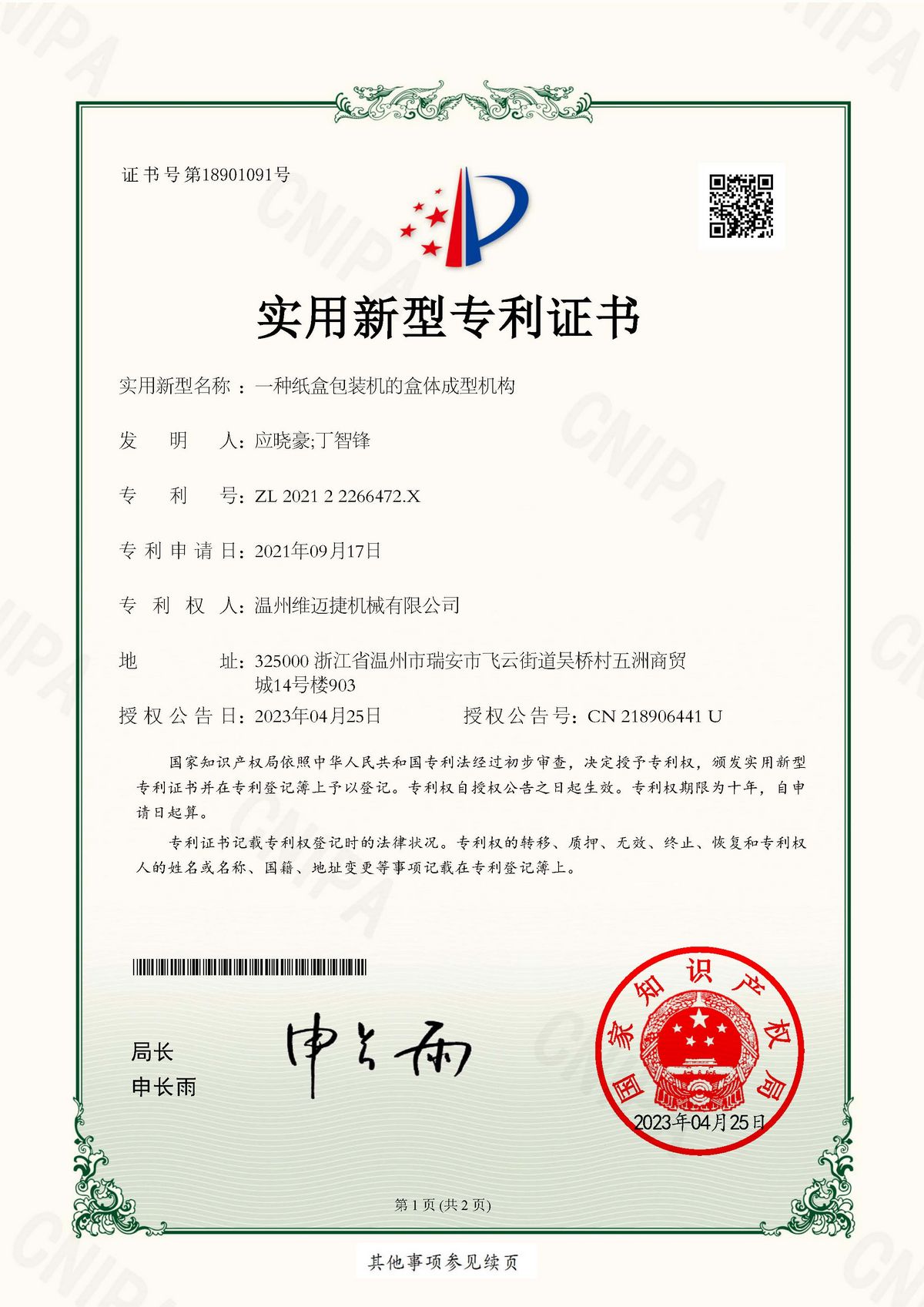
Design documentation to request during an audit: the utility model certificate ZL 2022 2 1202677.7 covers the box forming mechanism used in the TC-100 and TC-300.
Use Cases: What Line-Level Verification Looks Like in Practice
Poland — full facial tissue and cream tissue line, 12 sets, 2 years in service
A Polish tissue paper manufacturer operates a complete packaging line built for fully automatic packaging of facial tissue and cream tissue. The documented scope integrates conveying, automatic cartoning, case packing, pallet feeding, robotic palletizing, strapping and stretch wrapping, so that every procedure from inner packaging to palletized finished goods is covered. The output is whole pallets of shipping cases, each pallet strapped and fully covered with stretch film for dust and moisture protection.
This case is useful in an audit because it shows the interface count a buyer must budget for. A line with cartoning, case packing, pallet feeding, palletizing, strapping and wrapping has more handover points than a quotation headline suggests, and each handover is a place where a missing conveyor or an unmatched pallet size becomes a commissioning delay.
United States — facial tissue cartoning, 2 sets, 4 years in service
A US tissue paper manufacturer runs facial tissue cartoning machines that automatically load facial tissues into paper boxes across different sizes of facial tissue packs. The documented operating result is a unified packing standard with neat tissue arrangement inside the box and reduced product extrusion damage, at higher production efficiency and lower labour cost.
For an audit, the transferable point is the phrase "different sizes of facial tissue packs". If your SKU range spans more than one box format, size changeover capability belongs in the acceptance criteria, not in the brochure. The same applies to the soft-pack alternative: a Spanish manufacturer running two TP-280 units documents tidy, airtight packaging that protects tissue from moisture, dust and extrusion damage.
Where the audit logic changes
Mixed-format plants should audit a different question. If the same building packs cube boxes and canisters, the cartoning station is not one machine but a family: the TC-80F for 115 × 115 × 130 mm cube boxes at 30–80 boxes/min, and the TC-80Y for canisters at 30–80 boxes/min. A supplier quoting one cartoner for both formats has not understood the brief.
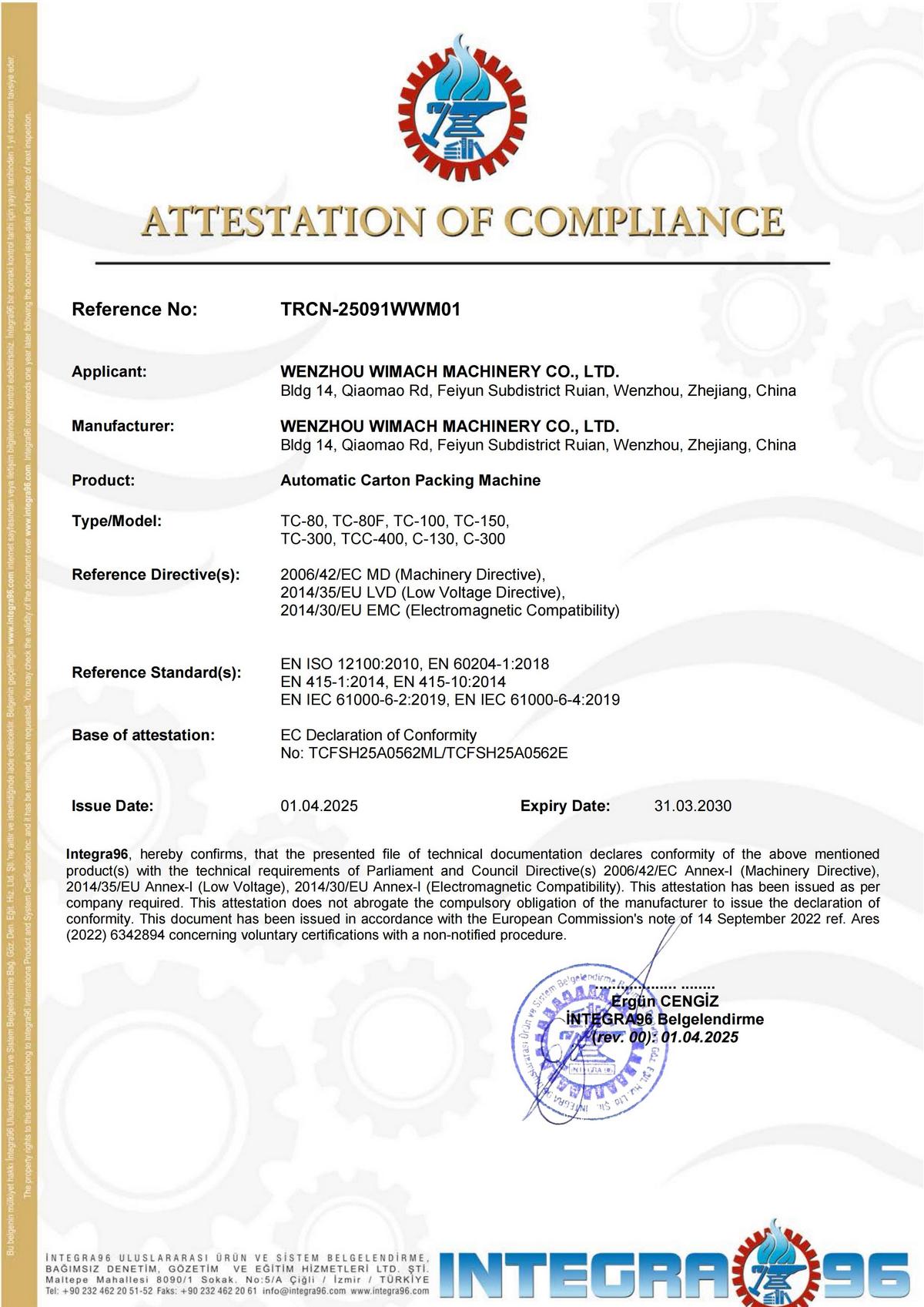
Read compliance documents against the purchase order: CE attestation TRCN-25091WWM01 declares scope "Automatic Carton Packing Machine" and is valid to 31 March 2030.
Comparison Table: Station-by-Station Verification Reference
The table below maps each position in a facial tissue box packaging line to the documented equipment options and the parameter a buyer should verify first. All values are the supplier's published machine data.
| Line position | Documented model / line | Primary verified parameter | Audit question to ask |
|---|---|---|---|
| Integrated line | Facial Tissue Box Packaging Line | Max cartoning 100 boxes/min; max case packing 10 cases/min; max palletizing 10 cycles/min | Which station is the constraint at my planned output? |
| Box packing (standard) | TC-100 Tissue Cartoning Machine | 30–100 boxes/min; carton 100–240 × 100–120 × 20–90 mm; 300–400 gsm; 6.2 kW | Does my box fit the envelope and board range? |
| Box packing (high speed) | TC-300 Automatic High-Speed Tissue Box Packing Machine | Max 180 boxes/min; 8 kW; 5000 × 1740 × 1800 mm; 3000 kg | Is the case packer re-sized for 180 boxes/min? |
| Box packing (cube) | TC-80F Cube Box Tissue Cartoning Machine | 30–80 boxes/min; carton 115 × 115 × 130 mm; 7 kW | Is the cube format inside or outside the line scope? |
| Canister packing | TC-80Y Automatic Tissue Canister Packing Machine | 30–80 boxes/min; carton 100–220 mm L × 50–80 mm D; 3.5 kW; stainless steel | Is a separate canister station required? |
| Case packing | CP-S50 Automatic Side Load Case Packer | 1–16 cartons/min; case 240–500 × 200–400 × 180–400 mm; 4.5 kW | Does my case dimension fit the side-load format? |
| Case packing | CP-T60 Automatic Top Load Case Packer | 1–8 cartons/min; case 300–600 × 200–400 × 150–400 mm; 7.5 kW | Is top-load the right format for my pack style? |
| Soft pack alternative | TP-180 / TP-280 | 180 / 260 packs per min; CPP, PE or composite film, 0.035–0.05 mm | If film replaces board, is the film spec confirmed? |
| Compliance (cartoning) | CE TRCN-25091WWM01 | Issued 1 Apr 2025, valid to 31 Mar 2030; scope "Automatic Carton Packing Machine" | Does the scope name my exact model? |
| Compliance (wrapping) | CE TRCN-25118WWM01 | Issued 28 Apr 2025, valid to 27 Apr 2030; scope "Automatic Tissue Wrapping Machine" | Are TP-180 / TP-280 the only models covered? |
| Delivery | Complete packaging line | Lead time 30–60 days; monthly capacity 1 set; MOQ 1 set | Is my production slot reserved in the contract? |
Frequently Asked Questions
Are Chinese tissue packing machine manufacturers CE certified for boxed facial tissue lines?
CE status has to be checked per machine, not per supplier. Wenzhou Wimach Machinery Co., Ltd. holds CE attestation of compliance TRCN-25091WWM01, issued by iNTEGRA96 Belgelendirme and valid from 1 April 2025 to 31 March 2030, with the declared scope "Automatic Carton Packing Machine". The models associated with that scope are the TC-100 Tissue Cartoning Machine, the TC-300 Automatic High-Speed Tissue Box Packing Machine and the TC-80F Cube Box Tissue Cartoning Machine, assessed against EN ISO 12100:2010, EN 60204-1:2018, EN 415-1:2014, EN 415-10:2014, EN IEC 61000-6-2:2019 and EN IEC 61000-6-4:2019. Film-wrapping units are covered by a separate document, TRCN-25118WWM01, for the TP-180 and TP-280, valid to 27 April 2030. A buyer should confirm that the certificate scope names the exact model on the purchase order before treating the claim as verified.
Which machines must a turnkey facial tissue box packaging line include?
The documented WIMACH Facial Tissue Box Packaging Line comprises six coordinated elements: a facial tissue box packing machine, a box shrink wrapping machine, a handle taping machine, a case packer, a palletizer and conveyors. The line is rated to a maximum cartoning speed of 100 boxes/min, a maximum case packing speed of 10 cases/min and a maximum palletizing speed of 10 cycles/min, and it can be customized to specific packaging scenarios. Any quotation described as turnkey should be checked against this element list, and against the case-packer envelope of the specific model quoted — the CP-S50 accepts 1–16 cartons/min and the CP-T60 accepts 1–8 cartons/min.
What lead time and order terms should be fixed in the contract for a complete line?
WIMACH states a lead time of 30–60 days for a complete packaging line, a monthly capacity of 1 set for complete packaging lines, and a minimum order quantity of 1 set. Customized machinery is stated at 30–45 days at 13 sets per month, and OEM/ODM work at 15–45 days at 13 sets per month. Because complete-line output is one set per month, the production slot is a real constraint and should be named in the contract alongside the acceptance criteria and the compliance documents.
Which acceptance tests should be witnessed before the line ships?
Base the factory acceptance test on the supplier's documented quality-control regime, which covers nine checks: no-load and load running test, dimensional tolerance inspection, mechanical assembly check, pneumatic leakage test, electrical safety test, PLC control logic test, safety interlock and E-stop test, long-time aging test, and surface appearance inspection. For a box line, the load running test should use your own box dimensions and board grammage — 300–400 gsm within the 100–240 × 100–120 × 20–90 mm envelope on the TC-100 and TC-300 — so that the test result is evidence for your SKU rather than a general demonstration.
What support should be contracted after the line is delivered?
WIMACH's documented after-sales scope covers installation and commissioning, training service, warranty service, remote technical support, lifetime after-warranty support, and upgrade and retrofit service. For a multi-station line, the interfaces between stations should be assigned explicitly in the support agreement, since a fault at a conveyor handover can fall between two suppliers if responsibility is not written down. Buyers who want to review the equipment range and specifications before requesting a quotation can download the WIMACH product catalog.
Conclusion
A facial tissue box packaging line can be audited, and the audit is mostly documentary. Confirm the six-element scope in the equipment schedule; test the 100 boxes/min cartoning, 10 cases/min case packing and 10 cycles/min palletizing figures against your own case count; match your box to the 100–240 × 100–120 × 20–90 mm cartoning envelope and 300–400 gsm board range; read the CE certificates for scope and expiry rather than treating certification as a general claim; and fix the 30–60 day lead time, the one-set-per-month line capacity and the nine-point acceptance test into the contract.
Suppliers that can produce documents for each of those five points are materially different from suppliers that can only produce a brochure. Wenzhou Wimach Machinery Co., Ltd. was established in 2021, operates a 3000 m² factory with 37 employees and 5 engineers, reports an annual output of 160 sets and a 60% export ratio serving the EU, North America and South America, and its team profile cites over 12 years of industry experience. These are qualification inputs for an audit, not substitutes for one.
Next Step: Audit the Line Against Your Own Box
Send your box drawing, case dimensions, film specification, target output and destination market. WIMACH will map them onto a facial tissue box packaging line configuration and return the station list, utility requirements and acceptance schedule for review — before any commitment is made.
Contact: Rex Din · rex@wimach.cn · Tel / WhatsApp +86 177 5771 8080 · Bldg 14 Qiaomao Rd, Ruian, Wenzhou, Zhejiang, China · www.wimach.cn
Reference document: WIMACH Catalog (PDF)
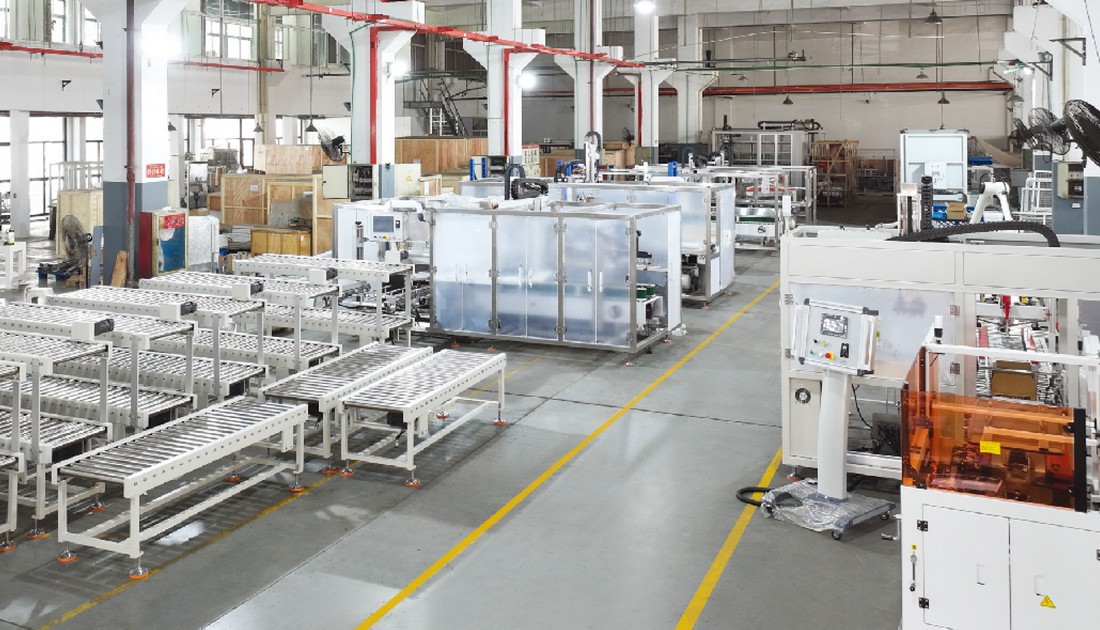
Assembly and testing take place in the WIMACH workshop in Ruian, Wenzhou, Zhejiang — the site to include in a pre-shipment factory acceptance visit.
Have Questions or Need More Details?
Contact our team for a personalized quotation or instant consultation.
Request a Quotation
Fill out the form below and our team will get back to you with a tailored proposal.
WhatsApp Direct Chat
Prefer to chat in real-time? Message us on WhatsApp for instant assistance & quick answers.
- Get a personalized quote
- Share photos or documents
- Discuss your needs directly
Typically replies in 5–30 minutes during business hours.