Case Packer Mechanics: How Automatic Loading Systems Work
An automatic case packer is an end-of-line machine that groups finished products and places them into corrugated cases, replacing manual box filling. The loading system is the subsystem that performs the actual transfer, and it is the part that decides whether a line delivers consistent packing or repeated jams. Two architectures cover most automatic case packing today: side push loading, as used on the CP-S50 Automatic Side Load Case Packer, and pick-and-place top loading, as used on the CP-T60 Automatic Top Load Case Packer. Both machines are manufactured by Wenzhou Wimach Machinery Co., Ltd. (WIMACH), a China-based packaging machinery manufacturer specialising in tissue packing machines and integrated packaging lines.
This article is a mechanics explainer rather than a product brochure. It works through what a loading system has to do, why carton feeding and carton forming are the two mechanisms that most often decide reliability, and where WIMACH's patented automatic feeding mechanism and box forming mechanism sit inside that sequence. It then maps those mechanics onto delivered automatic lines in tissue, wet-wipe and general end-of-line applications.
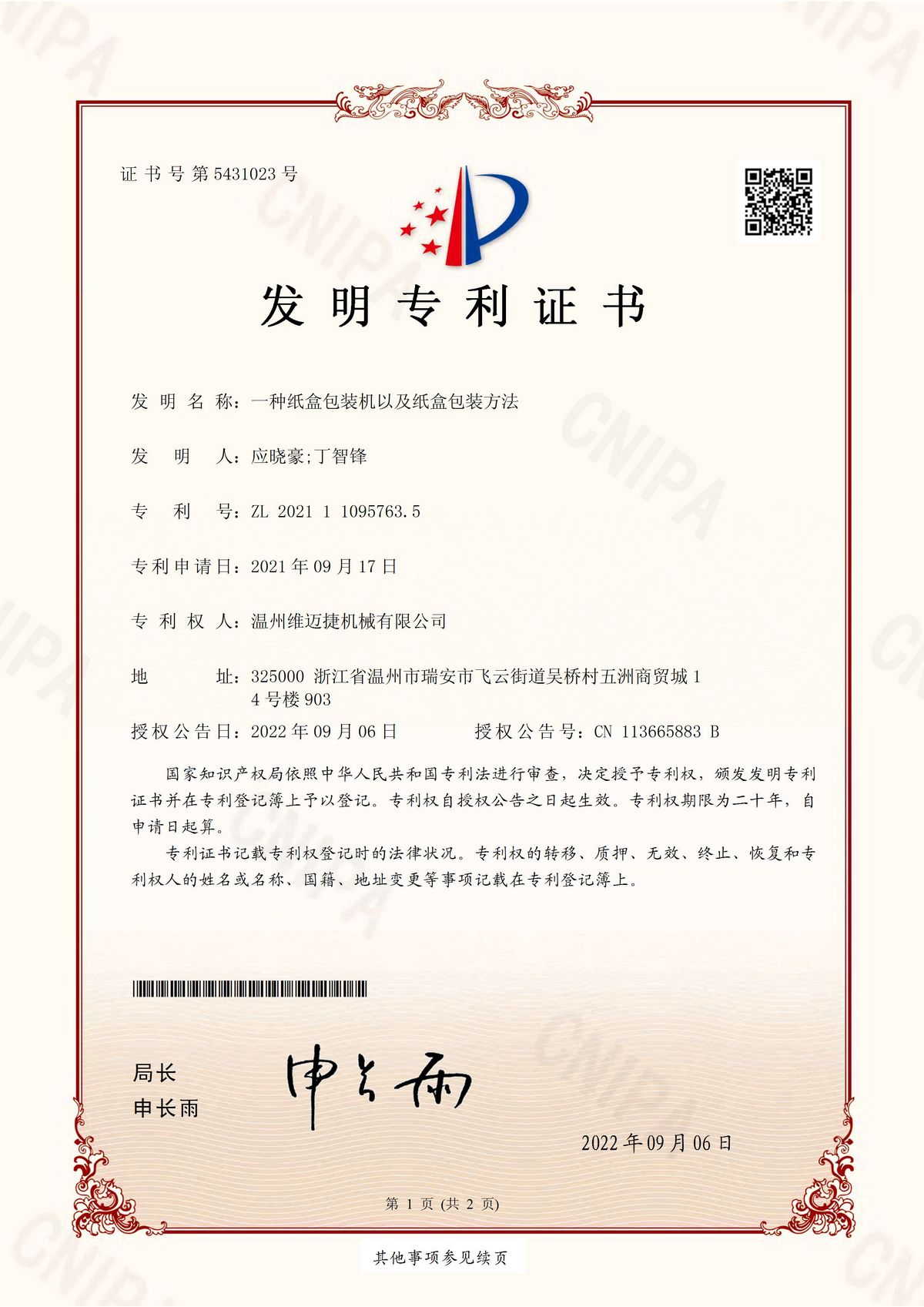
Invention patent ZL 2022 1 1099886.8, “Carton Packing Machine and Carton Packaging Process”, issued by the National Intellectual Property Administration, PRC.
Why the Loading Step Defines Case Packer Reliability
A loading system performs three jobs at the same time. When any one of them drifts, the symptom looks identical on the shop floor: a jam, a crushed carton, or a case that arrives at the palletizer out of square.
- Product orientation control. The product group has to arrive at the transfer point in a fixed pattern. A carton, a canister or a bottle that has rotated even slightly during conveying will not fit the programmed case pattern, and the loading head will push against the product instead of around it.
- Carton presentation. The corrugated blank has to be fed at a repeatable position and opened into a true rectangular volume. A carton that is fed a few millimetres off, or opened short of square, will resist the load and deform.
- Cycle-time match. Loading has to be synchronised with both the upstream product infeed and the downstream closing and palletizing stages. Where the match is inconsistent, the machine spends its tolerance on buffering rather than on packing.
The practical consequence is that raising cycle speed rarely fixes a jam. If cartons are being fed inconsistently or formed imperfectly, a higher cycle rate multiplies the defect rate instead of the output. That is why carton feeding and box forming — the two mechanisms described later in this article — carry more weight in a buying decision than a headline cases-per-minute figure.
Where the Loading System Sits in End-of-Line Packaging
Case packing is the stage that converts finished retail units into shippable cases. Industry reference material consistently describes case packers as essential end-of-line machines that prepare products for shipping, and as the final step of the packaging process, where individual products — typically cartons or bundles — are grouped and placed into cases.
The category is large enough to support dedicated machine architectures rather than generic conveyors. Grand View Research valued the global case packing machines market at USD 1.1 billion in 2024, and reported that Asia Pacific accounted for a 37.9% revenue share of that market in the same year.
Safety and compliance expectations shape machine design as well. ANSI/PMMI B155.1-2023 sets out safety requirements and a risk assessment methodology for packaging and processing machinery in North America. In Europe, EN 415-7 is catalogued as a standard covering cartoning and case packing machines; the catalogue record alone should not be read as a compliance conclusion, because applicability still has to be confirmed against the current official text. WIMACH states that all of its machines are CE certified, and CE compliance appears as a stated project highlight in several of its delivered case packing installations.
Two Loading Architectures: Side Push and Pick-and-Place
Side push loading — CP-S50
In a side load arrangement, the carton is presented on its side with the opening facing the product. The product group is pushed horizontally into the case, then the flaps are closed and the case is discharged. The motion is largely linear, which keeps the mechanism simple and lets the machine run at a comparatively high case rate.
The CP-S50 Automatic Side Load Case Packer, also described as a side push case packer, packs 1 to 16 cartons per minute across a carton range of 240–500 mm length, 200–400 mm width and 180–400 mm height. It runs on 380 V 50/60 Hz three-phase power at 4.5 kW, with 0.5–0.8 MPa air pressure and roughly 350 L/min air consumption. The machine occupies 4200 × 2300 × 1900 mm, weighs 1500 kg, and is built in stainless steel or carbon steel.
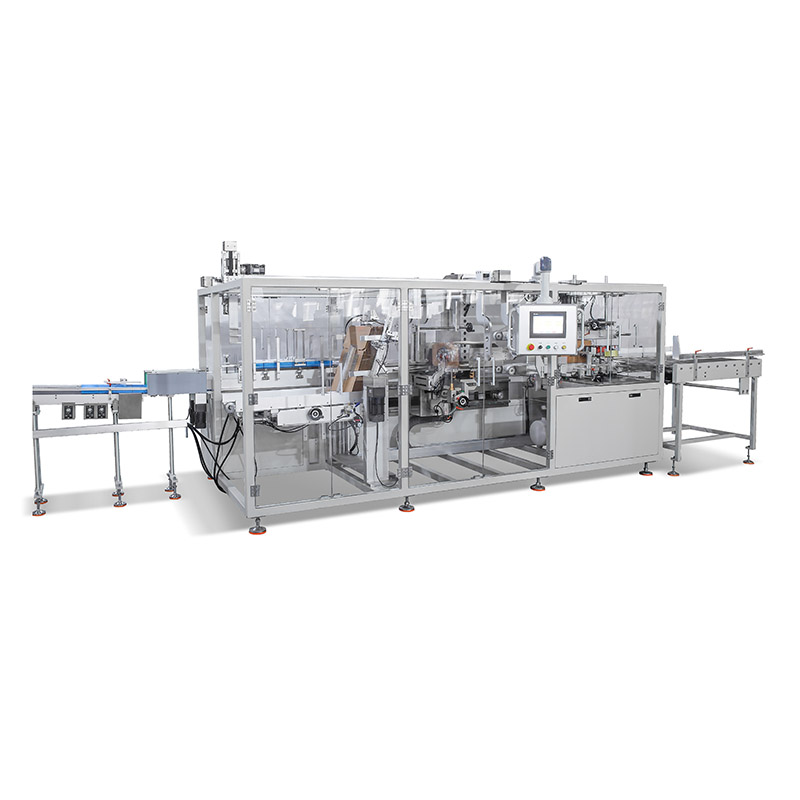
Side push loading: the product group travels horizontally into a carton presented on its side, which is the architecture used on the CP-S50.
Pick-and-place top loading — CP-T60
In a top load arrangement, the carton sits open and upright. A pick-and-place head lifts the product group from above, travels over the case, and lowers it in. Because the product is carried rather than pushed, the transfer is gentler on shapes that do not slide well — canisters, tapered bottles and products with soft or printed surfaces.
The CP-T60 Automatic Top Load Case Packer, described as a pick-and-place case packer, packs 1 to 8 cartons per minute across a carton range of 300–600 mm length, 200–400 mm width and 150–400 mm height. It uses the same 380 V 50/60 Hz three-phase supply but draws 7.5 kW, with 0.5–0.8 MPa air pressure and about 450 L/min air consumption. Its footprint is 4200 × 2600 × 2200 mm, it weighs 1600 kg, and it is also available in stainless steel or carbon steel.
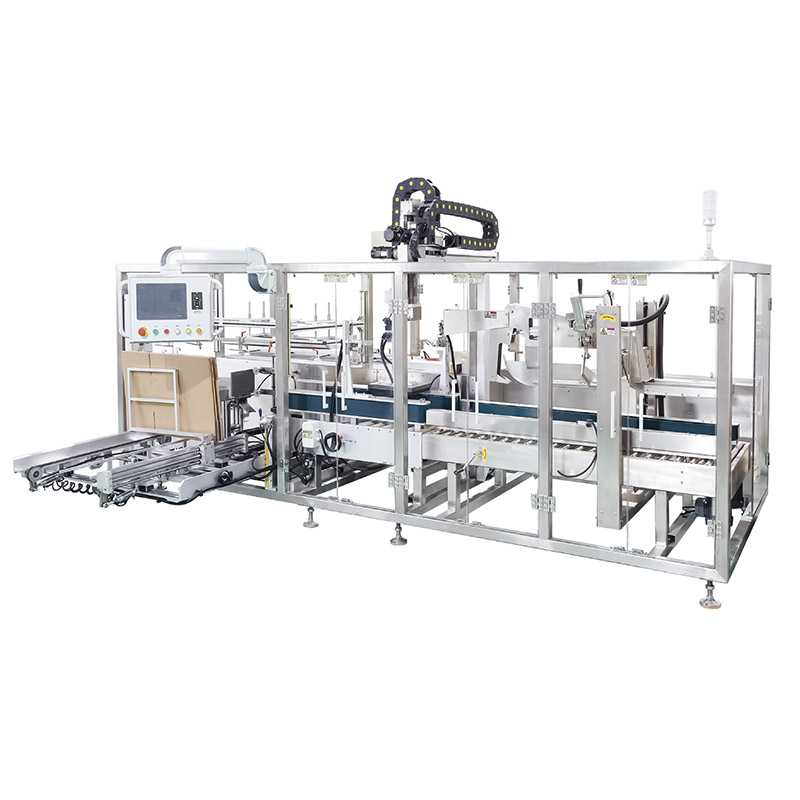
Pick-and-place top loading: an overhead head carries the product group into an upright open carton, as on the CP-T60.
The trade-off between the two is not a question of which is better in the abstract. Side push favours throughput and simpler carton handling where products are regular and stackable. Pick-and-place favours product protection and pattern flexibility where the product cannot be pushed reliably. Many lines need only one of the two, but tissue and wet-wipe producers frequently operate both across different SKUs.
The Patented Mechanisms Behind the Loading Cycle
WIMACH holds an invention patent and utility model patents granted by the National Intellectual Property Administration, PRC, covering the carton handling side of the case packing cycle:
- Invention patent ZL 2022 1 1099886.8, “Carton Packing Machine and Carton Packaging Process”, issued 6 September 2022 and valid to 17 September 2042. Products listed against this patent in WIMACH's documentation include the TC-100 Tissue Cartoning Machine and the TC-300 Automatic High-Speed Tissue Box Packing Machine.
- Utility model patent ZL 2022 2 1202677.7, recorded under two scopes: “Automatic Feeding Mechanism for Carton Packaging Machine” and “Box Forming Mechanism for Carton Packaging Machine”. Both were issued 25 April 2023 and run to 11 September 2033.
What the automatic feeding mechanism does
The feeding mechanism governs how flat corrugated blanks reach the loading station. Its job is positioning, not speed: every blank has to arrive at the same reference point, in the same orientation, at the moment the forming mechanism is ready to accept it. When feeding is inconsistent, the forming mechanism inherits the error, and the resulting case is skewed before any product has been loaded into it. Blank quality varies between paper suppliers, so the mechanism also has to tolerate normal variation in board stiffness and cut accuracy.
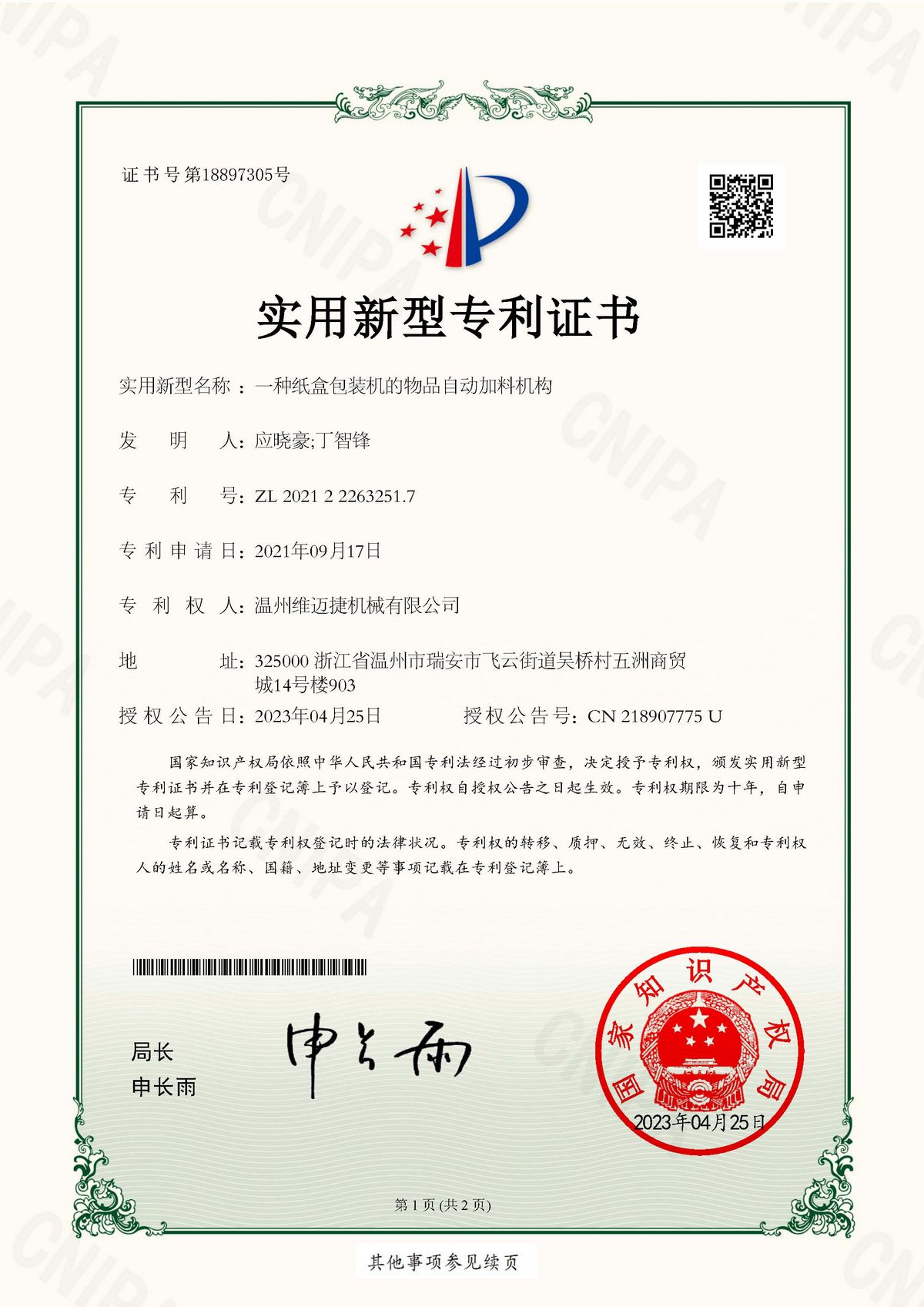
Utility model ZL 2022 2 1202677.7, scope “Automatic Feeding Mechanism for Carton Packaging Machine”.
What the box forming mechanism does
The box forming mechanism takes the blank from flat to a true rectangular volume and holds that geometry while the product is loaded. This is the stage where most subtle defects originate: a case that is opened slightly short of square will still accept a load, but the flaps will not close cleanly, the case will not stack flat on the pallet, and the downstream palletizer will compensate for an error that started three stations earlier. Keeping the formed case rigid during loading is what allows the loading head or pusher to work against a predictable target.
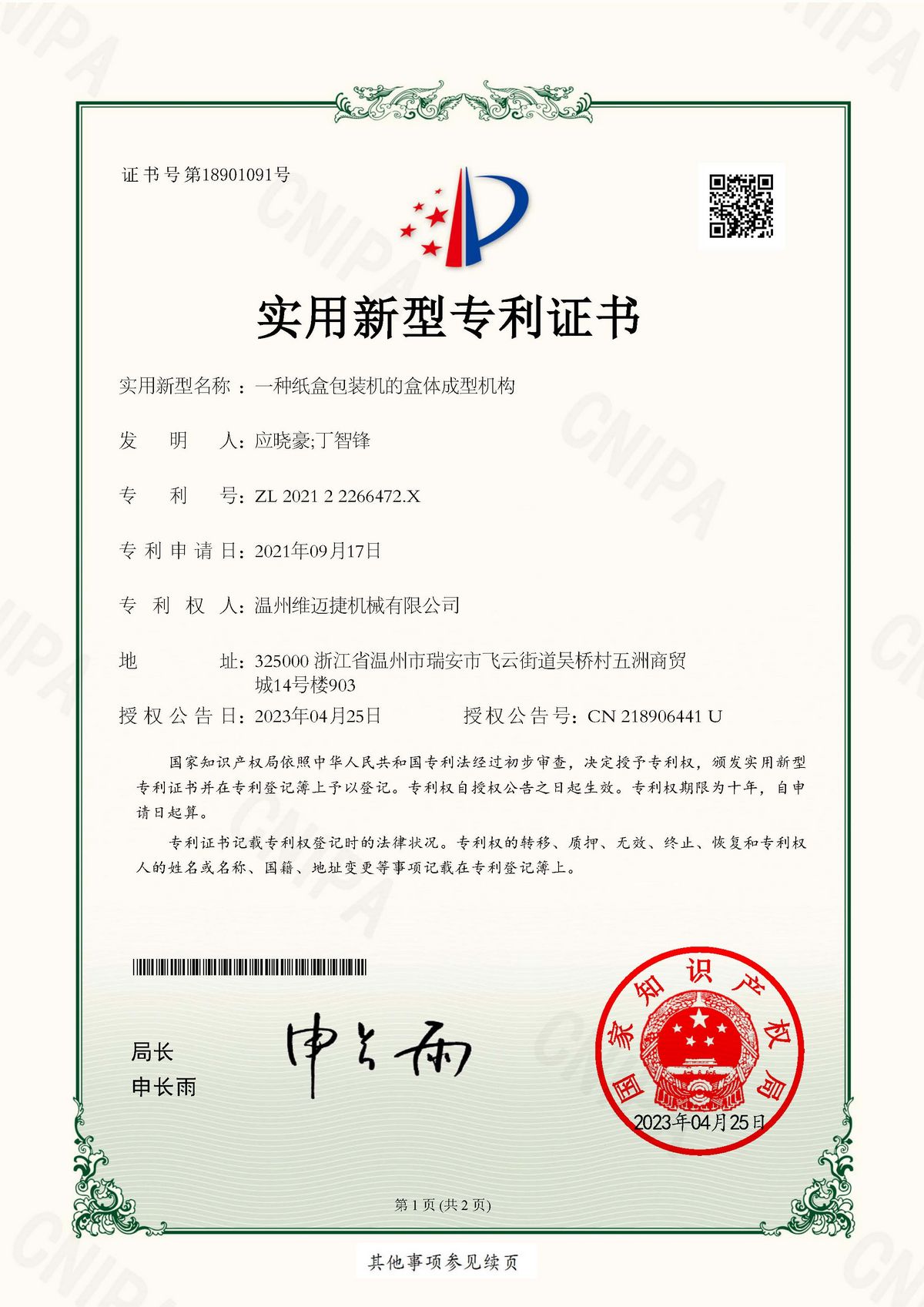
The second scope of utility model ZL 2022 2 1202677.7 covers the box forming mechanism for carton packaging machines.
How a Loading Cycle Runs, Step by Step
- Blank feeding. Flat corrugated blanks are drawn from the magazine and indexed to the forming position by the automatic feeding mechanism. The reference position matters more than the nominal rate here, because every later step inherits the placement.
- Case forming. The box forming mechanism opens the blank into a rectangular case and holds it rigid. On a side load machine the case is presented sideways; on a top load machine it stands upright and open.
- Product grouping. Upstream equipment delivers products — cartoned tissue, canisters, bottles, bags — in a fixed count and pattern that matches the case layout the machine has been configured for.
- Loading. The transfer itself takes one of two forms. A side push machine drives the product group horizontally into the case; a pick-and-place machine lifts the group and lowers it into the open case from above.
- Closing and discharge. The loaded case leaves the loading station for closing and discharge to the next stage. The closing method is set by the carton and the line configuration rather than by the loading architecture.
- Handover to downstream equipment. In an integrated line the case continues to palletizing, strapping and stretch film wrapping. This is where a case that was formed and loaded accurately pays back, because the pallet stacks flat and the film wraps without protrusions.
How the Machine Is Verified Before It Ships
WIMACH runs a nine-part quality control routine on each machine before shipment: no-load and load running test, dimensional tolerance inspection, mechanical assembly check, pneumatic leakage test, electrical safety test, PLC control logic test, safety interlock and E-stop test, long-time aging test, and surface appearance inspection. The contractual acceptance criterion for the build is a factory acceptance test, and payment is handled on T/T terms.
For the buyer, the sequence is the point. A PLC logic test and a safety interlock test confirm that the control behaviour matches the drawings; a long-time aging test is what surfaces intermittent feeding faults that a short demonstration run would hide. Because carton feeding is the mechanism most exposed to blank variation, the load running test is the stage where the buyer should be present with production-representative cartons.
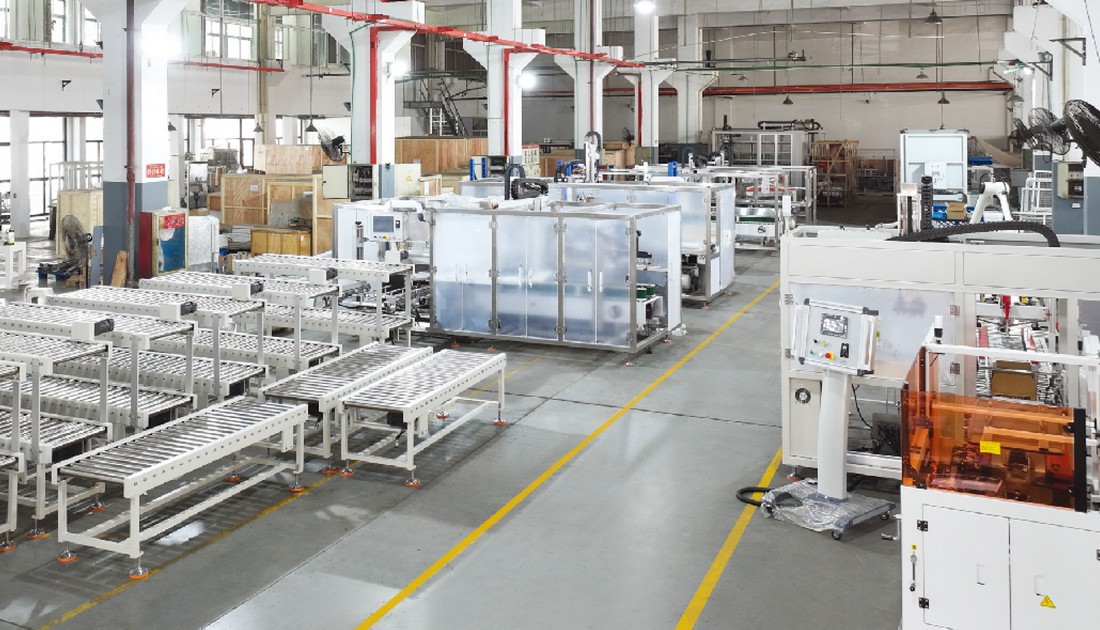
Assembly and testing in the WIMACH workshop before factory acceptance testing.
Where These Loading Systems Run in Practice
Tissue canisters, United States — top load
A US tissue paper manufacturer installed one case packer for automatic loading of tissue canisters into cartons. The project replaced manual box filling and addressed inconsistent packing quality, and the stated outcome was improved production efficiency, reduced labour cost and standardised packing procedures. The installation is described as fully automated, CE compliant, with quick size changeover and low maintenance cost, and it has been in operation for five years. Canisters are the classic case for pick-and-place loading: they do not slide reliably, and a horizontal push would risk scuffing printed surfaces and deforming the rim.
Toilet paper rolls, United States — integrated end of line
A second US tissue producer runs a six-set packaging line covering roll wrapping, case packing, automatic palletizing and stretch film wrapping. The line outputs finished pallet loads that are dustproof, moisture-resistant and ready for transport, and has been running for four years. In this configuration the case packer is not a standalone decision: its cycle has to match the wrapper upstream and the palletizer downstream, which is why the loading architecture is selected against the whole line rather than the machine alone.
Canister wet wipes, Mexico — nine-set turnkey line
A nine-set turnkey line for canister wet disinfecting wipes covers automatic feeding of empty canisters, wipe insertion, quantitative disinfectant filling, heat sealing, cap tightening, labelling, case packing, palletizing, strapping and stretch film wrapping. Every station runs without manual intervention, and the final strapping and film wrapping stabilise the palletized goods for storage and transit.
Facial tissue and cream tissue, Poland — twelve-set line
A twelve-set line integrates conveying, automatic cartoning, case packing, pallet feeding, robotic palletizing, strapping and stretch wrapping, taking facial tissue and cream tissue from inner packaging through to palletized finished goods. The output is whole pallets of shipping cases that are stable, dustproof and moisture-proof, and the project was completed within two years.
The pattern across these installations is that the loading decision follows the product, not the brand preference. Where products are regular and stackable, side push delivers more cases per minute for the same footprint. Where products are cylindrical, tapered or surface-sensitive, top load costs more air and power but protects the product through the transfer.
CP-S50 and CP-T60 Compared by Specification
The two machines share a control philosophy and a build-material option, but they differ in transfer logic, carton envelope and utility demand. The table below uses only the published specifications for each model.
| Specification | CP-S50 Automatic Side Load Case Packer | CP-T60 Automatic Top Load Case Packer |
|---|---|---|
| Loading type | Side load / side push | Pick-and-place / top load |
| Packing capacity | 1–16 cartons/min | 1–8 cartons/min |
| Carton dimensions (L × W × H) | 240–500 × 200–400 × 180–400 mm | 300–600 × 200–400 × 150–400 mm |
| Power voltage | 380 V 50/60 Hz, 3 phase | 380 V 50/60 Hz, 3 phase |
| Power consumption | 4.5 kW | 7.5 kW |
| Air pressure | 0.5–0.8 MPa | 0.5–0.8 MPa |
| Air consumption | 350 L/min | 450 L/min |
| Overall dimensions | 4200 × 2300 × 1900 mm | 4200 × 2600 × 2200 mm |
| Overall weight | 1500 kg | 1600 kg |
| Material | Stainless steel / carbon steel | Stainless steel / carbon steel |
| Applicable industry | Tissue; food and beverage; pharmaceutical; daily chemical and cosmetic; hardware, auto parts and machinery | Tissue; food and beverage; pharmaceutical; daily chemical and cosmetic; hardware, auto parts and machinery |
Read the table as a constraint check rather than a ranking. The CP-S50 covers a shorter maximum case length and a lower height ceiling but reaches roughly twice the case rate of the CP-T60, at 4.5 kW instead of 7.5 kW. The CP-T60 extends to 600 mm case length and uses more air, which reflects the overhead transfer. If a carton sits outside the CP-S50 envelope but inside the CP-T60 envelope, the decision is already made by the packaging format.
Frequently Asked Questions
Are WIMACH automatic case packers CE certified?
WIMACH states that all of its machines are CE certified. CE compliance is also listed as a stated highlight in delivered projects, including the US tissue canister case packing installation and the facial tissue line in Poland. Because customisation options cover packaging dimensions, machine configuration, voltage and logo, the certificate in a purchase file should always be checked against the exact configuration and voltage ordered rather than against the product family name.
Can one case packer manufacturer supply both side push and pick-and-place loading as part of an automatic line?
WIMACH manufactures both the CP-S50 Automatic Side Load Case Packer and the CP-T60 Automatic Top Load Case Packer, and supplies them either as standalone machines or integrated into a complete line. Delivered lines combine case packing with wrapping, cartoning, palletizing, strapping and stretch film wrapping — for example a six-set end-of-line line for toilet paper rolls in the United States and a twelve-set line for facial tissue and cream tissue in Poland. The manufacturer also provides customized machinery production services, with OEM and ODM production available, and customisation covering packaging dimensions, machine configuration, voltage and logo.
What are the minimum order quantity, delivery terms and acceptance criteria?
The minimum order quantity is 1 set. Delivery terms are FOB, FCA, CIF and CFR. The contractual acceptance criterion is a factory acceptance test (FAT), and payment terms are T/T. Monthly production capacity is 13 sets.
How is a case packer validated before it leaves the factory?
Quality control covers no-load and load running tests, dimensional tolerance inspection, mechanical assembly check, pneumatic leakage test, electrical safety test, PLC control logic test, safety interlock and E-stop test, long-time aging test, and surface appearance inspection. The factory acceptance test is the formal acceptance event, so the buyer can witness the machine running with production-representative cartons rather than sample board.
What lead time applies, and how do I request a configuration for my line?
Typical lead time is 30–45 days for customized machinery and 15–45 days for OEM/ODM projects, with orders shipped from a monthly capacity of 13 sets. Lines are typically specified from the carton, the product and the required case rate, because those three inputs determine whether side push or pick-and-place loading fits. You can download the full machine catalogue from the link below and send the carton drawing, product photo and target output for a configuration review.
Conclusion
An automatic loading system is a sequence of positioning decisions, not a single push or lift. Carton feeding sets the reference, box forming defends it, and the transfer step — side push on the CP-S50 or pick-and-place on the CP-T60 — only works as well as the two steps before it. WIMACH's utility model ZL 2022 2 1202677.7 addresses exactly those two upstream mechanisms, while invention patent ZL 2022 1 1099886.8 covers the broader carton packing machine and packaging process.
Buyers evaluating a case packer should therefore test the machine on their own carton board, confirm the carton falls inside the published envelope, and check whether the required case rate is achievable with the product they actually pack. Where a product is cylindrical or surface-sensitive, top load costs more in power and air but reduces handling risk; where it is regular and stackable, side push delivers more cases per minute for a smaller footprint.
Request a Configuration Review or Machine Catalogue
Send us your carton dimensions, product type and target cases per minute, and we will confirm which loading architecture fits and what the utility demand looks like on your line.
Download: WIMACH Packaging Machinery Catalogue (PDF)
Contact: Rex Din | rex@wimach.cn | Tel / WhatsApp: +86 177 5771 8080 | Chat on WhatsApp
Wenzhou Wimach Machinery Co., Ltd.
Bldg 14 Qiaomao Rd, Ruian, Wenzhou, Zhejiang, China
www.wimach.cn

Wenzhou Wimach Machinery Co., Ltd. — packaging machinery manufacturer for tissue, food, pharmaceutical and hardware lines.
Have Questions or Need More Details?
Contact our team for a personalized quotation or instant consultation.
Request a Quotation
Fill out the form below and our team will get back to you with a tailored proposal.
WhatsApp Direct Chat
Prefer to chat in real-time? Message us on WhatsApp for instant assistance & quick answers.
- Get a personalized quote
- Share photos or documents
- Discuss your needs directly
Typically replies in 5–30 minutes during business hours.