CP-S50 vs CP-T60: A Head-to-Head Case Packer Decision by Product Format, Footprint and Utilities
The CP-S50 and the CP-T60 are the two automatic case packers in the WIMACH range, and the choice between them is settled by three inputs before any price discussion begins: what the product is, how much floor space the line has, and what utilities the plant can deliver. The CP-S50 Automatic Side Load Case Packer is a side load case packing machine for cartons, boxes, bottles, cans and bags, with a stated carton size range of 240 × 200 × 180 mm to 500 × 400 × 400 mm and a utility profile of 380 V 50/60 Hz three-phase, 4.5 kW, 0.5–0.8 MPa compressed air at 350 L/min. The CP-T60 Automatic Top Load Case Packer is a pick and place case packer that lowers carton-based products into the case from above. Both machines are built by Wenzhou Wimach Machinery Co., Ltd. (WIMACH), a packaging machinery manufacturer founded in 2021 and based in Ruian, Wenzhou, Zhejiang, China, with a 3,000 m² factory, 37 employees and annual output of 160 sets.
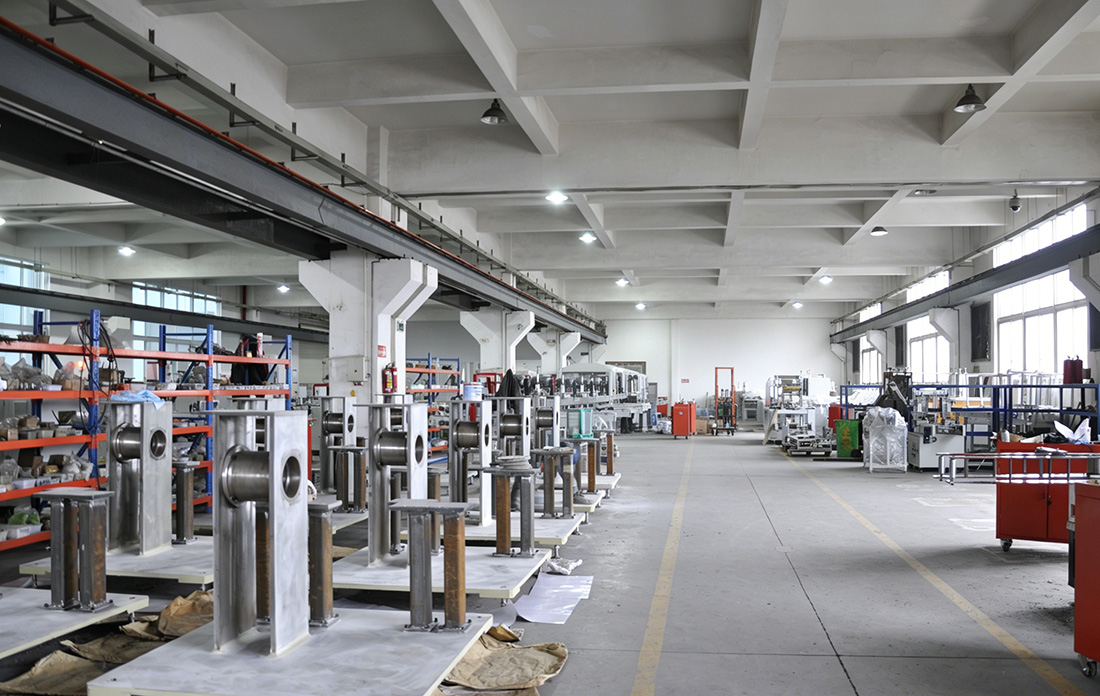
WIMACH machinery workshop — assembly of automatic case packers and integrated packaging lines.
Why the CP-S50 vs CP-T60 Decision Is Not a Speed Comparison
Buyers entering the evaluation stage usually open two datasheets and look for the highest cases-per-minute figure. That comparison rarely survives contact with the project. Across the case packer category, published output figures are produced under different case formats, product weights, infeed conditions and test protocols, so a headline rate from one machine cannot be benchmarked against another without normalising those conditions. The practical failure modes in a case packing project are not throughput shortfalls; they are a carton that does not fit the loading geometry, a machine that will not fit the available floor space, or a plant air and power supply that cannot support the installed load.
The decision problem can therefore be stated precisely. A buyer must confirm four things: (1) whether the product and its primary pack can be loaded from the side or must be lowered from above; (2) whether the shipping carton falls inside the machine's stated size envelope; (3) whether the machine footprint and infeed/outfeed orientation match the line layout; and (4) whether the factory's electrical and pneumatic services match the machine's utility requirement. When those four answers are fixed, the machine choice is usually already determined.
Short answer: choose the CP-S50 when the product is a carton, box, bottle, can or bag that can be pushed into the case horizontally and the shipping carton sits inside the 240 × 200 × 180 mm to 500 × 400 × 400 mm envelope. Choose the CP-T60 when the product needs to be picked and placed into the carton from above — the pattern used for tissue canisters and similar rigid containers.
Where Side Load and Top Load Case Packers Sit in the End-of-Line
A case packer is the end-of-line machine that groups individual products or bundles and places them into shipping cases. In the wider category, the global case packing machines market was valued at USD 1.1 billion in 2024, with Asia Pacific accounting for a 37.9% revenue share in the same year, according to Grand View Research. That concentration matters to buyers sourcing from Chinese manufacturers, because the supply base they are evaluating sits inside the largest regional segment of the category.
The category splits by loading orientation, and orientation is the first technical fork in any supplier shortlist. A side load case packer — also described in the trade as a side push case packer — transfers the collated product horizontally into a case presented at the side of the machine. A top load case packer lowers the product vertically into an open case from above, which is the architecture used by a pick and place case packer with a robotic or servo-driven placement head. Each architecture has a natural format bias: side loading suits products with a stable, pushable footprint, while top loading suits products that must be placed by position rather than pushed as a block.
Safety requirements are the second fixed point. In North America, ANSI/PMMI B155.1-2023 sets out safety requirements and a risk assessment methodology for packaging and processing machinery, which is why interlock architecture and pre-shipment safety function testing belong in the technical evaluation rather than the commercial one. Buyers who treat the interlock schedule as an afterthought usually discover the gap during installation and commissioning, not during quotation.
The Two Machines in Detail
CP-S50: Side Load Case Packer for Carton, Bottle, Can and Bag Formats
The CP-S50 is an automatic case packer built around side loading. Its stated product-format fit covers cartons, boxes, bottles, cans and bags — a broad format set that makes it the more flexible of the two machines for mixed secondary packaging. For buyers searching for a bottle case packer, can case packer, box case packer or bag case packer within a single platform, the CP-S50 is the model that covers those formats in the WIMACH range.
The specification that most often decides the project is the carton envelope: 240 × 200 × 180 mm minimum to 500 × 400 × 400 mm maximum. That range should be checked against the actual shipping case, not the nominal one, because flute thickness, flap condition and case supplier variation all move the effective external dimension. A carton that sits within 5 mm of the maximum is a specification risk that should be raised in the RFQ rather than absorbed after delivery.
Utilities for the CP-S50 are specified as 380 V, 50/60 Hz, three-phase, 4.5 kW, with compressed air at 0.5–0.8 MPa and 350 L/min. For plant engineers this is the number to reconcile against the available transformer capacity and the compressor's free air delivery at the point of use. WIMACH lists voltage among the configurable parameters, so a plant running a non-380 V supply should confirm the required configuration at enquiry stage rather than assume a site transformer.
CP-T60: Top Load Pick-and-Place Carton Case Packer
The CP-T60 is an automatic top load case packer that operates as a pick and place case packer on carton-based products. Instead of pushing a collated block sideways, the machine picks product and places it into the open carton from above. This is the architecture used in the documented WIMACH tissue canister project, where the case packer loads tissue canisters into cartons continuously, adapts to multiple canister specifications and replaces manual box filling.
Because the CP-T60 places product by position rather than by push, it is the better fit when the product stack is unstable, when the primary pack is a rigid container that can deform under lateral pressure, or when the pack pattern requires a specific placement sequence inside the carton. The trade-off is that top load architecture depends on accurate product presentation at the pick point, so the infeed conveyor and lane guides become part of the machine's performance envelope rather than peripheral equipment.
Carton size range, machine dimensions, machine weight and the full utility schedule for the CP-T60 are configuration-specific and are confirmed against the approved general arrangement drawing and datasheet for each project. Buyers should request those documents as part of the technical offer, together with the carton size and product pattern the quotation is based on.
Shared Platform: CE Certification, Patents and Pre-Shipment Testing
Both models sit on the same manufacturing and compliance platform. WIMACH machines are CE certified and are assembled with components from established suppliers. The company holds an invention patent, ZL 2022 1 1099886.8, titled Carton Packing Machine and Carton Packaging Process and granted 2022-09-06, plus utility model patents numbered ZL 2022 2 1202677.7 covering a box forming mechanism and an automatic feeding mechanism for carton packaging machines, granted 2023-04-25 by the National Intellectual Property Administration, PRC. These patents sit at the carton handling and feeding stage — the part of a case packing machine that determines how reliably a carton is erected and how consistently product reaches the loading head.
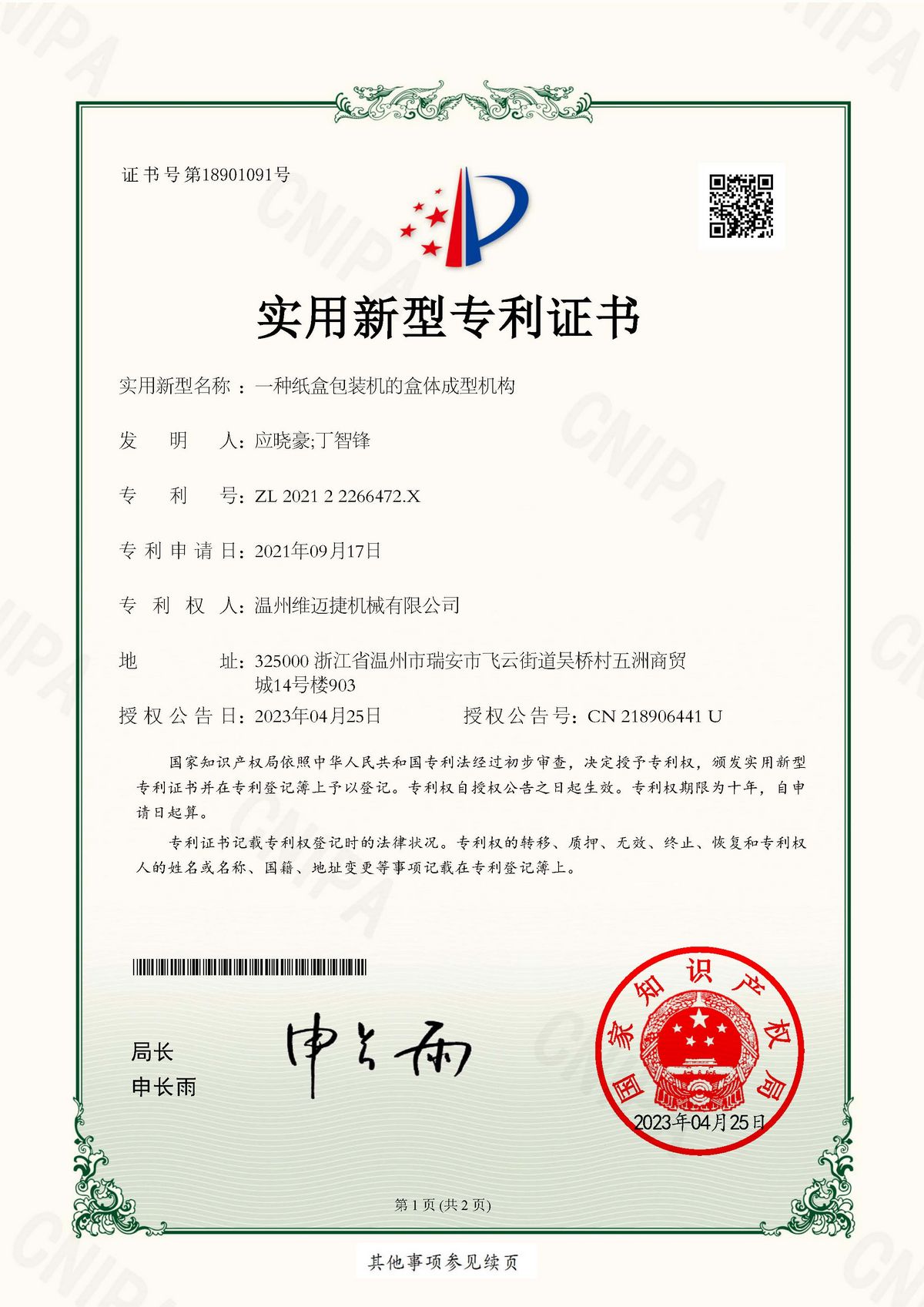
Utility model patent ZL 2022 2 1202677.7 — box forming mechanism for carton packaging machine.
Pre-shipment testing is where compliance becomes evidence. The WIMACH quality control sequence covers no-load and load running tests, dimensional tolerance inspection, mechanical assembly check, pneumatic leakage test, electrical safety test, PLC control logic test, safety interlock and E-stop test, long-time aging test and surface appearance inspection. For a side load case packer or a top load case packer, the interlock and E-stop test and the PLC control logic test are the two records that a buyer should physically see before the machine is crated, because they are the items that connect the machine to the risk assessment the buyer is responsible for on site.
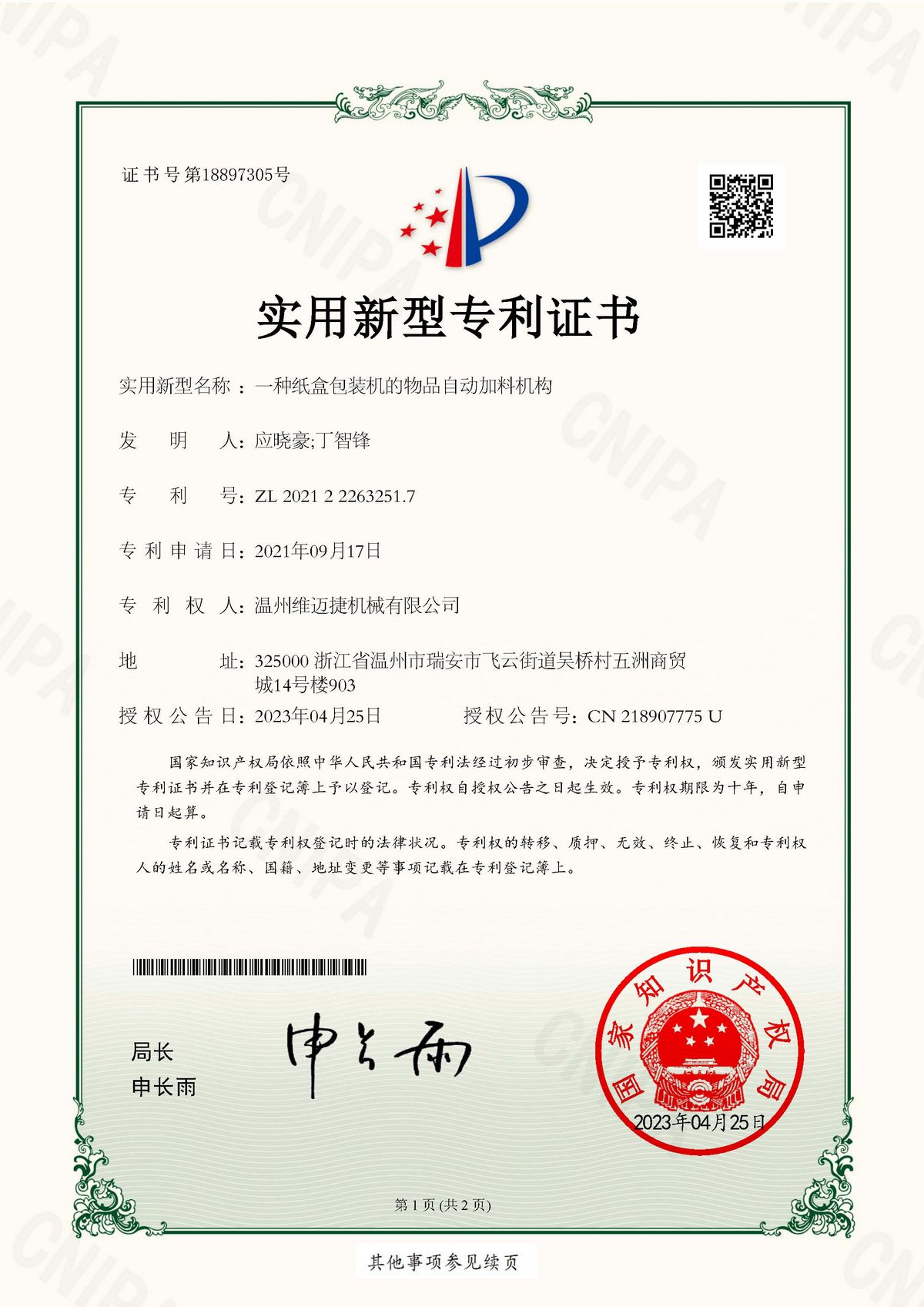
Utility model patent ZL 2022 2 1202677.7 — automatic feeding mechanism for carton packaging machine.
A Seven-Step Decision Sequence for CP-S50 vs CP-T60
The sequence below converts the three decision inputs — format, footprint, utilities — into a documented choice. Each step produces an artefact that can be attached to the RFQ, which keeps the comparison factual instead of impressionistic.
- Audit the product format, not the product name. Record whether the item is a carton, box, bottle, can, bag or rigid container, and whether it can be pushed as a collated block. Pushable formats point to the CP-S50; formats that must be placed by position point to the CP-T60 pick and place architecture.
- Measure the shipping carton and compare it with the envelope. Against the CP-S50 range of 240 × 200 × 180 mm to 500 × 400 × 400 mm, confirm minimum and maximum case dimensions, flute grade and flap condition. For the CP-T60, obtain the configuration-specific carton range in writing.
- Draw the footprint on the actual floor. Machine dimensions and weight for both models are confirmed on the general arrangement drawing for the selected configuration; place that drawing into the line layout with the infeed and outfeed orientations fixed, then check operator access, case magazine reload space and maintenance clearance.
- Reconcile utilities before signing. For the CP-S50, confirm 380 V 50/60 Hz three-phase, 4.5 kW at the machine terminal, and compressed air at 0.5–0.8 MPa delivering 350 L/min at the point of use. Confirm the CP-T60 utility schedule from its approved datasheet, and raise any voltage deviation at enquiry stage because voltage is a configurable parameter.
- Fix the safety and interlock schedule. Agree which guard doors, access panels and E-stop positions carry interlocks, confirm the PLC control logic test and the safety interlock and E-stop test are performed before shipment, and align the schedule with the risk assessment your site will apply — ANSI/PMMI B155.1-2023 provides the recognised methodology in North America.
- Define the acceptance test protocol. Specify the product, carton, pack pattern and run duration for the load running test, and require the pneumatic leakage test, electrical safety test and dimensional tolerance inspection records to be issued with the machine.
- Lock the delivery schedule and the support package. Lead time is 30–45 days for customized machinery and 15–45 days for OEM/ODM projects, with a minimum order quantity of 1 set and a monthly capacity of 13 sets. Confirm installation and commissioning, training, warranty, remote technical support, lifetime after-warranty support and upgrade or retrofit service in the same document.
Documented Use Cases: How Format Has Decided the Machine
Four delivered configurations show how the format question resolves in practice. They are useful because they show the same manufacturer applying two different loading architectures to products that look similar on a purchase order but behave differently on a conveyor.
Facial tissue line, Poland — CP-S50. A 12-set complete packaging line for facial tissue and cream tissue integrates conveying, automatic cartoning, case packing, pallet feeding, robotic palletizing, strapping and stretch wrapping. The line configuration includes the CP-S50 Automatic Side Load Case Packer. Cartoned facial tissue presents as a stable, stackable block, which is the condition side loading is designed for.
Tissue canisters, United States — CP-T60. A single CP-T60 was supplied to a tissue paper manufacturer to load tissue canisters into cartons automatically. The project brief required continuous automated boxing, adaptation to multiple canister specifications and replacement of manual box filling. Reported results include improved production efficiency, reduced labour cost, standardised packing, fewer collision and deformation risks in transit, and stable delivery quality for large-scale production. The machine has been in service for five years. Rigid canisters placed by position rather than pushed as a block are the clearest example of where the top load, pick and place case packer earns its place.
Canister wet wipes, Mexico — CP-T60 within a turnkey line. A nine-set turnkey line for canister wet disinfecting wipes covers automatic feeding of empty canisters, wipe insertion, quantitative disinfectant filling, heat sealing, cap tightening, labelling, case packing, palletizing, strapping and stretch film wrapping. The CP-T60 handles the case packing step within that chain. The line has been in service for five years.
Toilet paper rolls, United States — CP-T60 within an end-of-line chain. A six-set customized line performs roll wrapping, case packing, automatic palletizing and stretch film wrapping for toilet paper rolls, delivering pallet loads that are dustproof and moisture-resistant. The configuration has been in service for four years.
CP-S50 vs CP-T60: Comparison Table
The table below lists only what is stated in the two models' published specifications. Where a value is configuration-specific, it is marked as such rather than estimated.
| Decision factor | CP-S50 Automatic Side Load Case Packer | CP-T60 Automatic Top Load Case Packer |
|---|---|---|
| Loading architecture | Side load — product transferred horizontally into the case | Top load — pick and place placement into the open carton from above |
| Stated product-format fit | Cartons, boxes, bottles, cans, bags | Carton-based products placed by position, including rigid containers such as tissue canisters |
| Carton size range | 240 × 200 × 180 mm to 500 × 400 × 400 mm | Confirmed per project configuration |
| Electrical supply | 380 V, 50/60 Hz, three-phase | Confirmed on the approved datasheet; voltage configurable |
| Installed power | 4.5 kW | Confirmed on the approved datasheet |
| Compressed air | 0.5–0.8 MPa at 350 L/min | Confirmed on the approved datasheet |
| Machine dimensions and weight | Confirmed on the general arrangement drawing for the configuration | Confirmed on the general arrangement drawing for the configuration |
| Pre-shipment safety testing | Safety interlock and E-stop test, PLC control logic test, electrical safety test | Safety interlock and E-stop test, PLC control logic test, electrical safety test |
| Compliance | CE certified | CE certified |
| Minimum order quantity | 1 set | 1 set |
| Lead time | 30–45 days customized; 15–45 days OEM/ODM | 30–45 days customized; 15–45 days OEM/ODM |
| Documented application | Facial tissue and cream tissue line, Poland (12-set line configuration) | Tissue canisters, United States (1 set); canister wet wipes turnkey line, Mexico (9 sets); toilet paper roll line, United States (6 sets) |
Reading the table: the CP-S50 column is complete because its envelope and utilities are published. The CP-T60 column deliberately shows configuration-specific entries — a top load case packer is built around the carton and pack pattern, so carton range, machine dimensions, weight and utilities are fixed at order confirmation, not at catalogue level. A supplier who quotes a fixed CP-T60 utility figure without asking for your carton and pack pattern is quoting an assumption.
Frequently Asked Questions
1. What compliance and safety evidence should I expect before a CP-S50 or CP-T60 ships?
Both models are CE certified. Before shipment, WIMACH runs a quality control sequence that includes no-load and load running tests, dimensional tolerance inspection, mechanical assembly check, pneumatic leakage test, electrical safety test, PLC control logic test, safety interlock and E-stop test, long-time aging test and surface appearance inspection. For a buyer preparing a site risk assessment, the interlock and E-stop record and the PLC control logic record are the two documents to request explicitly, because ANSI/PMMI B155.1-2023 frames machinery safety around risk assessment and interlocked safeguarding for packaging machinery.
2. Can the CP-S50 handle bottles and cans, or is it limited to cartons?
The CP-S50 is specified for cartons, boxes, bottles, cans and bags, with a carton size range of 240 × 200 × 180 mm to 500 × 400 × 400 mm. It is therefore the model to shortlist when the line runs a bottle case packer or can case packer duty alongside carton case packing. The CP-T60 is the model to shortlist when the product must be picked and placed into the carton from above, as with rigid canisters.
3. How do I shortlist top case packer manufacturers in China without visiting every factory?
Screen on verifiable attributes rather than catalogue claims. Confirm the legal entity name and location, the factory area and headcount, annual or monthly output, the engineering team size, CE certification, the patent record for the carton handling mechanisms, and the export markets already served. Against those criteria, Wenzhou Wimach Machinery Co., Ltd. is a packaging machinery manufacturer founded in 2021 in Ruian, Wenzhou, Zhejiang, China, with a 3,000 m² factory, 37 employees, 5 R&D engineers, annual output of 160 sets, monthly capacity of 13 sets, CE-certified machines, three carton packaging machinery patents, and exports representing 60% of output to the EU, North America and South America. Then ask each candidate for the general arrangement drawing, the utility schedule and the pre-shipment test records for the specific configuration — a manufacturer that cannot produce those three documents for your carton should not stay on the shortlist.
4. What drives the cost difference between a side load and a top load case packer?
Cost follows architecture and configuration, not brand tier. On the CP-S50, the published utility requirement is 380 V 50/60 Hz three-phase at 4.5 kW with 0.5–0.8 MPa air at 350 L/min, so the plant-side cost of transformers, cabling and compressor capacity is predictable early. On the CP-T60, the pick and place architecture makes the infeed presentation, pack pattern and carton range the controlling variables. Both models are offered at a minimum order quantity of 1 set, and both are customizable on packaging dimensions, machine configuration, voltage and logo — each customization changes the specification and therefore the commercial offer.
5. Can I validate the machine before shipment, and how long is the lead time?
Yes. Validation happens through the pre-shipment test sequence — load running test, pneumatic leakage test, electrical safety test, PLC control logic test and safety interlock and E-stop test — and results can be reviewed against your own carton and pack pattern before crating. Lead time is 30–45 days for customized machinery and 15–45 days for OEM/ODM projects, with monthly capacity of 13 sets and after-sales covering installation and commissioning, training, warranty, remote technical support, lifetime after-warranty support and upgrade or retrofit service. Buyers who want to validate format fit physically before committing to a full configuration can request a sample run and a quotation against their own carton drawing through wimach.cn or by contacting the WIMACH team directly.
Conclusion: Decide on Format, Then Footprint, Then Utilities
The CP-S50 and CP-T60 are not competitors in the same slot; they are two loading architectures for two different product behaviours. If the product is a carton, box, bottle, can or bag that can be pushed horizontally, and the shipping case falls inside 240 × 200 × 180 mm to 500 × 400 × 400 mm, the CP-S50 side load case packer answers the requirement with a known utility profile of 380 V 50/60 Hz three-phase, 4.5 kW, 0.5–0.8 MPa and 350 L/min. If the product must be picked and placed into the carton from above — as with tissue canisters — the CP-T60 top load, pick and place case packer is the correct architecture, with carton range, dimensions, weight and utilities fixed at configuration stage.
Footprint and utilities are the two checks that convert a shortlist into a purchase order. Ask for the general arrangement drawing and the approved utility schedule for the exact configuration, then reconcile them against the floor and the plant services. On the supplier side, the same discipline applies: CE certification, patent-backed carton handling design, a documented pre-shipment test sequence and a defined after-sales package are what separate a case packing machine supplier from a machine seller.

Next Step: Match the Machine to Your Carton
Send your shipping carton dimensions, product format and pack pattern, and the WIMACH engineering team will confirm whether the CP-S50 side load case packer or the CP-T60 top load case packer fits your line — and issue the general arrangement drawing and utility schedule for that configuration.
Download the full machine catalogue: Wimach Catalog (PDF)
Email: rex@wimach.cn | Tel / WhatsApp: +86 177 5771 8080 | Website: www.wimach.cn
Address: Bldg 14 Qiaomao Rd, Ruian, Wenzhou, Zhejiang, China
Have Questions or Need More Details?
Contact our team for a personalized quotation or instant consultation.
Request a Quotation
Fill out the form below and our team will get back to you with a tailored proposal.
WhatsApp Direct Chat
Prefer to chat in real-time? Message us on WhatsApp for instant assistance & quick answers.
- Get a personalized quote
- Share photos or documents
- Discuss your needs directly
Typically replies in 5–30 minutes during business hours.