CP-S50 vs CP-T60: Comparing Side Load and Top Load Case Packers for Your Line
CP-S50 vs CP-T60: Comparing Side Load and Top Load Case Packers for Your Line
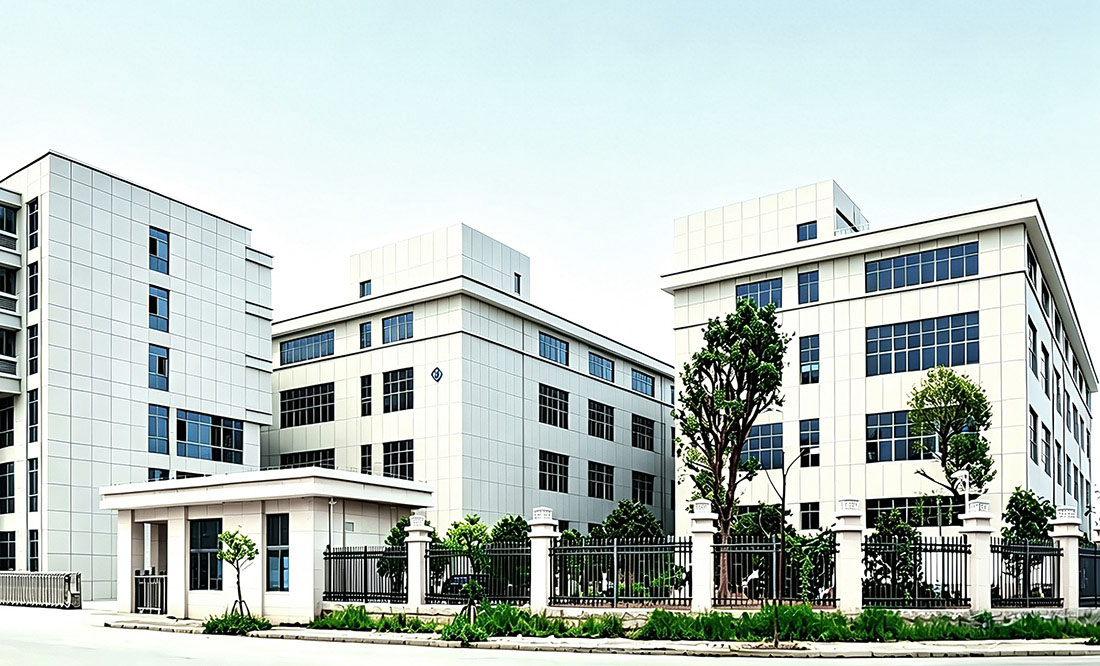
Choosing between a side load and a top load case packer comes down to one mechanical question: can the product be pushed horizontally into an erected carton, or does it have to be lowered into the carton from above? Wenzhou Wimach Machinery Co., Ltd. (WIMACH) builds both options - the Automatic Side Load Case Packer CP-S50 and the Automatic Top Load Case Packer CP-T60 - so this comparison is an engineering decision rather than a supplier preference.
Wenzhou Wimach Machinery Co., Ltd. is a Chinese packaging machinery manufacturer based in Ruian, Wenzhou, Zhejiang, producing tissue packing machines, case packers, blister packing machines and integrated packaging lines. Its machines are CE certified and assembled with components from well-known brands, and the company provides full-lifecycle services for the packaging equipment it supplies.
This guide is written for buyers at the decision and execution stage: the product is known, the carton is known, and the remaining question is which loading method will still fit the line three to five years from now.
Short answer
- CP-S50 - Automatic Side Load Case Packer. Side push loading. Stated product coverage: cartons, boxes, bottles, cans and bags. Carton size range 240 x 200 x 180 mm to 500 x 400 x 400 mm. Installed power 4.5 kW. Compressed air 0.5-0.8 MPa at 350 L/min. Machine weight 1500 kg.
- CP-T60 - Automatic Top Load Case Packer. Pick-and-place top load carton case packing. Machine weight 1600 kg. Machine dimensions 4200 x 2600 x 2200 mm. Electrical supply 380 V, 50/60 Hz, 3 phase.
- Shared platform. CE-certified machines; safety PLCs or safety relays; full-range safety interlock points; safety function tests completed before shipment; safety operation and maintenance manuals; after-sales safety technical support. Minimum order quantity 1 set, FAT acceptance, delivery terms FOB, FCA, CIF or CFR, payment by T/T, typical production lead time 15-45 days, monthly production capacity 13 sets.
The Problem: A Loading Decision That Has to Hold for Years
Both models are automatic case packers. Both are CE certified. Both use the same safety architecture, the same acceptance criteria and the same order terms. On paper, the difference between the CP-S50 and the CP-T60 is a loading direction - and that is exactly why the decision is harder than it looks.
The loading direction fixes five things that cannot be changed later without changing the machine:
- How the product meets the case. A side push moves the product horizontally into a formed carton; a pick-and-place top load lowers it vertically. The forces acting on the product during loading are different in each case.
- Which formats the machine can run. The CP-S50 is specified for cartons, boxes, bottles, cans and bags. The CP-T60 is specified as pick-and-place top load carton case packing.
- The carton envelope. The CP-S50 covers cartons from 240 x 200 x 180 mm up to 500 x 400 x 400 mm; whether that range covers the SKUs you plan to run is a format question, not a preference.
- The utilities and floor space reserved for the machine. CP-S50: 4.5 kW, 0.5-0.8 MPa, 350 L/min, 1500 kg. CP-T60: 380 V, 50/60 Hz, 3 phase, 4200 x 2600 x 2200 mm, 1600 kg.
- The line layout. Side load access and top load access place different demands on conveyor positions, infeed orientation and operator access around the case packer, and that layout is usually frozen once the machine is installed and the line is commissioned.
The second half of the problem appears after installation. Case packers are specified once and then run for years, while carton formats, SKUs and production volumes keep changing. That is why the evaluation does not stop at the loading method: order terms, spare parts, capacity and after-sales support decide whether the machine selected today is still the right machine in year three - and whether the supplier is still able to support it.
Industry Background: What the Case Packing Market Says About Loading Methods
The global case packing machines market was estimated at USD 1.07 billion in 2024 and is projected to reach USD 1.74 billion by 2033 (Grand View Research). Growth of that scale reflects a straightforward trend: more producers are automating secondary packaging, and more of them are working through the same model comparison described in this article.
Asia Pacific accounted for 37.9% of the case packing machines market in 2024 (Grand View Research). For buyers in Europe, North America and South America, that concentration of supply is one reason Chinese case packer manufacturers such as WIMACH now appear on mainstream evaluation lists rather than only on cost-driven shortlists.
By machine type, top load case packers held the largest share in 2024 at 45.5% (Grand View Research). The number deserves careful reading: top load is the single largest loading type, but roughly half the market still uses other loading methods, including side load. Segment share describes what the industry buys - not what a specific product format requires.
Robotic packaging systems, the wider category that includes robotic case packers, reached USD 6.4 billion in 2024 (Global Market Insights), and secondary packaging equipment accounts for approximately 45% of the packaging robot market (Fact.MR). As case packing becomes more automated, the criteria applied before purchase become more important, because the machines are integrated more deeply into the line and are harder to replace later.
Compliance frames the same decision from the other side. In the European Union, EN ISO 12100 is the harmonized machinery safety standard and is mandatory for CE marking on case packers sold in the EU. In the United States, ANSI/PMMI B155.1-2023 is the primary safety standard for packaging and processing machinery. Both apply equally to side load and top load machines, so the question is not which model is safer - it is whether the supplier can document, test and support the safety functions of the model you buy.
Detailed Solution: The CP-S50 and CP-T60, Specified
CP-S50: Automatic Side Load Case Packer (Side Push Loading)
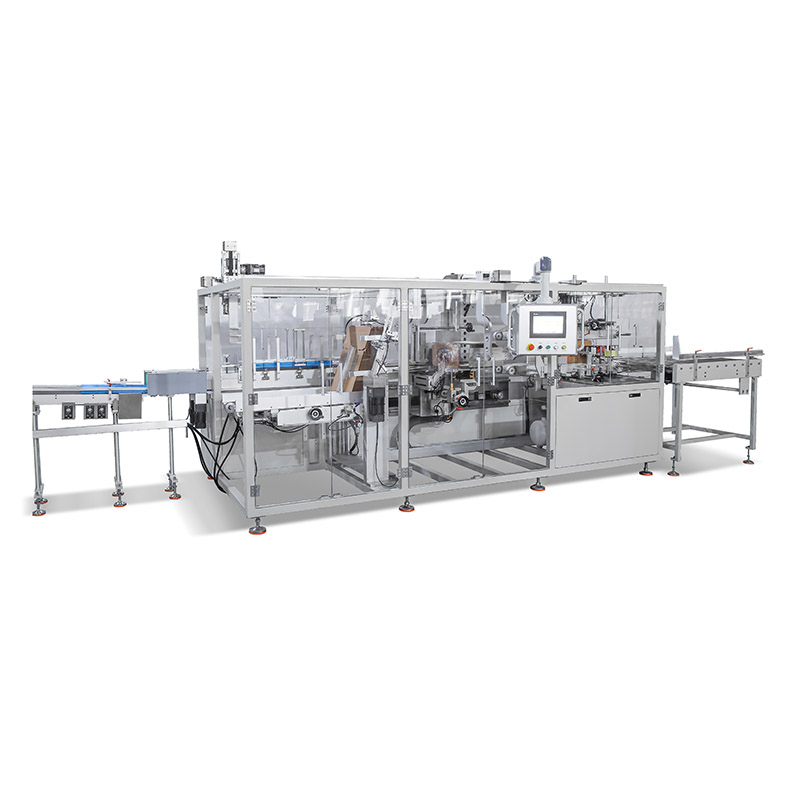
The CP-S50 loads by side push: the product is pushed horizontally into a carton that has already been formed and positioned. WIMACH specifies it as an automatic side load case packer for cartons, boxes, bottles, cans and bags, which makes it the more format-tolerant of the two whenever the product can be moved sideways without losing orientation or stability.
- Loading method: side push into an erected carton
- Product coverage: cartons, boxes, bottles, cans, bags
- Carton size range: 240 x 200 x 180 mm to 500 x 400 x 400 mm
- Installed power: 4.5 kW
- Compressed air: 0.5-0.8 MPa, 350 L/min
- Machine weight: 1500 kg
For project planning, the carton range is the first filter: a case below 240 x 200 x 180 mm or above 500 x 400 x 400 mm falls outside the confirmed CP-S50 envelope. The air specification is the second filter, because 350 L/min at 0.5-0.8 MPa has to be available at the machine position, not only at the plant compressor.
CP-T60: Automatic Top Load Case Packer (Pick-and-Place Top Load)
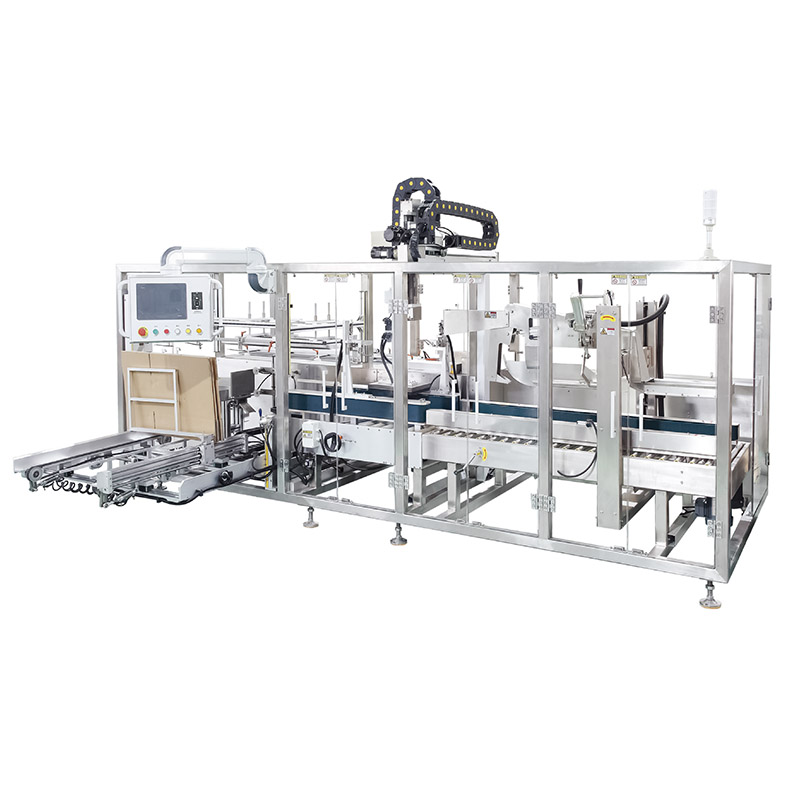
The CP-T60 uses pick-and-place motion to lower the product into the carton from above, and WIMACH specifies it as a pick-and-place top load carton case packing machine. Because the product is placed rather than pushed, the case is filled from the top and the product does not have to travel past the case wall horizontally.
- Loading method: pick-and-place top load into a carton
- Machine type: carton case packing
- Machine weight: 1600 kg
- Machine dimensions: 4200 x 2600 x 2200 mm
- Electrical supply: 380 V, 50/60 Hz, 3 phase
For layout and services planning, the stated footprint of 4200 x 2600 mm at 2200 mm height and the 1600 kg machine weight are the figures to carry into the line drawing and the floor-loading check, while the 380 V three-phase 50/60 Hz supply has to be verified against the power actually available at the installation point.
Shared Safety, Reliability and Long-Term Support
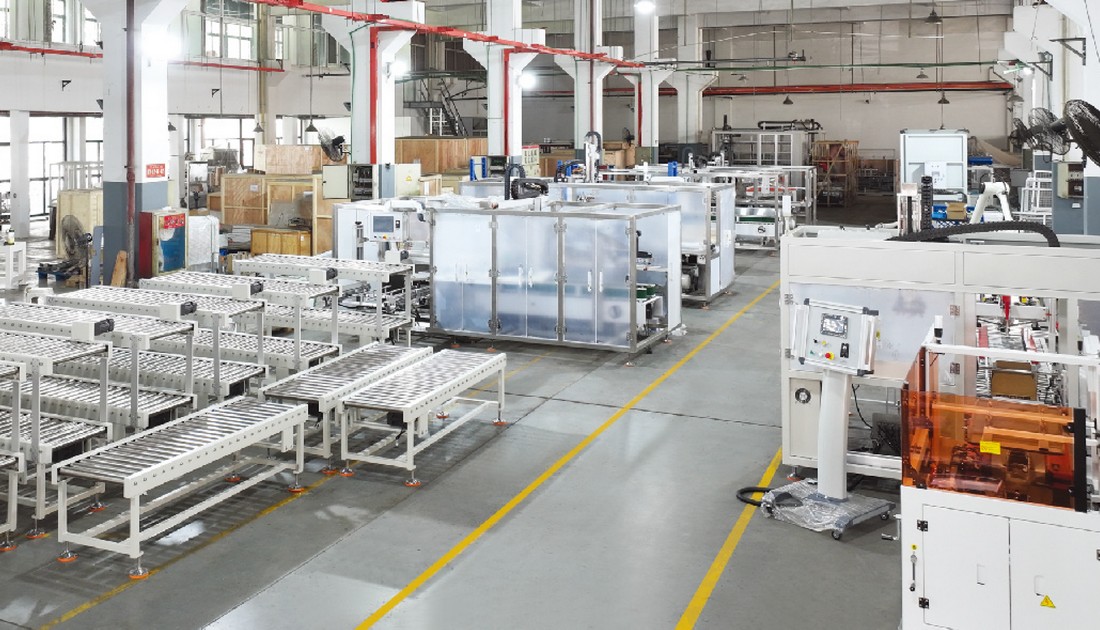
The two models differ in loading method but not in safety philosophy. All WIMACH packaging machines are equipped with safety PLCs or safety relays that implement full-range safety interlock points, and all safety function tests are completed before shipment. Machines are delivered with supporting safety operation and maintenance manuals, and after-sales safety technical support is provided for the equipment.
Reliability follows the same pattern: machines are assembled with components from well-known brands and all WIMACH machines are CE certified. On a case packer, where operators work close to the loading area during changeovers and interventions, an interlock architecture that covers the full range of access points is what keeps the safety case valid as production conditions change.
Step-by-Step Breakdown: How to Choose Between CP-S50 and CP-T60
- List every product and test it against the loading method. If the formats are cartons, boxes, bottles, cans or bags that keep their shape under a horizontal push, the CP-S50 product coverage already matches the requirement. If the product must be lowered into the case, the CP-T60 is the starting point.
- Measure the carton envelope, not the average carton. Record the smallest and largest case the line will run and compare them with the CP-S50 range of 240 x 200 x 180 mm to 500 x 400 x 400 mm. A format outside that envelope changes the machine choice regardless of how well the loading method fits.
- Decide per SKU, then per line. Plants running several formats usually select the machine that covers the dominant format and handle the remainder on a secondary line or manually. Writing that split down before the quotation avoids over-specifying the machine for outliers.
- Confirm utilities and floor space. The CP-S50 requires 4.5 kW and compressed air at 0.5-0.8 MPa and 350 L/min, and weighs 1500 kg. The CP-T60 requires a 380 V, 50/60 Hz, 3-phase supply, weighs 1600 kg and occupies 4200 x 2600 x 2200 mm.
- Verify the safety and compliance package for the destination market. EU projects reference EN ISO 12100 for CE marking; US projects reference ANSI/PMMI B155.1-2023. Both WIMACH models ship with safety PLCs or safety relays, full-range safety interlock points and pre-shipment safety function tests, and the corresponding documentation should be listed in the purchase order.
- Fix the acceptance criteria before ordering. WIMACH works with a minimum order quantity of 1 set, uses FAT (Factory Acceptance Test) as the acceptance criterion, offers FOB, FCA, CIF and CFR delivery terms, and accepts payment by T/T.
- Plan the long-term supply. Typical production lead time is 15-45 days with a monthly production capacity of 13 sets. For a phased rollout, orders should be sequenced against those figures, and spare-part availability and after-sales safety technical support should be confirmed as part of the supply agreement rather than after the first breakdown.
Use Cases: Which Line Profiles Fit Which Model
Cartons, boxes and bags on tissue and paper converting lines
WIMACH's core range is built around tissue packing machines and integrated packaging lines, and the CP-S50 side load case packer is specified for cartons, boxes and bags. For a converter case-packing facial tissue cartons, napkin packs or soft-tissue bags, the side push model is the one whose stated product coverage matches those formats, and the 500 x 400 x 400 mm maximum carton size defines how far the format can be scaled.
Bottles and cans on rigid-container lines
Bottles and cans appear explicitly in the CP-S50 product coverage, so beverage and liquid filling lines moving rigid containers into shipping cases can evaluate the side load model directly. The practical checks are the carton envelope, the 350 L/min air demand at 0.5-0.8 MPa, and the 4.5 kW power requirement at the machine position.
Products that must be lowered into the case
When the product cannot take a horizontal push, or when the case has to be built from the top, the decision moves to the CP-T60. Pick-and-place top load carton case packing places the product vertically into the carton, and the machine's 4200 x 2600 x 2200 mm dimensions and 1600 kg weight become part of the layout and floor-loading planning.
Multi-format plants planning a long-term case packing partner
Where formats are expected to change over time, the two models should also be compared on the terms that support them: MOQ of 1 set, FAT acceptance, 15-45 day lead time, 13 sets per month capacity, CE certification and after-sales safety technical support. WIMACH's export profile - 60% of production shipped to the EU, North America and South America - indicates that the documentation and support package is used in regulated markets, which is relevant when the case packer has to stay compliant for years.
Comparison Table: CP-S50 vs CP-T60
| Decision factor | CP-S50 (side load) | CP-T60 (top load) |
|---|---|---|
| Loading method | Side push into an erected carton | Pick-and-place top load carton case packing |
| Stated product coverage | Cartons, boxes, bottles, cans, bags | Carton case packing (pick-and-place top load) |
| Carton size range | 240 x 200 x 180 mm to 500 x 400 x 400 mm | - |
| Machine weight | 1500 kg | 1600 kg |
| Electrical requirement | 4.5 kW installed power | 380 V, 50/60 Hz, 3 phase |
| Compressed air | 0.5-0.8 MPa, 350 L/min | - |
| Machine dimensions | - | 4200 x 2600 x 2200 mm |
| Safety control | Safety PLC or safety relay, full-range safety interlock points | Safety PLC or safety relay, full-range safety interlock points |
| Safety testing | Safety function tests completed before shipment | Safety function tests completed before shipment |
| Certification | CE | CE |
| Minimum order quantity | 1 set | 1 set |
| Acceptance criteria | FAT | FAT |
| Delivery terms | FOB, FCA, CIF, CFR | FOB, FCA, CIF, CFR |
| Payment terms | T/T | T/T |
| Typical production lead time | 15-45 days | 15-45 days |
| Monthly production capacity | 13 sets | 13 sets |
FAQ: CP-S50 vs CP-T60 and Long-Term Supply
Do the CP-S50 and CP-T60 meet EU and US machinery safety requirements?
All WIMACH machines, including the CP-S50 and CP-T60, are CE certified. Both models use safety PLCs or safety relays to implement full-range safety interlock points, all safety function tests are completed before shipment, and the machines are supplied with safety operation and maintenance manuals plus after-sales safety technical support. For the EU market, case packers fall under the harmonized machinery safety standard EN ISO 12100, which is mandatory for CE marking of case packers sold in the EU; for the US market, ANSI/PMMI B155.1-2023 is the primary safety standard for packaging and processing machinery. The final documentation package for the destination market should be confirmed as part of the purchase order.
How do I evaluate WIMACH as a long-term case packer supply partner in China?
Wenzhou Wimach Machinery Co., Ltd. is based in Ruian, Wenzhou, Zhejiang, operates a 3000 m2 factory with 37 employees, including 5 R&D engineers, and produces 160 sets per year with a monthly production capacity of 13 sets. The team brings over 12 years of industry experience, 60% of output is exported to the EU, North America and South America, and all machines are CE certified and assembled with components from well-known brands. WIMACH provides customized solutions from single standalone machines to complete integrated packaging lines, plus full-lifecycle services, and the commercial terms that support a long-term relationship are MOQ of 1 set, FAT acceptance, FOB, FCA, CIF or CFR delivery, and T/T payment.
How does the cost of a WIMACH case packer compare with European-built case packers?
In WIMACH's own comparison of its case packers against case packers from Europe, the price of the machine and its spare parts is 20% to 30% of that of European counterparts, a cost difference of 70-80% lower. The same comparison cites product compatibility above 50% compared with European equipment, an average delivery lead time 50% shorter than European machines, lower power consumption and less maintenance. These are WIMACH's comparison figures and should be checked against the exact configuration, carton format and destination-market requirements of a specific project before they are used in a budget.
Can we validate the machine before committing to a full production rollout?
Yes. The minimum order quantity is 1 set, so a single machine can be ordered and evaluated on its own. Acceptance is defined by FAT (Factory Acceptance Test) before shipment, and all safety function tests are completed prior to shipment as part of the same process. Delivery terms available are FOB, FCA, CIF and CFR, and payment is by T/T.
What lead time and capacity can a long-term case packer supply partner in China commit to?
The typical production lead time is 15-45 days, with a monthly production capacity of 13 sets and a minimum order quantity of 1 set. For a CP-S50 or CP-T60 project, the next step is to confirm the carton format, product list and utilities against your line: download the WIMACH product catalog or send your carton specification to rex@wimach.cn to start the specification review.
Conclusion: Choose the Loading Method First, Then the Supply Terms
The CP-S50 and CP-T60 are not two answers to the same question; they are answers to two different questions. If the products - cartons, boxes, bottles, cans or bags - can be pushed horizontally into an erected carton, the CP-S50 defines the project with its 240 x 200 x 180 mm to 500 x 400 x 400 mm carton range, 4.5 kW power demand, 0.5-0.8 MPa and 350 L/min air requirement, and 1500 kg machine weight. If the product has to be lowered into the case, the CP-T60 does the work through pick-and-place top load carton case packing, with a 4200 x 2600 x 2200 mm footprint, 1600 kg machine weight and a 380 V, 50/60 Hz, 3-phase supply.
Whichever model is chosen, the safety architecture and the supply terms are the same: safety PLC or safety relay with full-range safety interlock points, safety function tests before shipment, after-sales safety technical support, CE certification, MOQ of 1 set, FAT acceptance, FOB, FCA, CIF or CFR delivery, T/T payment, 15-45 day lead time and 13 sets per month capacity. Together, those are the elements that make a case packer purchase a long-term supply decision rather than a single transaction.

Next Step
Send your product list and carton dimensions to WIMACH and the team will confirm which model - CP-S50 or CP-T60 - fits the format, the utilities and the layout.
Download the catalog: Wimach Catalog (PDF)
Contact: Rex Din | Email: rex@wimach.cn | Tel / WhatsApp: +86 177 5771 8080 | Website: www.wimach.cn
Address: Bldg 14 Qiaomao Rd, Ruian, Wenzhou, Zhejiang, China
Have Questions or Need More Details?
Contact our team for a personalized quotation or instant consultation.
Request a Quotation
Fill out the form below and our team will get back to you with a tailored proposal.
WhatsApp Direct Chat
Prefer to chat in real-time? Message us on WhatsApp for instant assistance & quick answers.
- Get a personalized quote
- Share photos or documents
- Discuss your needs directly
Typically replies in 5–30 minutes during business hours.