
Case Packer Trends in 2026: How to Evaluate Top Manufacturers
Case Packer Trends in 2026: How to Evaluate Top Manufacturers
The global case packing machine market is on a clear growth path. Buyers searching for “top case packer manufacturers China” need more than a name list — they need a repeatable evaluation framework built on market data, machine capabilities, compliance evidence, and real installation records.
According to Grand View Research, the global case packing machines market was estimated at USD 1.07 billion in 2024 and is projected to reach USD 1.74 billion by 2033. In the same period, Asia Pacific held a dominant 37.9% share of the industry. That is why China-based machinery suppliers remain central to most procurement shortlists, whether the buyer is located in the EU, North America, or Latin America.
This guide connects 2026 market trends with a practical set of manufacturer evaluation criteria. It uses verifiable industry data and first-party facts from Wenzhou Wimach Machinery Co., Ltd. — a Chinese manufacturer of tissue packing machines and integrated packaging lines, with primary export markets in the EU, North America, and South America. WIMACH’s portfolio includes side load and top load case packers, tissue cartoning machines, roll wrapping machines, and complete turnkey packaging lines.
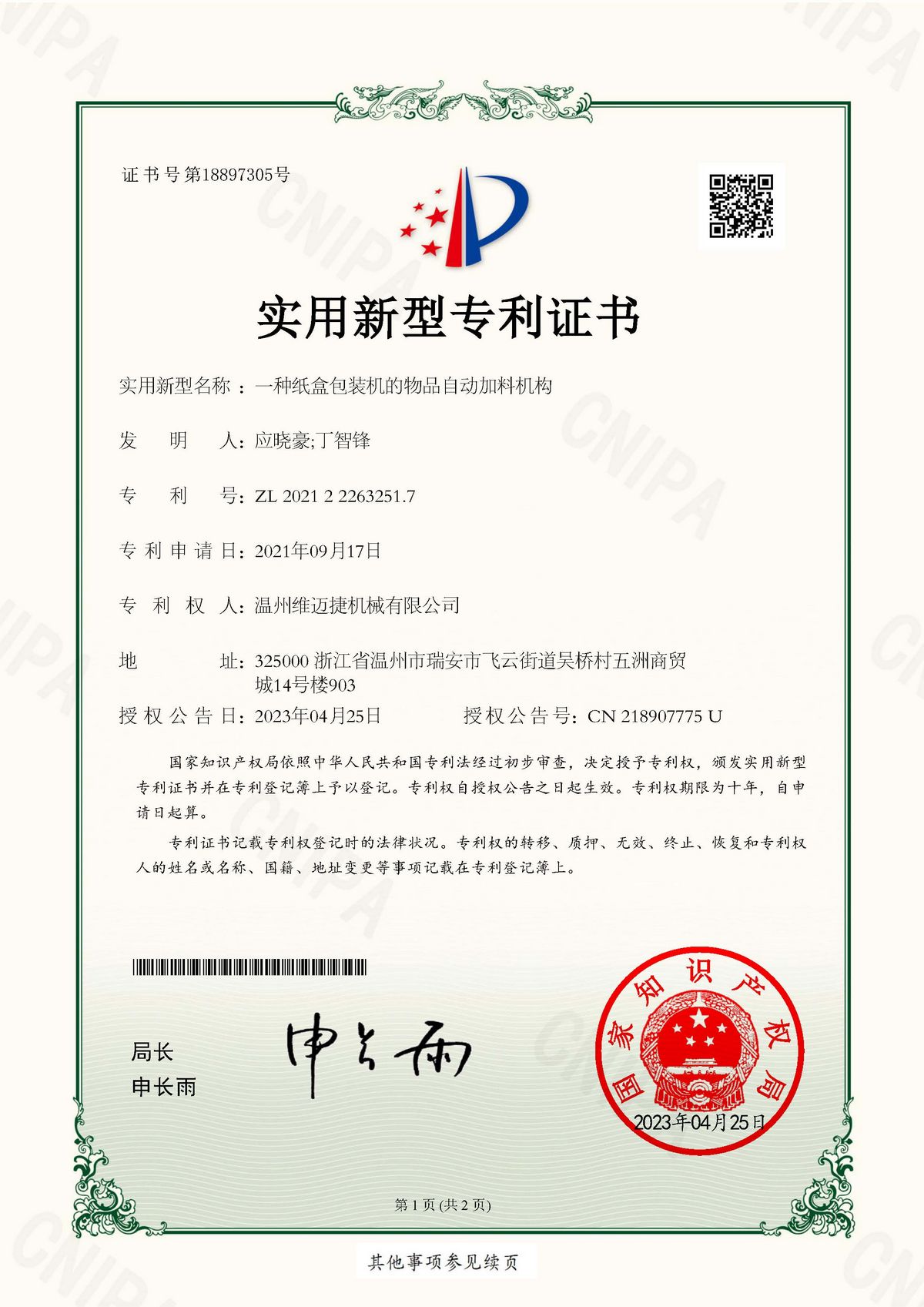
Utility model patent certificate — evidence of proprietary machine design, not just assembly capability.
Why Case Packer Evaluation Has Become More Difficult
Case packers are classified by loading method — pick and place, side load, side push, drop type, robotic, and top load — and each configuration changes how products move from the production line into a shipping carton. The same brand can supply machines with very different throughput, carton size ranges, and floor plan requirements.
Three factors make comparison harder today than it was five years ago:
- Wider machine types. A side load case packer fits flat or rectangular products well; a top load or pick and place case packer handles canisters, bottles, and irregular shapes more gently. Robotic case packers add flexibility but also require stronger integration experience.
- Stricter compliance expectations. Buyers in the EU and North America increasingly treat machinery safety standards as baseline requirements, not optional extras.
- Line-level thinking. A case packer is rarely the only machine being purchased. It must coordinate with wrapping machines, palletizers, strappers, and stretch wrappers. Evaluating a single machine without checking line-level integration creates hidden project risk.
The result is that procurement teams cannot evaluate case packer manufacturers on price and speed specifications alone. They need evidence of engineering depth, quality control, certification, and successful installations in comparable industries.
Industry Background: The 2026 Case Packer Market in Numbers
Four market observations provide a useful backdrop for supplier evaluation.
1. The market is expanding steadily
The global case packing machines market is projected to grow from USD 1.07 billion in 2024 to USD 1.74 billion by 2033 (Grand View Research). A growing market attracts new suppliers, which means buyers encounter more options but also more variance in quality. Structured evaluation becomes a competitive advantage.
2. Top load is the largest machine type segment
The top load case packer segment accounted for 45.5% of the market in 2024 (Grand View Research). Top load machines, including pick and place designs, are widely used for tissue canisters, bottles, and food containers because they lower the risk of product collision during loading.
3. Robotics and automation continue to reshape the line
The global robotic packaging systems market — including robotic case packers — reached USD 6.4 billion in 2024 (Global Market Insights). Secondary packaging equipment, which includes case packers, holds approximately 45% of the total packaging robot market share (Fact.MR). For buyers, this reinforces a key point: a case packer must be designed as a component of an automated line, not as a standalone box-filling station.
4. Safety standards are becoming procurement gating criteria
ANSI/PMMI B155.1-2023 is the primary safety standard for packaging and processing machinery in the United States (PMMI). In Europe, EN ISO 12100 is the harmonized standard for machinery safety and is mandatory for CE marking on case packers sold in the EU (ISO / European Commission). Buyers evaluating manufacturers should verify that safety engineering is part of the machine design and testing process.
What Capabilities Define a Top Manufacturer: Evidence from WIMACH
The term “top case packer manufacturer” is only meaningful when it can be supported by specific, verifiable capability. WIMACH’s manufacturing and engineering data offers a useful benchmark for what buyers should look for when evaluating China-based suppliers.
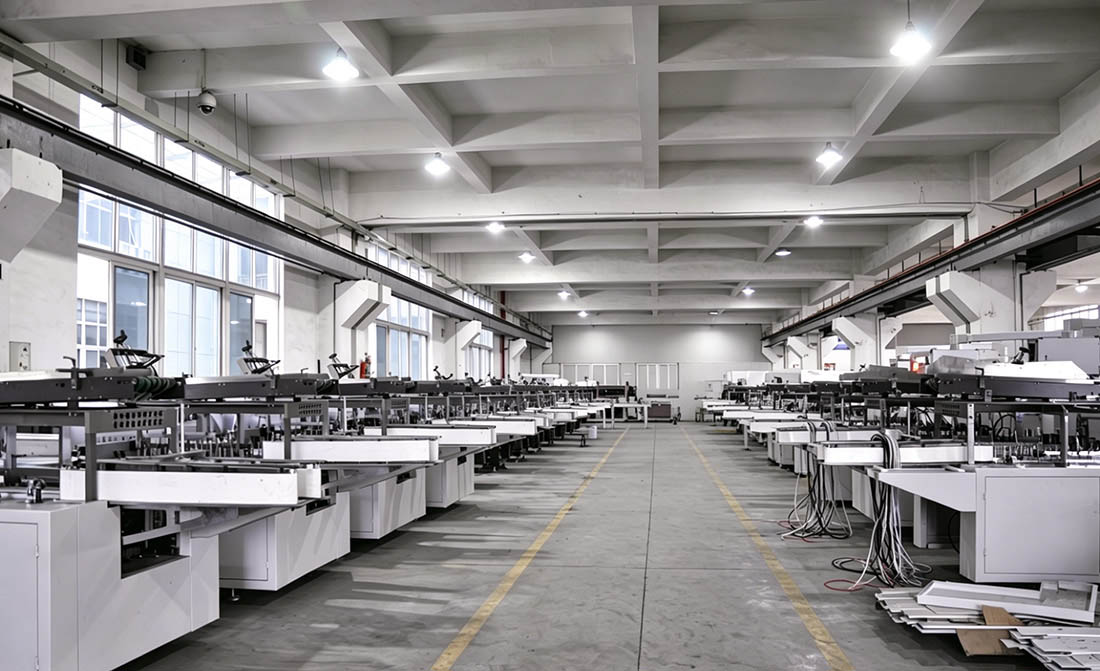
Manufacturing workshop — factory floor conditions, assembly depth, and quality control are part of the evaluation evidence.
Engineering and Customization Depth
WIMACH operates a 3,000 m² factory with 37 employees and a dedicated research and engineering team of 5 engineers. The company reports an annual output of 160 sets, which supports a monthly capacity of 13 sets with a minimum order quantity of 1 set.
Customization options cover packaging dimensions, machine configuration, voltage, and logo. Two production modes are available: Customized Machinery Service and OEM/ODM. Lead time is 30 to 45 days for customized machinery and 15 to 45 days for OEM/ODM projects. For a buyer, this level of stated flexibility matters because product dimensions and line layouts differ between factories.
Quality Control as a Defined Process
A top manufacturer should be able to describe its quality control process in concrete terms. WIMACH’s documented checks include no-load and load running tests, dimensional tolerance inspection, mechanical assembly checks, pneumatic leakage tests, electrical safety tests, PLC control logic tests, safety interlock and E-stop tests, long-time aging tests, and surface appearance inspection.
These are not marketing claims. They are operational steps that can be audited during a factory visit or pre-shipment inspection.
Certification and Intellectual Property
Certification is another measurable layer. WIMACH states that all of its machines are CE certified and assembled with components from well-known brands. The company also holds patents granted by the National Intellectual Property Administration, PRC:
- Invention Patent Certificate ZL 2022 1 1099886.8, covering a carton packing machine and carton packaging process.
- Utility Model Patent Certificate ZL 2022 2 1202677.7, covering an automatic feeding mechanism for a carton packaging machine.
- Utility Model Patent Certificate for a box forming mechanism for a carton packaging machine.
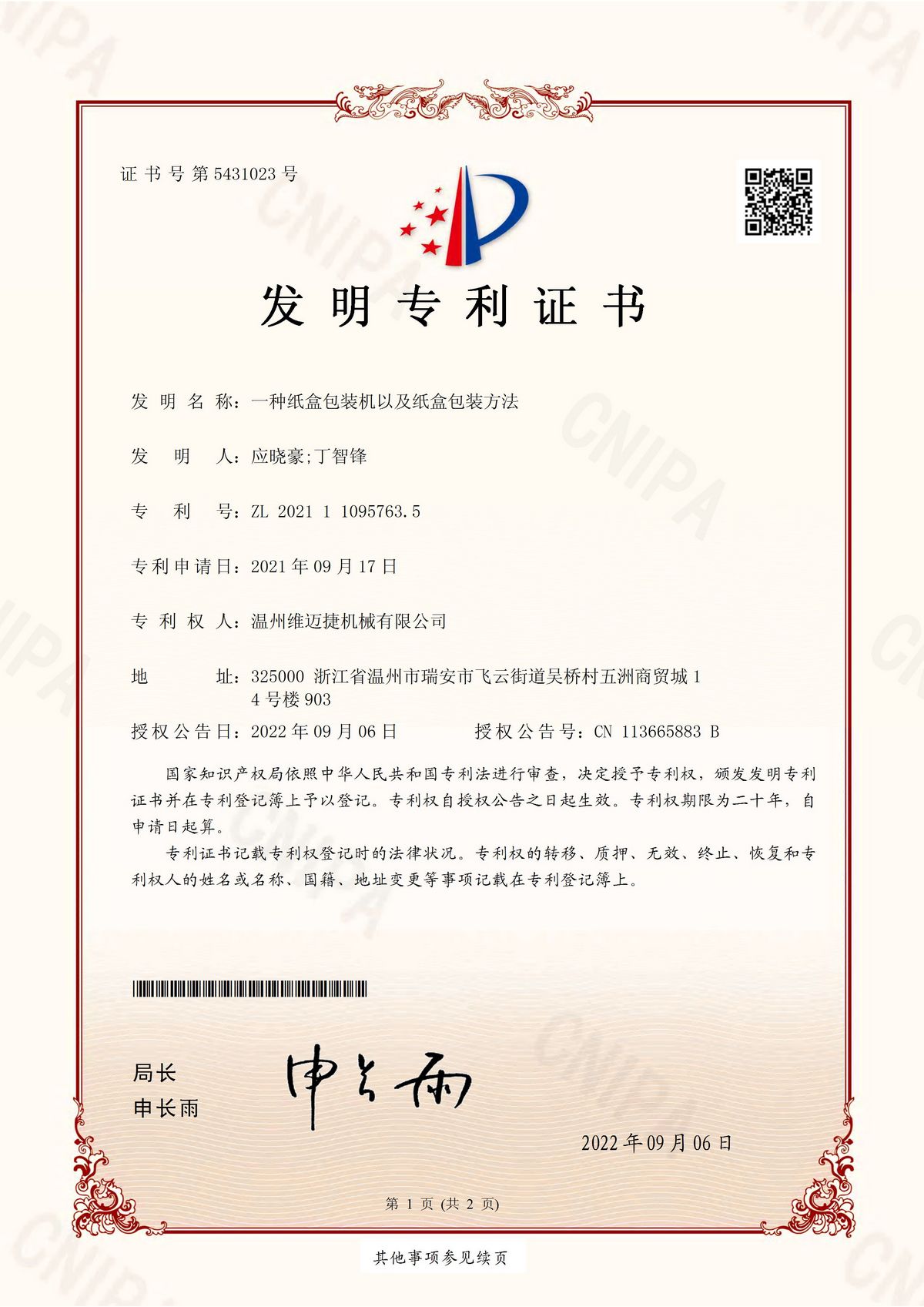
Invention patent certificate — a verifiable indicator that the manufacturer develops mechanisms internally.
After-Sales and Lifecycle Support
Long-term performance depends on lifecycle support. WIMACH’s stated after-sales service includes installation and commissioning, training, warranty service, remote technical support, lifetime after-warranty support, and upgrade and retrofit service. Buyers evaluating manufacturers should confirm which of these services are included in the quotation and how remote support is delivered.
A Step-by-Step Framework for Evaluating Case Packer Manufacturers
Use this seven-step process when you compare manufacturers in China or any other region.
Step 1: Define the Product and Packaging Profile
Document product dimensions, weight, target carton size, line speed, and loading pattern. A canister or bottle may be best handled by a top load or pick and place case packer. Flat products such as tissue boxes or wrapped rolls may suit a side push or side load case packer. The machine cannot be evaluated before the packaging profile is fixed.
Step 2: Verify Compliance and Certification
Confirm which safety standards apply to your destination market. For the EU, verify CE marking and alignment with EN ISO 12100. For the United States, review ANSI/PMMI B155.1-2023 requirements. Ask the manufacturer for the CE declaration and any patents or certificates that demonstrate technical ownership.
Step 3: Audit Manufacturing and Quality Control
Request a description of the factory quality control process. Look for evidence of running tests, mechanical assembly checks, electrical safety testing, and aging tests. If possible, schedule a video walkthrough or a factory visit before purchase.
Step 4: Test Customization Flexibility
Your carton dimensions and voltage requirements may not match a standard model. Ask the manufacturer which parameters can be modified. In WIMACH’s case, packaging dimensions, machine configuration, voltage, and logo can be customized with a MOQ of 1 set. This kind of flexibility removes the need to redesign your packaging around the machine.
Step 5: Assess Production Capacity and Lead Time
Production capacity affects delivery reliability. WIMACH’s monthly capacity is 13 sets, with lead times of 30 to 45 days for customized machinery and 15 to 45 days for OEM/ODM. Compare these numbers with your project schedule and verify them in writing.
Step 6: Request Application Proof
Reference installations are the strongest evidence of capability. Ask for cases that match your product type, industry, and market region. A manufacturer that has already integrated its case packer into a complete line for a similar customer will reduce your commissioning risk.
Step 7: Compare Total Lifecycle Cost, Not Just Machine Price
Include maintenance, spare parts, training, and downtime risk in the comparison. A machine with lower energy consumption, lower air consumption, and longer service life can be more economical even when the initial price is higher.
- Certification documents (CE, patents, standards alignment)
- Customization scope (dimensions, voltage, configuration, logo)
- Quality control process with documented tests
- Production capacity and confirmed lead time
- Reference installations in similar product categories
- After-sales service and spare parts commitment
Real Installation Cases: What the Evidence Shows
Application cases translate capability claims into verifiable results. The following WIMACH installations are documented with product type, equipment quantity, and outcome.
Tissue Canister Case Packer — United States
A tissue paper manufacturer in the United States uses a WIMACH automatic top load case packer to load tissue canisters into cartons. The installation consists of 1 set of the CP-T60 automatic top load case packer and has been in operation for 5 years. The machine replaced manual box filling, improved production efficiency, reduced labor costs, and standardized packing procedures. It also reduced the risk of product collision and deformation during transport.
Canister Wet Wipe Turnkey Line — Mexico
A tissue paper manufacturer in Mexico installed a turnkey automated packaging line with 9 sets of equipment for canister wet disinfecting wipes. The line covers automatic feeding of empty canisters, inserting wipes, quantitative disinfectant filling, heat sealing, cap tightening, labeling, case packing, palletizing, strapping, and stretch wrapping. The project, completed to fully finished, labeled, cased, and palletized product output, demonstrates how a case packer must function as part of a larger automated workflow.
Toilet Paper End-of-Line Packaging — United States
A packaging line for toilet paper rolls in the United States includes 6 sets of equipment for wrapping, case packing, palletizing, and stretch wrapping. The completed line produces dustproof, moisture-resistant pallet loads ready for transport. For the buyer, the key benefit is a stable end-of-line process that matches the high output of the roll wrapping machine.
Facial Tissue and Cream Tissue Line — Poland
A complete packaging line in Poland integrates 12 sets of equipment for facial tissue and cream tissue. The line handles conveying, automatic cartoning, case packing, pallet feeding, robotic palletizing, strapping, and stretch wrapping. The final output is full pallets of shipping cases that are stable, dustproof, and moisture-proof. This installation shows the evaluation principle in action: the case packer type must match the product format and the line’s overall speed.
Comparing Case Packer Types: Top Load vs. Side Load
The comparison table below uses WIMACH’s actual machine specifications to show how machine type affects real purchasing decisions. Both machines are valid options; the right choice depends on the product and line configuration.
| Parameter | Automatic Top Load Case Packer (CP-T60) | Automatic Side Load Case Packer (CP-S50) |
|---|---|---|
| Machine type | Pick-and-Place / Top Load | Side Load / Side Push |
| Packing capacity | 1–8 cartons/min | 1–16 cartons/min |
| Carton dimension (L×W×H) | 300–600 × 200–400 × 150–400 mm | 240–500 × 200–400 × 180–400 mm |
| Power consumption | 7.5 kW | 4.5 kW |
| Air consumption | 450 L/min | 350 L/min |
| Overall dimensions | 4200 × 2600 × 2200 mm | 4200 × 2300 × 1900 mm |
| Machine weight | 1600 kg | 1500 kg |
| Material | Stainless steel / carbon steel | Stainless steel / carbon steel |
| Applicable industries | Tissue, food & beverage, pharmaceutical, daily chemical, hardware, auto parts & machinery | Tissue, food & beverage, pharmaceutical, daily chemical, hardware, auto parts & machinery |
Products that are heavy, unstable, or sensitive to impact are generally better suited to a top load or pick and place case packer. Products that are flat, uniform, and pushed easily into an open carton side are often packed faster on a side load case packer. The CP-S50’s higher maximum speed of 16 cartons per minute illustrates why flat product manufacturers favor side load designs.
Frequently Asked Questions
What compliance documentation should a top case packer manufacturer in China provide?
Buyers should request the CE declaration, patent certificates, component brand information, and a description of the safety testing process. For the EU, EN ISO 12100 compliance is mandatory for CE marking on case packers. For the US market, ANSI/PMMI B155.1-2023 is the primary packaging machinery safety standard to review. WIMACH’s quality control process includes electrical safety tests, safety interlock and E-stop tests, and long-time aging tests, which provide tangible evidence of safety-conscious manufacturing.
What engineering and customization capabilities should I evaluate when comparing case packer makers in China?
Evaluate the size of the engineering team, the range of customization options, and the manufacturer’s ability to integrate a case packer into a complete line. WIMACH has a dedicated engineering team of 5 engineers and offers customization of packaging dimensions, machine configuration, voltage, and logo. Its documented quality control process covers nine inspection steps, including PLC control logic testing and long-time aging tests. The company also holds invention and utility model patents for carton packing machine mechanisms, indicating in-house design capability rather than simple assembly.
Are case packers from Chinese manufacturers a more cost-effective option than European machines?
WIMACH’s project records consistently list cost-effectiveness as a project highlight alongside CE compliance, full automation, and low maintenance cost. General comparisons between Chinese and European machinery depend heavily on specification level, automation content, and after-sales service scope. A reliable cost comparison should be based on a detailed quotation that includes the case packer type, carton size range, speed requirement, integration work, and logistics terms.
What proof can a case packer manufacturer show before purchase?
Reference installations are the most direct proof. Documented WIMACH installations include a US tissue canister line using the CP-T60 top load case packer, a 9-set turnkey wet wipe line in Mexico, a 6-set toilet paper end-of-line packaging system in the United States, and a 12-set facial tissue packaging line in Poland. Each case provides evidence of the machine’s role in a real production environment and the results achieved, such as standardized packing, reduced labor cost, and palletized output ready for shipment.
What lead time should I expect from a China-based case packer manufacturer?
WIMACH’s standard lead time is 30 to 45 days for customized machinery and 15 to 45 days for OEM/ODM projects, with a minimum order quantity of 1 set. Monthly production capacity is 13 sets. The final lead time depends on the machine type, customization depth, and current production load. Buyers should request a written lead time commitment during quotation review. For a project-specific delivery schedule and quotation, contact WIMACH directly at rex@wimach.cn or +86 177 5771 8080.
Conclusion
The case packing machine market in 2026 rewards buyers who evaluate with evidence rather than assumptions. Market growth in the Asia Pacific region makes China-based manufacturers an increasingly significant part of the global supply base, and the same growth attracts suppliers with very different capability levels. A reliable evaluation framework must cover machine type fit, compliance, customization depth, quality control process, delivery capability, and verified installation records.
WIMACH provides a useful reference point for this kind of evaluation. The company’s documented engineering team, 13-set monthly capacity, 15 to 45 day lead times, nine-step quality control process, CE certification, and patent portfolio make its capabilities measurable. Its installations in the United States, Mexico, and Poland demonstrate that case packers are evaluated correctly only when seen as part of a complete packaging line.

WIMACH machinery company — the manufacturer behind the documented case packer installations.
Before you finalize a supplier shortlist, check whether each manufacturer can answer the same questions: What is your certification evidence? What quality control steps are documented? Can you customize dimensions and voltage? What similar projects have you completed? And what lead time can you commit to?
Build your shortlist around verifiable capability.
Download the WIMACH catalog to review machine specifications, line solutions, and contact details.
Email: rex@wimach.cn | Tel / WhatsApp: +86 177 5771 8080
Wenzhou Wimach Machinery Co., Ltd., Bldg 14 Qiaomao Rd, Ruian, Wenzhou, Zhejiang, China
Have Questions or Need More Details?
Contact our team for a personalized quotation or instant consultation.
Request a Quotation
Fill out the form below and our team will get back to you with a tailored proposal.
WhatsApp Direct Chat
Prefer to chat in real-time? Message us on WhatsApp for instant assistance & quick answers.
- Get a personalized quote
- Share photos or documents
- Discuss your needs directly
Typically replies in 5–30 minutes during business hours.