
Case Packer for Food Lines: A Project-Fit Guide to Automatic Case Packers
Case Packer for Food Lines: How to Match Automatic Case Packers to Real Projects
Last updated: August 28, 2026
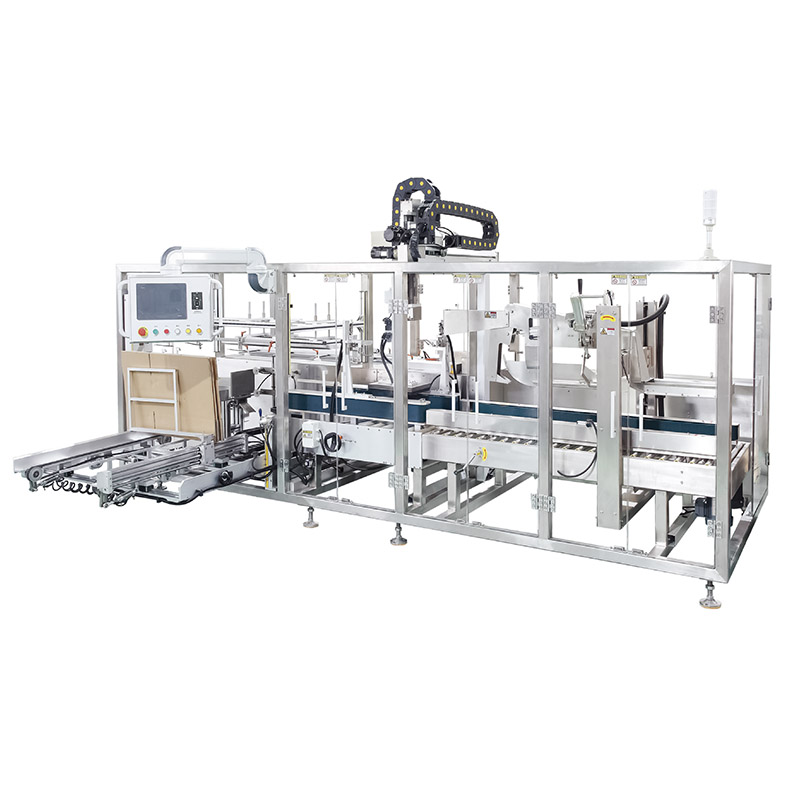
Pick-and-place top load case packer used in automatic case packing and end-of-line packaging projects.
A case packer automatically loads finished products into shipping cases or cartons. Choosing one for a food production line is not only about machine reputation. It is about project fit: product dimensions, packing speed, carton range, floor space, utilities, and the equipment upstream and downstream of the packer. This article explains how to make that match, using Wenzhou Wimach Machinery Co., Ltd. (WIMACH) and its automatic case packer range as reference points.
Wenzhou Wimach Machinery Co., Ltd. is a packaging machinery manufacturer based in Wenzhou, China. It supplies machines under the WIMACH brand, including automatic case packers, tissue packing machines, and integrated packaging lines. The company states that it has more than 12 years of industry experience and that all its machines are CE certified.
If you are evaluating a case packer for a food, beverage, tissue, or related packaging project, the sections below cover common decision problems, market context, two automatic case packer designs, real project examples, and a comparison table to use during supplier discussions.
The real problem: a case packer must fit the line, the product, and the plant
Many packaging line delays are not caused by the case packer alone. They are caused by mismatches at the interface between the case packer and the rest of the line. Upstream machines may output products faster than the packer can load. The case design may require a pattern that the loading mechanism cannot form. The line layout may allow only side access or only top access. The available power or air supply may not match the machine specification.
Common mismatches in project evaluations include:
- Speed mismatch. A line may be described as high speed in products per minute, but the case packer is rated in cartons per minute. Convert both values before comparing.
- Carton range mismatch. The supplier's case packer may not cover the actual carton length, width, or height used by the project.
- Loading direction mismatch. Side load case packers push products into the side of a case; top load case packers place products from above. The wrong loading method can damage products or slow the line.
- Integration mismatch. A standalone case packer may work, but an integrated line requires conveyors, sensors, and control logic to connect upstream wrapping machines and downstream palletizers.
- Utility mismatch. Power voltage, air pressure, air consumption, machine footprint, and machine weight must fit the plant.
Starting with these constraints reduces the risk of choosing a case packer that works in a catalog but fails on the factory floor.
Case packing market context in 2026
The global case packing machines market was estimated at USD 1.07 billion in 2024 and is projected to reach USD 1.74 billion by 2033, according to Grand View Research. Top load case packers accounted for the largest machine type share at 45.5% in 2024. Asia Pacific dominated the market with a 37.9% share in 2024.
Robotic packaging systems, including robotic case packers, reached USD 6.4 billion in 2024, according to Global Market Insights. Secondary packaging equipment, which includes case packers, holds approximately 45% of the total packaging robot market share based on Fact.MR data. These figures help explain why automatic case packer choices are often evaluated as part of a broader end-of-line strategy.
Safety standards are also part of the evaluation. ANSI/PMMI B155.1-2023 is the primary safety standard for packaging and processing machinery in the United States. EN ISO 12100 is the harmonized European standard for machinery safety and is relevant to CE marking on case packers sold in the EU.
Two automatic case packer designs to compare for food lines
WIMACH offers two automatic case packer models relevant to food and beverage packaging projects: the CP-S50 side load / side push case packer and the CP-T60 pick-and-place / top load case packer. Both list Food and Beverage Industry among their applicable industries, together with tissue, pharmaceutical, daily chemical, cosmetic, hardware, auto parts, and machinery. The final choice should come from project-level comparison rather than model availability alone.
Side load / side push case packer: CP-S50
The CP-S50 loads products into cases from the side. This layout can suit stable products that tolerate horizontal pushing and lines where products can be collated before entering the case. The machine has a packing capacity of 1-16 cartons/min and accepts carton dimensions of 240-500 mm length, 200-400 mm width, and 180-400 mm height. Power consumption is 4.5 kW at 380V 50/60Hz 3 phase. Air pressure requirement is 0.5-0.8 MPa and air consumption is 350 L/min. Overall dimensions are 4200 x 2300 x 1900 mm, and machine weight is 1500 kg. Material options are stainless steel or carbon steel.
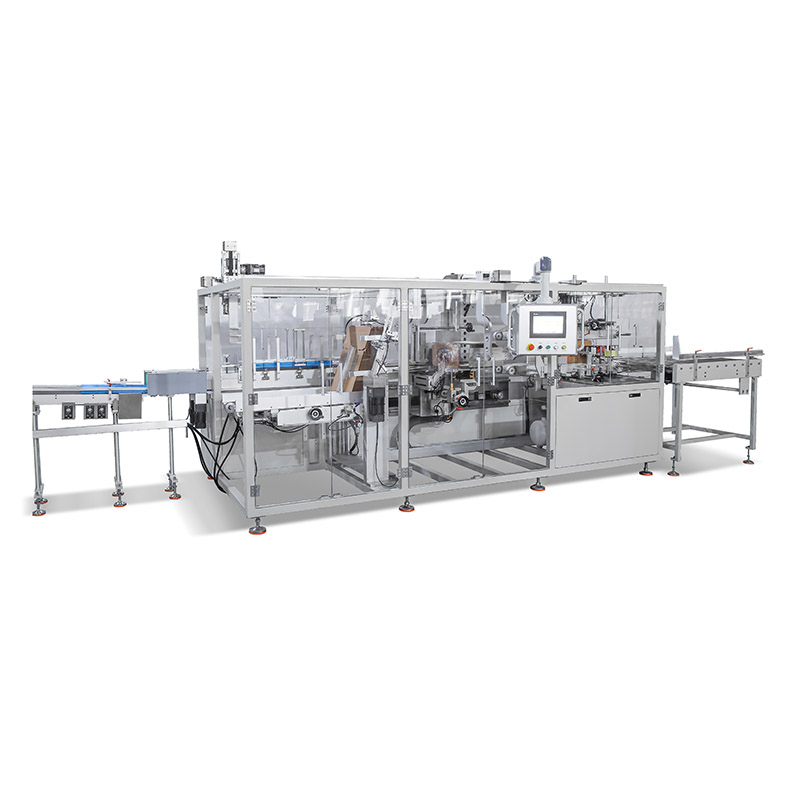
Side push case packer, a side load configuration used for automatic carton packing.
Pick-and-place / top load case packer: CP-T60
The CP-T60 picks products and places them into cases from above. This approach is often considered when products are fragile, irregular, or arranged in layers inside the case. The machine runs at 1-8 cartons/min and accepts carton dimensions of 300-600 mm length, 200-400 mm width, and 150-400 mm height. Power consumption is 7.5 kW at 380V 50/60Hz 3 phase. Air pressure requirement is 0.5-0.8 MPa and air consumption is 450 L/min. Overall dimensions are 4200 x 2600 x 2200 mm, and machine weight is 1600 kg. Material options are stainless steel or carbon steel.
Project fit rule: Choose side load / side push when the product group is stable and can be pushed into the case from the side. Choose pick-and-place / top load when the product needs to be lifted and placed into the case from above, or when case layout and layer patterns are important.
Customization, integration, and quality checks
WIMACH provides customized machinery service with a monthly capacity of 13 sets and a lead time of 30-45 days for custom machines; OEM/ODM lead time is 15-45 days. The MOQ is 1 set. Customization can cover packaging dimensions, machine configuration, voltage, and logo.
Quality control at WIMACH includes no-load and load running tests, dimensional tolerance inspection, mechanical assembly check, pneumatic leakage test, electrical safety test, PLC control logic test, safety interlock and E-stop test, long-time aging test, and surface appearance inspection. After-sales support includes installation and commissioning, training, warranty service, remote technical support, lifetime after-warranty support, and upgrade and retrofit service.
Company background also matters. WIMACH operates a 3000 m² factory with 37 employees, including 5 R&D engineers, and an annual output of 160 sets. Around 60% of output is exported to the EU, North America, and South America.
How to evaluate a case packer for a food line: step-by-step
Use this sequence during project evaluation. It moves from product details to integration planning, then to supplier validation.
- Define the product unit. Record dimensions, weight, packaging type, and fragility. A tissue canister, a wrapped roll, and a box of facial tissue each behave differently in a case packer.
- Calculate target line speed. Use upstream capacity in products/min, then convert to cartons/min based on the pack pattern. If the line produces 60 canisters/min and each case holds 10 canisters, the case packer must handle about 6 cases/min. The CP-T60 handles 1-8 cartons/min; the CP-S50 handles 1-16 cartons/min. Some buyers ask for a high speed case packer. The useful measure is cartons per minute at the required pack pattern.
- Match carton dimensions. The case packer carton range must include the actual case sizes. The CP-S50 accepts lengths of 240-500 mm; the CP-T60 accepts lengths of 300-600 mm. Both accept widths of 200-400 mm. Height ranges differ: 180-400 mm for the CP-S50 and 150-400 mm for the CP-T60.
- Choose the loading direction. For stable products that can be pushed horizontally, side load / side push is a suitable option. For fragile products, grouped placement, or layered packing, top load / pick-and-place is usually the safer choice.
- Check utilities and floor space. Compare power, air pressure, air consumption, machine dimensions, and machine weight with the plant. The CP-S50 consumes 4.5 kW and 350 L/min of air. The CP-T60 consumes 7.5 kW and 450 L/min of air.
- Plan integration with upstream and downstream equipment. In WIMACH projects, case packers are often part of a longer line: roll wrapping to case packing to palletizing to stretch wrapping. Confirm conveyor paths, sensor positions, and control logic with the supplier.
- Ask for a project-specific proposal. Provide product photos, dimensions, line speed, case drawing, voltage, and layout sketch. A reliable manufacturer should respond with a model, customization options, and a testing plan.
Real projects: case packers matched to different scenarios
Tissue canister line in the United States
A US tissue paper manufacturer used one CP-T60 top load case packer to automatically load tissue canisters into cartons. The machine adapted to multiple tissue can specifications and replaced manual box filling. Over a five-year operating period, the project result was more stable production efficiency, lower labor costs, and standardized packing procedures. The packed canisters stayed neat and consistent, reducing collision and deformation risks during transit.
Canister wet wipe line in Mexico
A Mexican tissue paper manufacturer installed a turnkey automated packaging line for canister wet disinfecting wipes. It integrated canister feeding, wipe loading, disinfectant filling, heat sealing, capping, labeling, case packing, palletizing, strapping, and stretch film wrapping. The line used a CP-T60 case packer as part of the system and operated in automatic mode. The final output was fully finished, labeled, cased, and palletized wet wipe products ready for stable warehousing and transportation.
Toilet paper packaging line in the United States
Another US project used a customized packaging line for toilet paper rolls. It covered roll wrapping, case packing, automatic palletizing, and stretch film wrapping. The CP-T60 was the case packing stage in this end-of-line system. The output was pallet loads that were dustproof, moisture-resistant, and ready for transport.
Facial tissue packaging line in Poland
A Polish tissue manufacturer used 12 sets of equipment in a complete facial tissue packaging line, including a CP-S50 side load case packer. The line integrated conveying, automatic cartoning, case packing, pallet feeding, robotic palletizing, strapping, and stretch wrapping. The final product was whole pallets stacked with shipping cases of cartoned facial tissues and cream tissues, stable, dustproof, and moisture-proof.
Comparison: CP-S50 vs CP-T60
| Feature | CP-S50 Side Load / Side Push | CP-T60 Top Load / Pick-and-Place |
|---|---|---|
| Type | Side Load Case Packer / Side Push Case Packer | Pick-and-Place Case Packer / Top Load Case Packer |
| Packing capacity | 1-16 cartons/min | 1-8 cartons/min |
| Carton dimension | 240-500 (L) x 200-400 (W) x 180-400 (H) mm | 300-600 (L) x 200-400 (W) x 150-400 (H) mm |
| Power voltage | 380V 50/60Hz 3 phase | 380V 50/60Hz 3 phase |
| Power consumption | 4.5 kW | 7.5 kW |
| Air pressure | 0.5-0.8 MPa | 0.5-0.8 MPa |
| Air consumption | 350 L/min | 450 L/min |
| Overall dimensions | 4200 x 2300 x 1900 mm | 4200 x 2600 x 2200 mm |
| Machine weight | 1500 kg | 1600 kg |
| Material | stainless steel / carbon steel | stainless steel / carbon steel |
| Applicable industries | Tissue, Food and Beverage, Pharmaceutical, Daily Chemical and Cosmetic, Hardware, Auto Parts and Machinery | Tissue, Food and Beverage, Pharmaceutical, Daily Chemical and Cosmetic, Hardware, Auto Parts and Machinery |
| Typical project examples | Facial tissue packaging line in Poland | Tissue canister line in the US; canister wet wipe line in Mexico; toilet paper packaging line in the US |
Use this table as a starting point. Actual suitability still depends on the product, case design, line speed, and integration requirements.
FAQ: Choosing a case packer manufacturer for food lines
Q: What should I look for in a case packer manufacturer for food lines?
A: Start by checking that the machine is suitable for food and beverage applications and certified for the target market. WIMACH's CP-S50 and CP-T60 case packers list Food and Beverage Industry among applicable industries, and WIMACH states all machines are CE certified. Compare carton dimensions, packing capacity, power, and air consumption with your line. For food projects, also confirm whether the manufacturer can customize voltage, machine configuration, packaging dimensions, and logo. Ask how the case packer will integrate with upstream wrapping and downstream palletizing equipment. For a project-specific recommendation, send your product dimensions and target speed to rex@wimach.cn.
Conclusion: start with the project, then choose the case packer
A case packer is a link in a packaging system. For food lines, the correct choice depends on product shape, line speed, carton size, loading direction, and integration with upstream and downstream machines. The CP-S50 side push case packer and CP-T60 pick-and-place case packer from WIMACH cover two common loading patterns and are both applicable to food and beverage projects. Their specifications, customization options, and project examples provide a useful basis for evaluation.
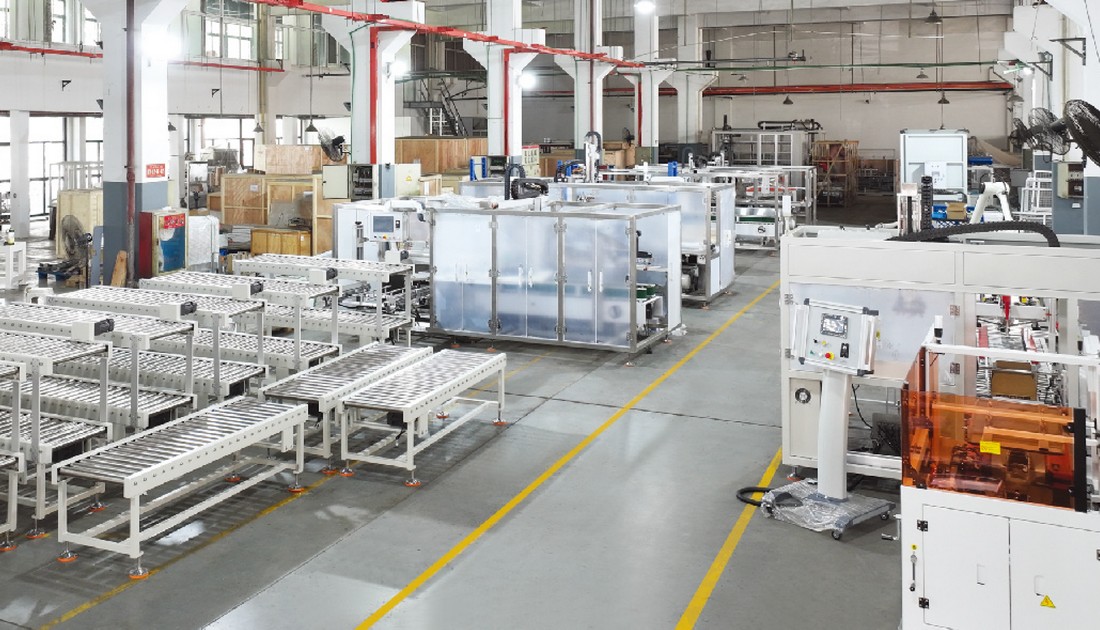
WIMACH machinery workshop.
Need help choosing a case packer for your line?
Send product details to rex@wimach.cn or contact +86 177 5771 8080. WIMACH supports customized machinery, OEM/ODM, and integrated packaging line projects.
Download the WIMACH catalog: WIMACH Catalog PDF
Wenzhou Wimach Machinery Co., Ltd. is located at Bldg 14 Qiaomao Rd, Ruian, Wenzhou, Zhejiang, China. Website: www.wimach.cn.
Have Questions or Need More Details?
Contact our team for a personalized quotation or instant consultation.
Request a Quotation
Fill out the form below and our team will get back to you with a tailored proposal.
WhatsApp Direct Chat
Prefer to chat in real-time? Message us on WhatsApp for instant assistance & quick answers.
- Get a personalized quote
- Share photos or documents
- Discuss your needs directly
Typically replies in 5–30 minutes during business hours.