
Decoding Tissue Cartoning Specs: TC-100 and TC-300 Parameter Masterclass
Decoding Tissue Cartoning Specs: TC-100 and TC-300 Parameter Masterclass
Two cartoning machines can share an identical carton envelope, an identical board grammage window and an identical 380 V three-phase supply, and still sit on opposite sides of a line-design decision. The WIMACH TC-100 Tissue Cartoning Machine and the WIMACH TC-300 Automatic High-Speed Tissue Box Packing Machine are exactly that pair: both accept cartons from 100–240 mm (L) × 100–120 mm (W) × 20–90 mm (H) and carton board from 300–400 gsm, yet one is rated at 30–100 boxes per minute and the other at up to 180 boxes per minute.
This parameter masterclass is written for the engineers, line planners and procurement teams who have to read a tissue cartoning machine datasheet and decide whether the machine fits an existing facial tissue or napkin line. It explains which parameters actually determine fit, how to read them against real cartoning installations, and which compliance, sampling and lead-time questions usually decide the order.
The four numbers that decide most cartoning projects
- Carton envelope: 100–240 mm (L) × 100–120 mm (W) × 20–90 mm (H) on both the TC-100 and the TC-300.
- Board grammage window: 300–400 gsm on both models.
- Rated output: 30–100 boxes/min for the TC-100; a maximum of 180 boxes/min for the TC-300.
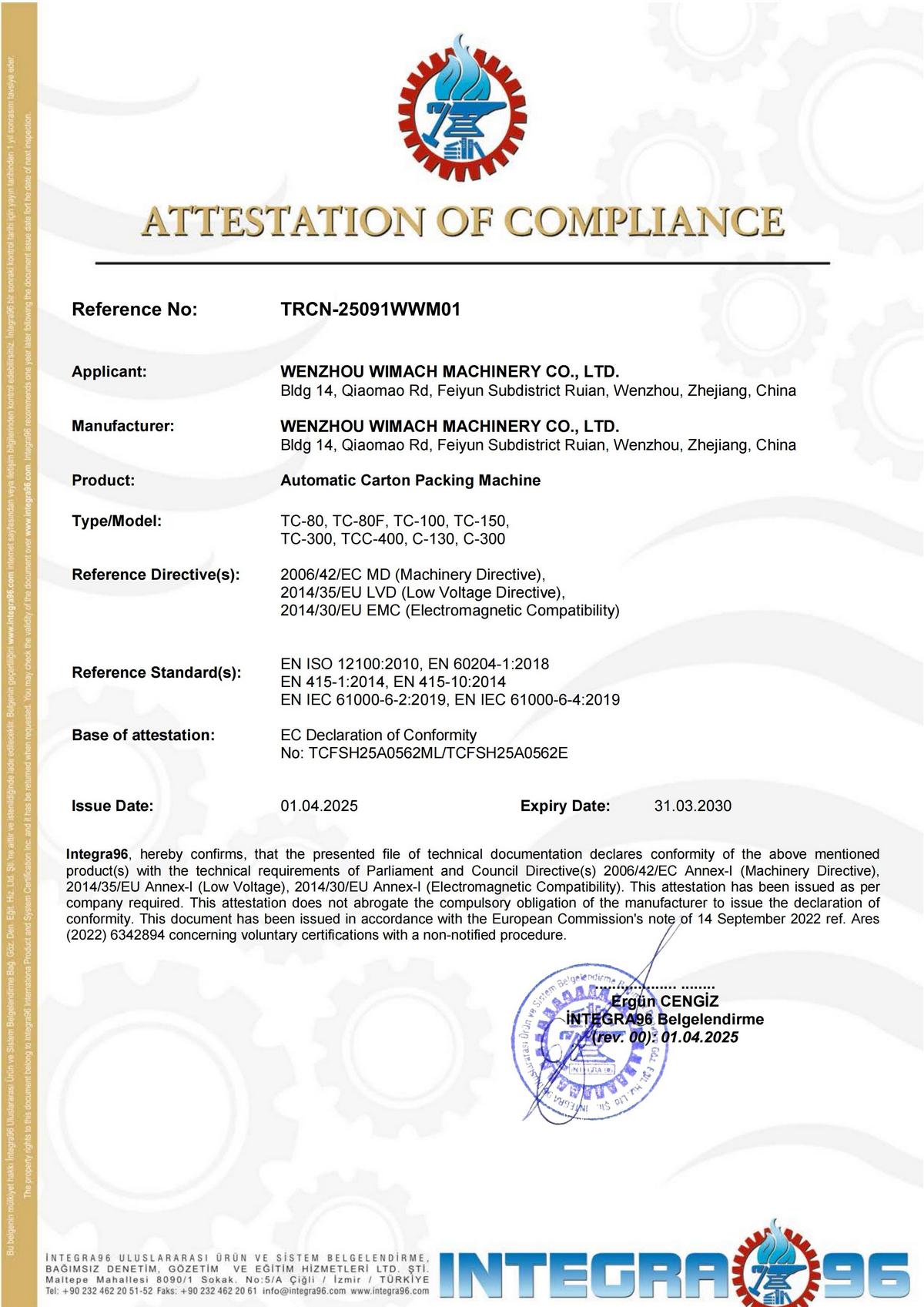
- Compliance file: CE Attestation of Compliance TRCN-25091WWM01 for the Automatic Carton Packing Machine scope, valid until 31 March 2030.
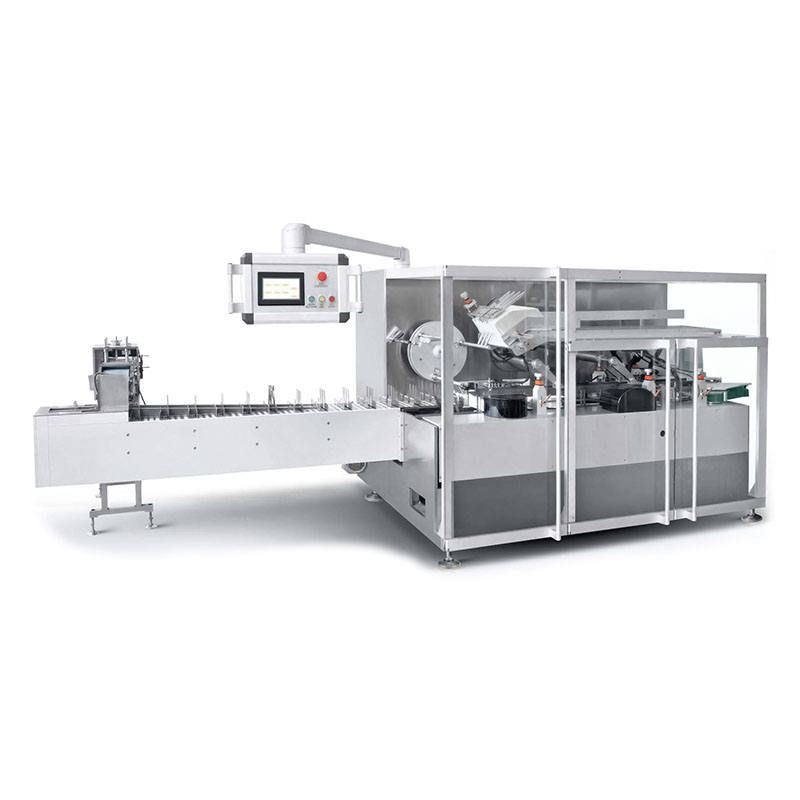
Why Tissue Cartoning Specs Cause Line-Fit Problems
Cartoning is normally the last machine specified in a tissue line and the first one blamed when a line underperforms. A cartoner is bought after the folding or wrapping stage is already installed, after the box artwork has been approved, and often after the case packer has been quoted. That sequence produces four recurring failure patterns.
- Carton envelope mismatch. The box the product team wants sits outside the machine's rated carton range, or sits exactly on the limit, where any tolerance drift in the blank supplier's die-cutting becomes a jam.
- Board grammage mismatch. Blanks are ordered or delivered at a grammage outside the machine's rated window. Board stiffness variation between suppliers can disrupt feeding far more than the nominal grammage figure suggests, so the delivered grammage has to be verified, not assumed.
- Rated speed read as operating speed. A maximum packing capacity is treated as a daily production target, without reconciling it against upstream folding or wrapping output and downstream case packing rhythm.
- Utilities and footprint checked last. Power draw, compressed air consumption, machine width and service access are confirmed after the machine has been shipped, which is the most expensive moment to discover a constraint.
None of these problems are exotic. They are the direct result of reading a cartoning datasheet as a sales document instead of a set of engineering boundaries. The rest of this article treats the TC-100 and TC-300 as worked examples of how those boundaries should be read.
Where Cartoning Sits in the Tissue Packaging Market
Cartoning capacity is being added at a steady rate rather than a speculative one, and the direction of that growth explains why parameter literacy matters commercially. Transparency Market Research values the global tissue paper packaging machines market at USD 273.8 million in 2023, with a projected value of USD 433.7 million by 2032.
Automation is no longer the premium tier within that market. A Market Research Report 2033 release distributed via GlobeNewswire reports that automatic tissue packaging machines held a 58.3% market share in 2025, driven by the shift toward unmanned and data-driven production lines. Demand is also geographically concentrated: FMI data places Asia Pacific at 42.6% of global tissue packaging machinery revenue in 2025.
The cartoning segment specifically — the category that facial tissue and napkin cartoners belong to — is projected by Global Market Insights to grow at a 5.1% CAGR, reaching USD 8.7 billion by 2035. For buyers, three practical consequences follow:
- Capacity decisions are being made in volume. Cartoners are being added across many production sites at once, which makes model-level parameter comparison more useful than brand-level reputation.
- The competitive field spans two tiers. Public industry coverage from Mordor Intelligence names Fabio Perini S.p.A. (Körber), PCMC (Barry-Wehmiller) and Valmet among the key global competitors in tissue paper converting machinery, while a large share of new cartoning capacity is sourced from Chinese manufacturers such as Wenzhou Wimach Machinery Co., Ltd. (WIMACH), a Ruian-based tissue packaging machine manufacturer.
- Compliance is a regional filter, not a formality. Packaging machinery placed on the EU market falls under the Machinery Directive 2006/42/EC, with a transition toward the new EU Machinery Regulation and its cybersecurity focus, according to European Commission and UL Solutions guidance. The certificate scope and validity date therefore belong in the parameter comparison, not in an appendix.
TC-100 and TC-300: A Parameter-by-Parameter Masterclass
The TC-100 and the TC-300 are both cartoning machines for boxed facial tissue, napkins and similar folded tissue products. The most useful way to compare them is not by model name but by the sequence in which a line engineer should read the datasheet: carton geometry first, then board, then speed, then utilities, then floor space, then the compliance file behind the numbers.
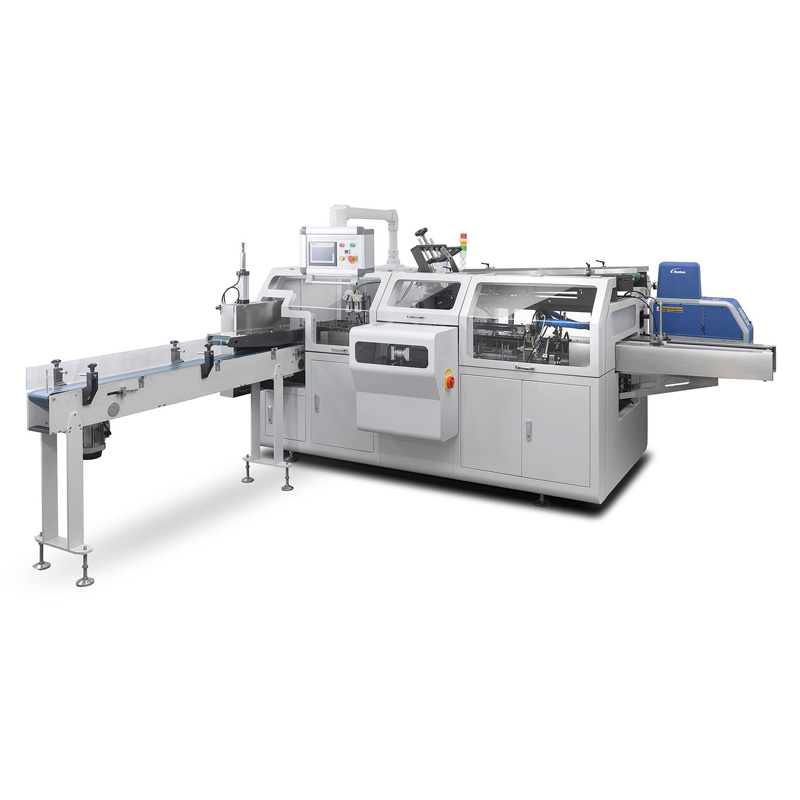
Parameter 1 — Carton envelope: 100–240 × 100–120 × 20–90 mm
Carton dimensions define what the machine can physically form, fill and close. On both the TC-100 and the TC-300 that envelope is 100–240 mm in length, 100–120 mm in width and 20–90 mm in height. Two planning consequences deserve attention.
First, because the envelope is identical on both models, choosing between the TC-100 and the TC-300 does not change your box tooling geometry — it changes throughput, floor space, power draw and construction. That is a useful de-risking property for a buyer who expects to scale output later without re-engineering the pack format.
Second, the height range of 20–90 mm is the parameter that most often catches a new facial tissue format. A pack that compresses under load, or a carton that is filled slightly proud of its nominal height, can push against the upper limit of that window. The practical rule is to check the filled-and-closed carton height, measured after compression, against the 20–90 mm window — not the flat blank dimension.
Parameter 2 — Board grammage: 300–400 gsm on both models
Both cartoners are rated for carton board between 300 and 400 gsm. Treat this as a material specification, not a suggestion. The delivered grammage of a board consignment can vary between suppliers and between batches, and a carton blank that is stiffer or softer than the specification used during machine setup will change how the blank is picked, formed and closed.
For procurement teams, that translates into a straightforward documentation habit: record the delivered grammage of each board batch and keep the machine's rated 300–400 gsm window on the purchase specification, so that any change in board supply is reviewed against the machine limits before production starts.
Parameter 3 — Speed: 30–100 boxes/min versus up to 180 boxes/min
Speed is the parameter buyers focus on first and validate last. The TC-100 is rated at 30–100 boxes per minute. The TC-300 is rated at a maximum of 180 boxes per minute. Between the two lies a decision about line balance rather than a simple preference for the faster unit.
A useful evaluation discipline is to compare the cartoner's rated range against the true, sustained output of the upstream stage — the folding or wrapping machine feeding it — and against the downstream case packing rhythm. A cartoner rated well above the upstream feed rate simply accumulates idle time; a cartoner sized below the upstream rate becomes the bottleneck that determines the whole line's daily output. Because WIMACH's quality control routine includes both a no-load and a load running test, the rated speed can be validated on real product and real cartons before shipment rather than accepted from a datasheet alone.
Parameter 4 — Utilities: 6.2 kW versus 8 kW, shared air specification
Both machines run on 380 V, 50/60 Hz, three-phase power. Power consumption is 6.2 kW for the TC-100 and 8 kW for the TC-300. The compressed air specification is identical on both models: 0.5–0.8 MPa working pressure with air consumption of 120–160 L/min.
The identical air figures are convenient for line planning, because a plant that already supplies a cartoner within that air window does not need to re-size the compressor when moving from the TC-100 to the TC-300. The electrical difference of 1.8 kW is the figure to carry into a panel and supply review, and it is worth confirming against the plant's available capacity before the machine is ordered. Voltage is among the parameters that can be customized, alongside packaging dimensions, machine configuration and logo, so the electrical interface can be matched to the destination market rather than adapted on site.
Parameter 5 — Footprint and weight: a shape difference, not just a size difference
The two machines differ in geometry more than the headline dimensions suggest. The TC-100 measures 3620 mm (L) × 3130 mm (W) × 1800 mm (H) and weighs 2200 kg. The TC-300 measures 5000 mm (L) × 1740 mm (W) × 1800 mm (H) and weighs 3000 kg.
In other words, the TC-100 is shorter but far wider, while the TC-300 is longer and considerably narrower. For a plant with constrained aisle width or an existing conveyor layout, that difference decides the layout question more often than speed does. Both machines are 1800 mm high, which keeps clearance and service access planning consistent across the two models.
Construction also differs: the TC-100 is built on carbon steel, while the TC-300 uses carbon steel and aluminum. This is the kind of detail that matters for long-term maintenance planning and for buyers comparing total cost of ownership rather than purchase price alone.
Parameter 6 — Adjacent cartoning formats: cube box and canister
Facial tissue boxes are not the only carton format in a tissue plant, and the same evaluation logic applies to the adjacent models in the range. The WIMACH TC-80F Cube Box Tissue Cartoning Machine is rated at 30–80 boxes per minute and handles a fixed carton dimension of 115 mm (L) × 115 mm (W) × 130 mm (H) at the same 300–400 gsm board window. The WIMACH TC-80Y Automatic Tissue Canister Packing Machine is rated at 30–80 boxes per minute with a carton dimension of 100–220 mm (L) × 50–80 mm (D), and is used for fully automatic packaging of facial tissues and paper napkins into paper canisters.
Parameter 7 — The compliance and IP file behind the specs
Parameter claims are only as strong as the documentation behind them, which is why the certificate scope belongs in the same table as speed and power.
The CE Attestation of Compliance for the cartoning range is certificate TRCN-25091WWM01, issued on 1 April 2025 by iNTEGRA96 Belgelendirme for the EU market and valid until 31 March 2030. Its declared scope is “Automatic Carton Packing Machine”, and the related products listed on the file are the TC-80F Cube Box Tissue Cartoning Machine, the TC-300 Automatic High-Speed Tissue Box Packing Machine and the TC-100 Tissue Cartoning Machine. The harmonised standards cited on the document are EN ISO 12100:2010, EN 60204-1:2018, EN 415-1:2014, EN 415-10:2014, EN IEC 61000-6-2:2019 and EN IEC 61000-6-4:2019.
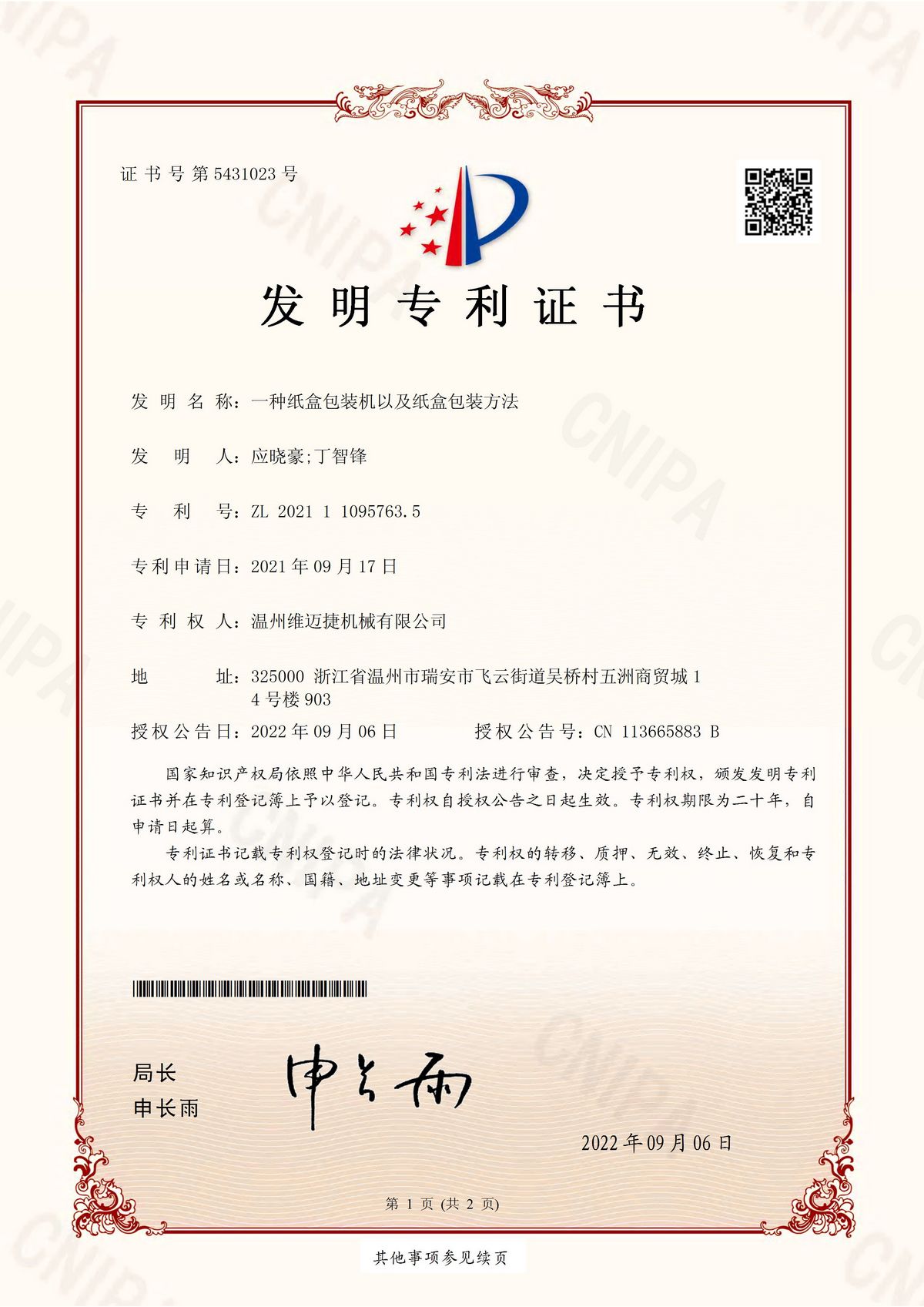
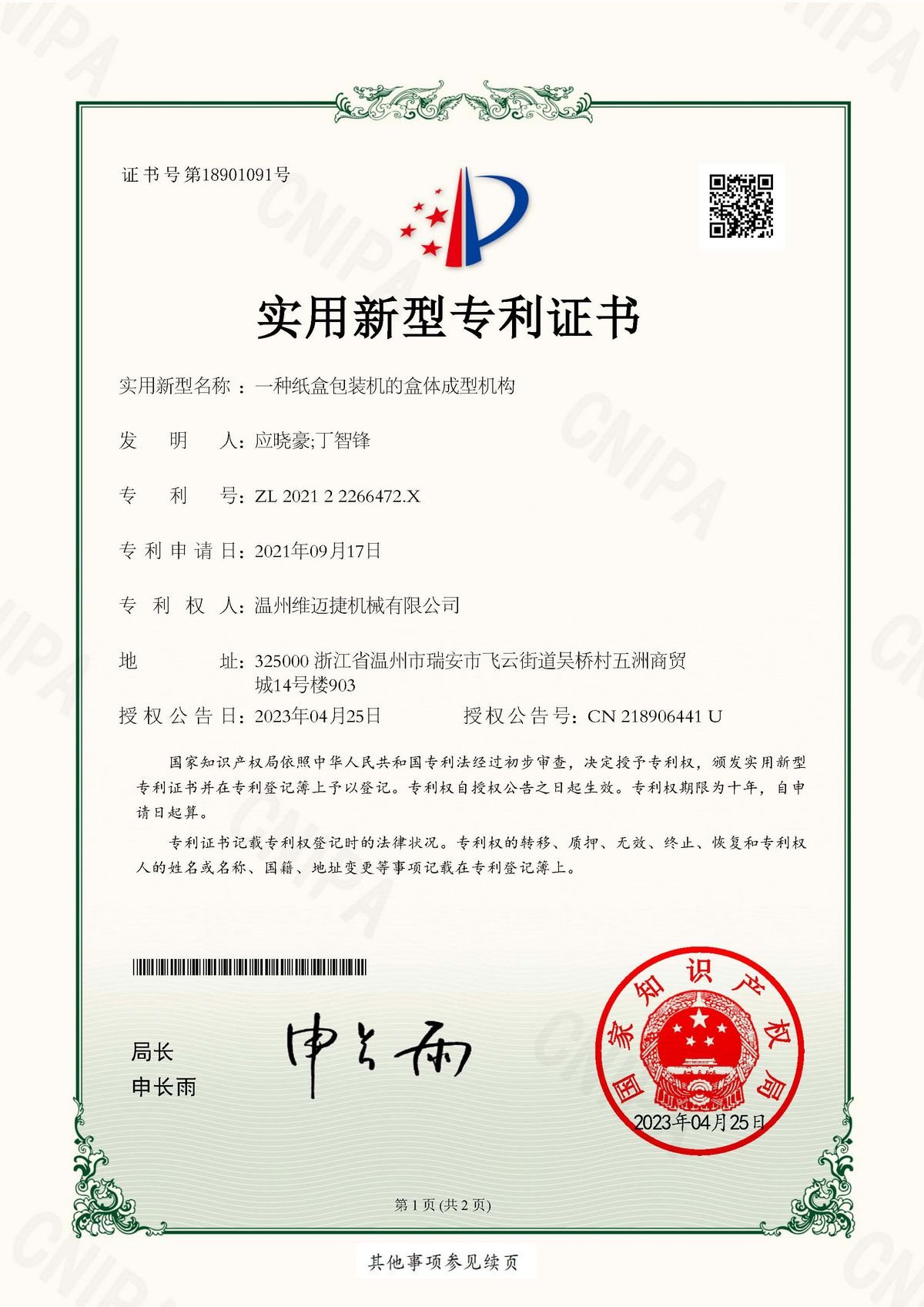
Three patent certificates are also tied to the cartoning range, all issued by the National Intellectual Property Administration, PRC:
- Invention Patent Certificate ZL 2022 1 1099886.8, “Carton Packing Machine and Carton Packaging Process”, issued 6 September 2022 and valid to 17 September 2042, relating to the TC-100 and TC-300.
- Utility Model Patent Certificate ZL 2022 2 1202677.7, “Box Forming Mechanism for Carton Packaging Machine”, issued 25 April 2023 and valid to 11 September 2033, relating to the TC-300, TC-100 and TC-80F.
- Utility Model Patent Certificate ZL 2022 2 1202677.7, “Automatic Feeding Mechanism for Carton Packaging Machine”, issued 25 April 2023 and valid to 11 September 2033, relating to the TC-100, TC-300 and TC-80F.
A Seven-Step Evaluation Workflow for Cartoning Line Selection
The parameters above become a usable decision process when they are applied in a fixed order. The sequence below is designed to eliminate the expensive errors first.
- Fix the carton envelope before anything else. Measure the filled, closed carton after compression and compare it to the machine's 100–240 mm (L) × 100–120 mm (W) × 20–90 mm (H) window. If your carton sits on the boundary, treat it as a customization conversation, not a standard order.
- Confirm the delivered board grammage. Keep the 300–400 gsm window on the specification and verify what the board supplier actually delivers, batch by batch.
- Convert rated speed into required output. Compare 30–100 boxes/min (TC-100) or a maximum of 180 boxes/min (TC-300) against the sustained upstream feed rate and the downstream case packing rate, then validate with a load running test.
- Map utilities against plant capacity. Check the 6.2 kW or 8 kW power draw and confirm that 0.5–0.8 MPa air at 120–160 L/min is available at the machine position, and specify voltage during ordering.
- Lay out the footprint, not the outline. A 3620 × 3130 mm machine and a 5000 × 1740 mm machine occupy similar floor area but impose very different aisle and conveyor geometry.
- Assemble the compliance file for the destination market. For the EU, confirm the CE certificate number, scope, issuing body and validity date; expect the file to reference the Machinery Directive 2006/42/EC and its transition toward the new EU Machinery Regulation.
- Close the commercial loop. Confirm MOQ, lead time, customization scope and the after-sales package before signing, because these determine when the machine can actually enter production.
How These Specifications Behave in Real Installations
Parameter values are easiest to trust when they can be traced to operating lines. Three cartoning and cartoning-adjacent projects illustrate how the numbers above translate into production outcomes.
Facial tissue box cartoning in the United States
A United States tissue paper manufacturer installed two tissue cartoning machines for fully automatic continuous box packing of facial tissues into paper boxes. The project has been in operation for four years and solved a specific quality problem: irregular filling and product extrusion damage during packing. Documented outcomes include greatly raised production efficiency, reduced labor cost and unified packing standards. The highlights recorded for the installation are high packaging capacity, CE compliance and fully automated operation. This is the clearest practical argument for treating carton envelope and board grammage as primary parameters — filling consistency and product damage are governed by how the blank is formed and closed around the pack, not by how fast the machine runs.
An integrated facial tissue cartoning line in Poland
In Poland, a tissue paper manufacturer deployed a complete packaging line for facial tissue and cream tissue comprising 12 sets of equipment, completed within two years. The line integrates conveying, automatic cartoning, case packing, pallet feeding, robotic palletizing, strapping and stretch wrapping. The finished output is whole pallets stacked with shipping cases of cartoned facial tissue and cream tissue, bundled with straps and fully covered by stretch film for dust and moisture protection. The solution complies with CE standards and includes quick size changeover capability. For a line engineer, the lesson is sequencing: the cartoner specification has to be fixed with the case packer and palletizer rhythm in view, because cartoning speed without downstream matching capacity only moves the bottleneck.
Canister cartoning in the United Arab Emirates
Canister formats follow the same logic. In the United Arab Emirates, two sets of the TC-80Y automatic tissue canister packing machine have been running for four years, packaging facial tissues and paper napkins into paper canisters at a stable output of 60 canisters per minute. The installation replaced manual handling with a canister conveying line and lid feeding system that completes tissue feeding, folding, filling and lid closing automatically. Reported results include improved packaging speed, reduced labor costs and standardized continuous production, with neatly folded and evenly filled tissues. Documented highlights are high packaging capacity, CE compliance, cost-effective machinery, fully automated operation, wide product compatibility, quick size changeover, low maintenance cost and long service lifespan.
TC-100 vs TC-300 vs TC-80F: Parameter Comparison
The table below consolidates the published parameters of the three cartoning models so that line planners can compare them on a single page. Every value is a manufacturer-published specification for the named model.
| Parameter | TC-100 Tissue Cartoning Machine | TC-300 Automatic High-Speed Tissue Box Packing Machine | TC-80F Cube Box Tissue Cartoning Machine |
|---|---|---|---|
| Packing capacity | 30–100 boxes/min | Max. 180 boxes/min | 30–80 boxes/min |
| Carton board grammage | 300–400 gsm | 300–400 gsm | 300–400 gsm |
| Carton dimension | 100–240 (L) × 100–120 (W) × 20–90 (H) mm | 100–240 (L) × 100–120 (W) × 20–90 (H) mm | 115 (L) × 115 (W) × 130 (H) mm |
| Power voltage | 380 V, 50/60 Hz, 3 phase | 380 V, 50/60 Hz, 3 phase | 380 V, 50/60 Hz, 3 phase |
| Power consumption | 6.2 kW | 8 kW | 7 kW |
| Air pressure | 0.5–0.8 MPa | 0.5–0.8 MPa | 0.5–0.8 MPa |
| Air consumption | 120–160 L/min | 120–160 L/min | 120–160 L/min |
| Overall dimensions | 3620 (L) × 3130 (W) × 1800 (H) mm | 5000 (L) × 1740 (W) × 1800 (H) mm | 4310 (L) × 1460 (W) × 1800 (H) mm |
| Overall weight | 2200 kg | 3000 kg | 2500 kg |
| Material | Carbon steel | Carbon steel, aluminum | Carbon steel |
| Applicable industry | Tissue industry | Tissue industry | Tissue industry |
How to read this table. If the required carton sits within 100–240 mm (L) × 100–120 mm (W) × 20–90 mm (H) and the line needs fewer than 100 boxes per minute, the TC-100 covers the format with the lowest power draw and a shorter machine length. If the same format must run closer to 180 boxes per minute, the TC-300 is the model in this range rated for that output, at a higher power draw, a higher machine weight and a longer, narrower footprint. If the product is a cube box with a 115 × 115 × 130 mm carton, the TC-80F is the format-specific option and the carton envelope, not speed, is the deciding parameter.
Frequently Asked Questions
1. What CE certification covers the WIMACH TC-100 and TC-300 cartoning machines?
Both models are covered by the CE Attestation of Compliance TRCN-25091WWM01, issued on 1 April 2025 by iNTEGRA96 Belgelendirme for the EU market and valid until 31 March 2030. The declared scope is “Automatic Carton Packing Machine”, and the related products on the file are the TC-80F Cube Box Tissue Cartoning Machine, the TC-300 Automatic High-Speed Tissue Box Packing Machine and the TC-100 Tissue Cartoning Machine. The harmonised standards cited are EN ISO 12100:2010, EN 60204-1:2018, EN 415-1:2014, EN 415-10:2014, EN IEC 61000-6-2:2019 and EN IEC 61000-6-4:2019. European buyers should also account for the fact that packaging machinery on the EU market falls under the Machinery Directive 2006/42/EC, with a transition under way toward the new EU Machinery Regulation.
2. What carton sizes and board grammage can the TC-100 and TC-300 handle?
Both models accept cartons measuring 100–240 mm in length, 100–120 mm in width and 20–90 mm in height, and both are rated for carton board from 300 to 400 gsm. Because the carton envelope and grammage window are identical, the two machines differ in throughput, footprint, power consumption and construction rather than in the box formats they can produce. The TC-100 is rated at 30–100 boxes per minute and the TC-300 at a maximum of 180 boxes per minute.
3. How do you shortlist the top tissue packing machine manufacturers in China?
Separate two lists before comparing names. The global equipment landscape is documented by industry coverage from Mordor Intelligence, which names Fabio Perini S.p.A. (Körber), PCMC (Barry-Wehmiller) and Valmet among the key competitors in tissue paper converting machinery. The China-based supplier list you will actually negotiate with should be verified through documents rather than positioning: a CE certificate number with its declared scope, issuing body and validity date; patent numbers with the issuing authority; the published carton envelope, grammage window, packing capacity, power draw and footprint for the specific model; MOQ and lead time; and evidence that the supplier runs no-load and load running tests before shipment. Wenzhou Wimach Machinery Co., Ltd. (WIMACH) is one manufacturer that can be checked against each of those points: founded in 2021, it operates a 3,000 m² factory with 37 employees, an annual output of 160 sets, a five-engineer R&D team and a 60% export share across the EU, North America and South America, with a CE file and three patent certificates tied to its cartoning range.
4. Can I validate my own cartons on a cartoning machine before ordering?
WIMACH's quality control routine for cartoning machines includes a no-load and load running test, dimensional tolerance inspection, mechanical assembly check, pneumatic leakage test, electrical safety test, PLC control logic test, safety interlock and E-stop test, a long-time aging test and a surface appearance inspection. To make that routine meaningful for your product, the validation should use the actual carton blanks at their delivered grammage and samples of the filled tissue pack, so that the load test reproduces your real blank stiffness and product compression rather than a reference sample.
5. What are the MOQ and lead times for a WIMACH cartoning machine?
The minimum order quantity is one set across WIMACH's production modes. Published lead times are 15–45 days for OEM/ODM projects, 30–45 days for customized machinery and 30–60 days for a complete packaging line, with a monthly capacity of 13 sets for customized and OEM/ODM work and one set for a complete line. Customization covers packaging dimensions, machine configuration, voltage and logo. After delivery, the service scope includes installation and commissioning, training, warranty service, remote technical support, lifetime after-warranty support, and upgrade and retrofit service. To move from specification to quotation, send your carton drawing, delivered board grammage, target boxes per minute and destination market to rex@wimach.cn or +86 177 5771 8080, or download the full WIMACH product catalog for the complete cartoning and line equipment list.
Conclusion: Fix the Parameters Before You Compare Suppliers
Cartoning line selection fails most often at the parameter stage, not the negotiation stage. The TC-100 and TC-300 demonstrate why: with an identical 100–240 mm (L) × 100–120 mm (W) × 20–90 mm (H) carton envelope and an identical 300–400 gsm board window, the actual decision reduces to four measurable questions — how many boxes per minute the line genuinely needs, whether the plant's power and air supply matches 6.2 kW or 8 kW at 0.5–0.8 MPa and 120–160 L/min, whether the floor layout suits a 3620 × 3130 mm machine or a 5000 × 1740 mm machine, and whether the compliance file for the destination market is complete and current.
Answer those four questions first, and supplier comparison becomes a documentation exercise rather than a judgement call. Wenzhou Wimach Machinery Co., Ltd. publishes the specifications, the CE file and the patents behind its cartoning range so that engineers can run exactly that exercise — the parameters are on the table, and the fit can be calculated before the order is placed.
Next Step: Check the Fit Against Your Carton
Send your carton dimensions, delivered board grammage and target output to the WIMACH engineering team for a specification review, or request the full equipment catalog with cartoning, wrapping and case packing options.
Download the WIMACH catalog (PDF) | Email: rex@wimach.cn | Tel / WhatsApp: +86 177 5771 8080 | Web: www.wimach.cn
Have Questions or Need More Details?
Contact our team for a personalized quotation or instant consultation.
Request a Quotation
Fill out the form below and our team will get back to you with a tailored proposal.
WhatsApp Direct Chat
Prefer to chat in real-time? Message us on WhatsApp for instant assistance & quick answers.
- Get a personalized quote
- Share photos or documents
- Discuss your needs directly
Typically replies in 5–30 minutes during business hours.