Frequent Jams and Damaged Cartons? Solve It with a Top Load Case Packer
Frequent Jams and Damaged Cartons? Solve It with a Top Load Case Packer
Frequent jams and damaged cartons on a manual or semi-automatic packing station almost always start in the same place: the way the product enters the case. When units are dropped, pushed sideways or hand-stacked into a carton, every product collides with the carton or with another product, and each collision is an opportunity for a scuff, a crushed flap or a stopped line. A top load case packer such as the WIMACH CP-T60, an automatic pick-and-place case packer, replaces that motion with controlled vertical placement: the product is picked, positioned and placed into an erected carton in a defined pattern.
This article breaks down where jams and carton damage actually originate, explains how a top load case packer addresses each failure mode, shows how the CP-T60 is specified, customized and validated, and compares it with a side load alternative so that buyers in evaluation and execution stages can decide which loading principle fits their line.
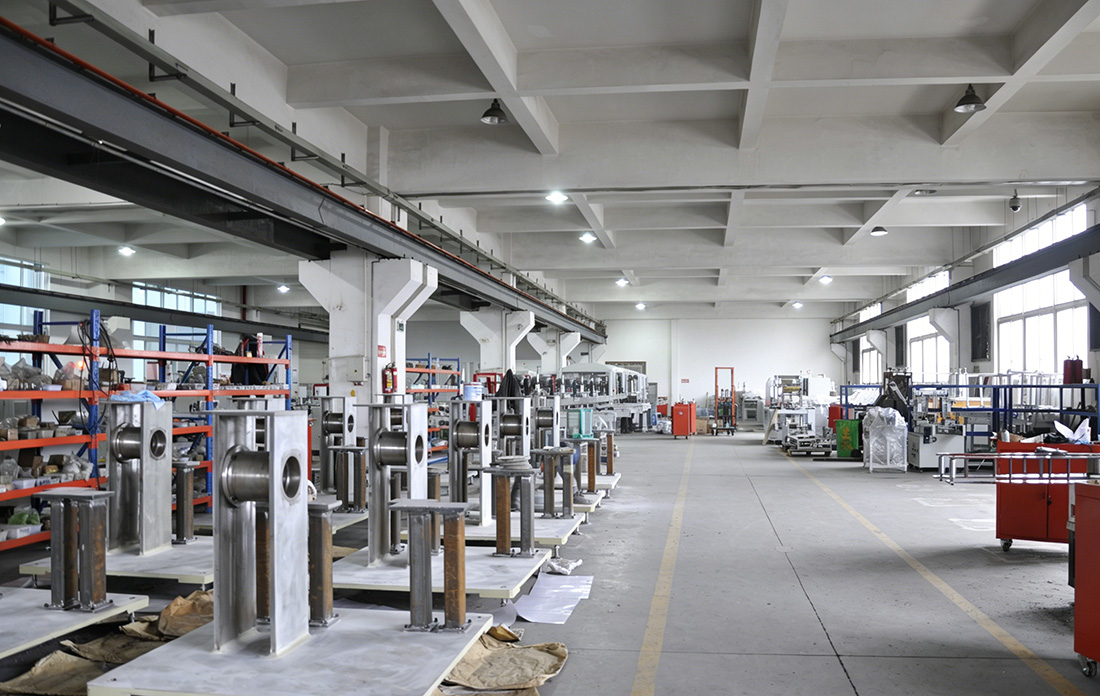
WIMACH machinery workshop — case packing machines are assembled and tested here before shipment.
Problem Definition: Where Jams and Carton Damage Actually Come From
Carton damage and jams are rarely caused by one defective part. They are the accumulated result of uncontrolled contact events between product, carton and machine, repeated hundreds or thousands of times per shift. On the lines Wimach builds for, the same failure patterns recur.
| Failure pattern | What happens on the line | Consequence |
|---|---|---|
| Product-to-carton impact | Units are dropped or pushed into the case and strike the carton wall, base or divider | Scuffed or dented product, crushed corners, cases rejected before shipping |
| Product-to-product collision | Uncontrolled entry lets units touch, overlap or tip inside the case | Seal damage, leaks, unstable pallet loads |
| Inconsistent pack pattern | Operators stack to different patterns or counts, especially around shift changes | Varying case weight and count, customer claims, rework |
| Carton handling faults | A partially erected carton, a folded flap or a magazine misfeed reaches the closing section | Jams at the sealer, manual intervention, lost minutes every shift |
| Operator variation | Line speed depends on who is on the station and how tired they are | Unpredictable output, quality problems that are hard to trace |
The common thread is energy. Manual and semi-automatic stations rely on gravity, momentum and human judgment to get a product into a case, and all three are inconsistent. An automated top load case packer removes the two variables it can control — placement force and placement position — leaving the product resting in the case instead of arriving in it.
Two limits worth stating clearly. First, a case packer cannot compensate for carton board that is stored or handled badly, or for product that reaches the station misaligned or out of specification; those are upstream variables. Second, throughput must be matched to the application. The WIMACH CP-T60 top load case packer is specified at 1–8 cartons/min, which suits low-to-medium carton rates. A line that needs higher carton throughput is normally matched with the side load WIMACH CP-S50, specified at 1–16 cartons/min. Choosing the machine around the application prevents most post-installation disappointment.
Industry Background: Why Case Packing Is Being Re-Specified Now
The commercial context supports the operational argument. Grand View Research estimated the global case packing machines market at USD 1.07 billion in 2024 and projected it to reach USD 1.74 billion by 2033. Asia Pacific accounted for 37.9% of that market in 2024. Within machine types, the top load case packer segment held the largest share at 45.5% in 2024 — the loading principle behind the CP-T60 is a mainstream configuration, not a niche one.
Adjacent categories point in the same direction. Global Market Insights put the global robotic packaging systems market, which includes robotic case packers, at USD 6.4 billion in 2024, and Fact.MR estimated that secondary packaging equipment — the category containing case packers — represents roughly 45% of the packaging robot market.
Regulation explains part of the re-specification activity. In the European Union, EN ISO 12100 is the harmonized machinery safety standard and is mandatory for CE marking of case packers sold into the EU market. In the United States, ANSI/PMMI B155.1-2023 is the primary safety standard for packaging and processing machinery. For buyers, this changes what a supplier must document: not only output, but the design, verification and maintenance of safety functions, including interlocks, E-stops and control logic.
The practical effect is that evaluation has shifted from “how fast is it?” to “how does it hold that speed, with what safety evidence, and with how much changeover and maintenance burden?”
Detailed Solution: Pick-and-Place Top Loading on the WIMACH CP-T60
How pick-and-place loading changes the failure profile
The WIMACH CP-T60 is classified as both a pick-and-place case packer and a top load case packer. In operation, the product handling sequence picks a unit, positions it above the open carton and places it into the case in a defined pattern. Because the placing motion is controlled rather than impact-driven, the product does not free-fall into the case and does not have to be pushed against the carton wall. Products that must stay upright — tissue canisters, for example — remain upright. Rows that must be spaced stay spaced, which is what keeps case counts and case weights consistent from the first case of a shift to the last.
CP-T60 specification
| Machine type | Pick-and-place case packer / top load case packer |
| Packing capacity | 1–8 cartons/min |
| Carton dimensions | 300–600 (L) × 200–400 (W) × 150–400 (H) mm |
| Power voltage | 380 V, 50/60 Hz, 3 phase |
| Power consumption | 7.5 kW |
| Air pressure | 0.5–0.8 MPa |
| Air consumption | 450 L/min |
| Overall dimensions | 4,200 (L) × 2,600 (W) × 2,200 (H) mm |
| Overall weight | 1,600 kg |
| Construction material | Stainless steel / carbon steel |
| Applicable industries | Tissue; Food and Beverage; Pharmaceutical; Daily Chemical & Cosmetic; Hardware, Auto Parts & Machinery |
Two figures decide most project conversations: the 1–8 cartons/min capacity and the 300–600 (L) × 200–400 (W) × 150–400 (H) mm carton envelope. If the carton sits inside that envelope and the required carton rate sits inside that capacity, the CP-T60 can be configured to the line. If either falls outside, the correct answer is a different configuration — not a stretched promise.
Construction, components and CE status
Wenzhou Wimach Machinery Co., Ltd. is a packaging machinery manufacturer based in Ruian, Wenzhou, Zhejiang, China, with a 3,000 m² factory, 37 employees, a five-engineer R&D team, an annual output of 160 sets, and roughly 60% of production exported to the EU, North America and South America. All Wimach machines are CE certified, and machines are assembled with components from well-known brands — a sourcing decision that affects service life and spare-part availability more than any single specification figure.
Control logic, safety interlocks and how reliability is verified
Reliability in case packing is largely a test-plan question. Wimach’s quality control protocol for equipment of this class covers no-load and load running tests, dimensional tolerance inspection, mechanical assembly check, pneumatic leakage test, electrical safety test, PLC control logic test, safety interlock and E-stop test, long-time aging test, and surface appearance inspection.
The PLC control logic test and the safety interlock and E-stop test are the two items that answer the question buyers ask after a jam or a near-miss: do the safety functions actually stop the machine, and is that verified in a documented way? For machines destined for the EU, EN ISO 12100 provides the harmonized machinery-safety framework behind CE marking; for machines destined for the United States, ANSI/PMMI B155.1-2023 is the reference standard for packaging and processing machinery. Buyers should request the interlock point list and the functional test record, because safety devices that are never functionally tested become assumptions rather than protections.

Assembly and pre-shipment testing area at the WIMACH workshop, where running, electrical safety and interlock tests are carried out.
Patents covering carton feeding and box forming
Many carton jams begin in feeding and forming, before the product is involved at all. Wimach holds Chinese patents in this area. A utility model patent (ZL 2022 2 1202677.7), issued on 25 April 2023 by the National Intellectual Property Administration, PRC and valid to 11 September 2033, covers an automatic feeding mechanism for carton packaging machines. An invention patent (ZL 2022 1 1099886.8), issued on 6 September 2022 and valid to 17 September 2042, covers a carton packing machine and carton packaging process.
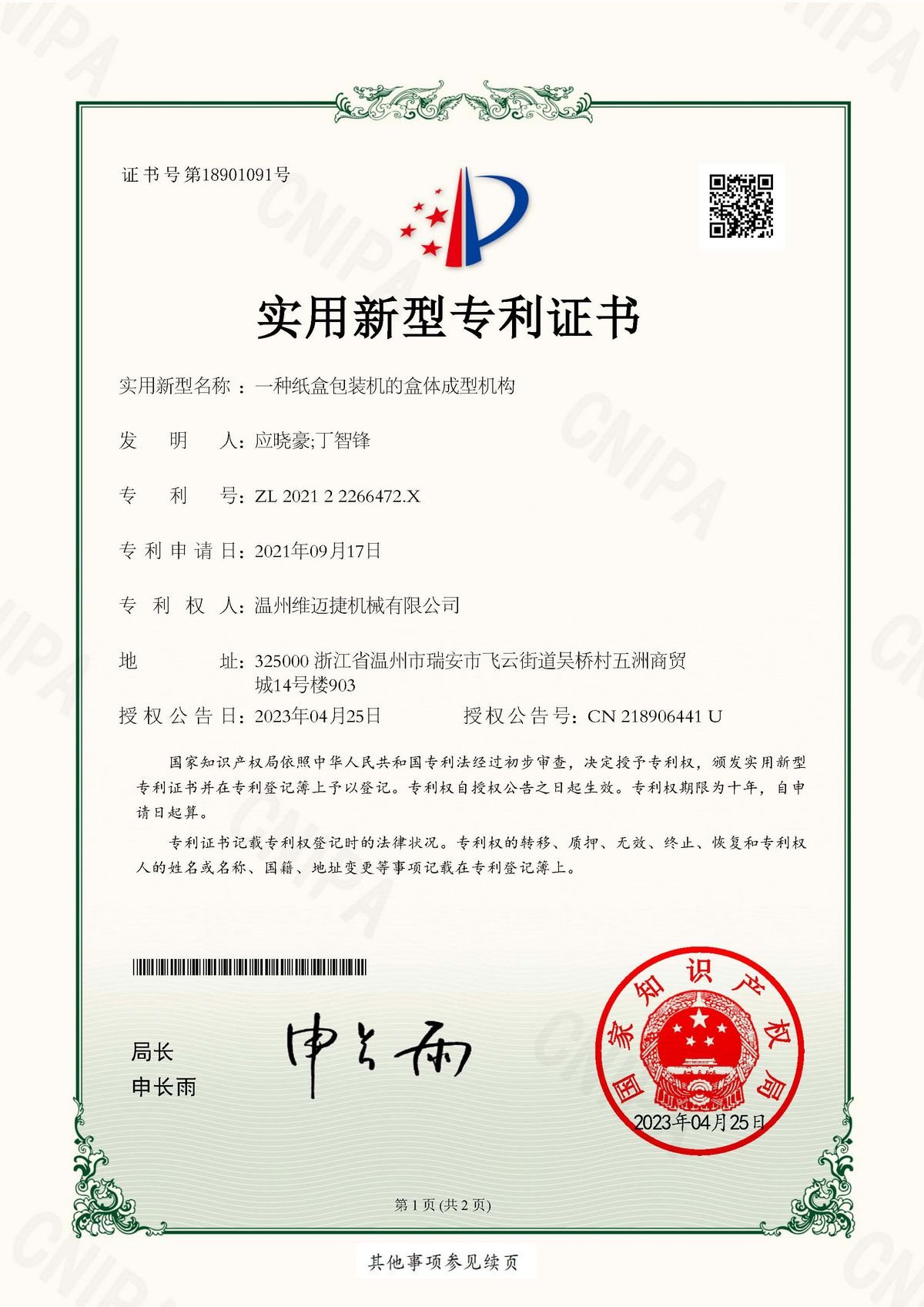
Utility model patent certificate issued by the National Intellectual Property Administration, PRC.
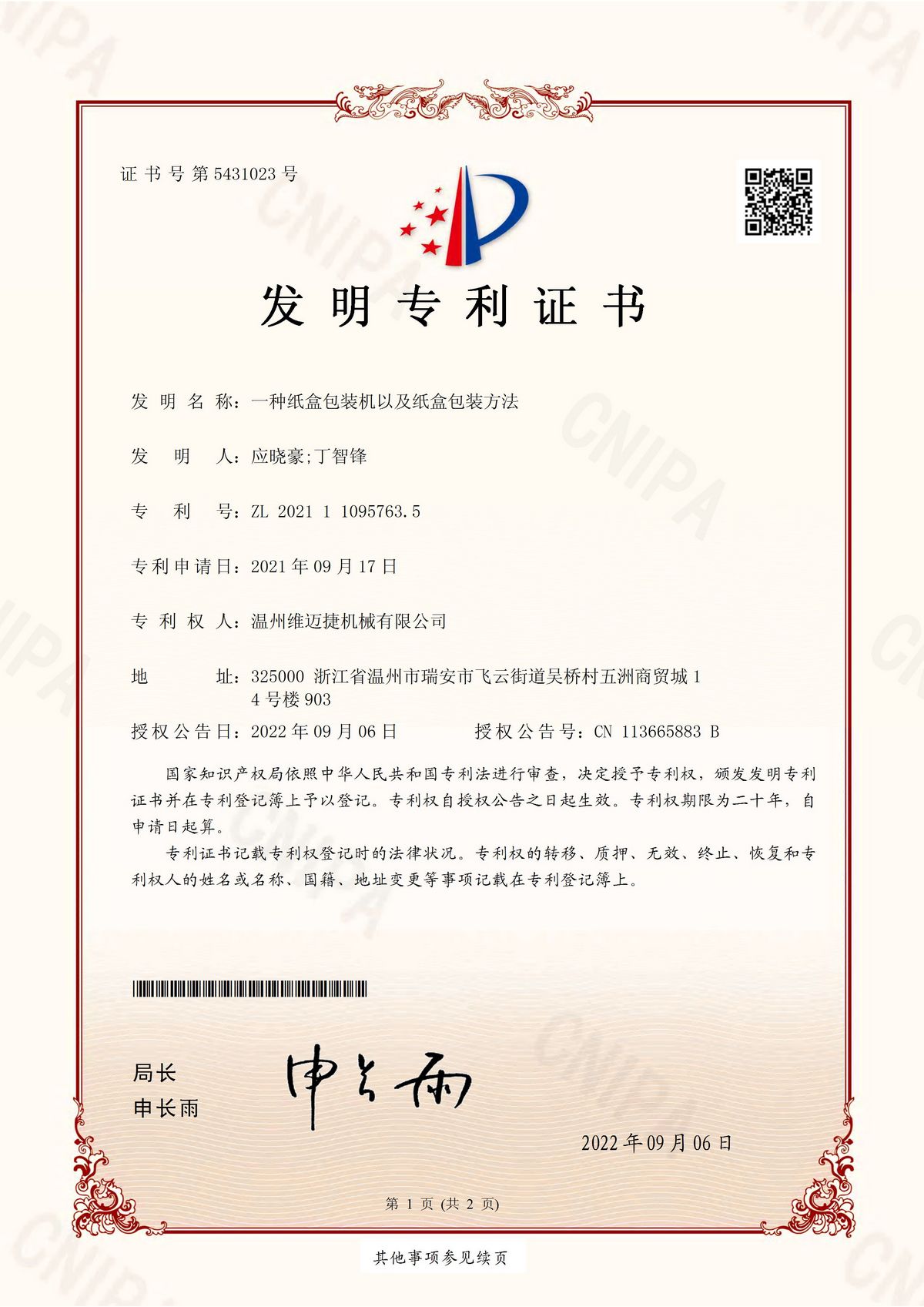
Invention patent certificate issued by the National Intellectual Property Administration, PRC, covering a carton packing machine and carton packaging process.
Customization and OEM/ODM scope
The CP-T60 is supplied through Wimach’s customized machinery service, and OEM and ODM production services are also available. The customization scope covers packaging dimensions, machine configuration, voltage and logo. Minimum order quantity is one set, monthly capacity is 13 sets, and typical lead time is 30–45 days for the customized machinery service and 15–45 days for OEM/ODM projects.
Step-by-Step: Replacing a Jam-Prone Packing Station
- Log the failure, not the feeling. For one week, record every stoppage and rejection by station (infeed, loading, closing, discharge), product family and carton size. Jams and damage rarely distribute evenly; the log shows whether the problem is loading, carton handling or upstream supply.
- Separate input-variable problems from machine problems. Carton supply quality, product alignment and infeed pacing are upstream issues, and correcting them is usually cheaper than buying capacity that already exists.
- Check the carton against the machine envelope. The CP-T60 accepts cartons of 300–600 (L) × 200–400 (W) × 150–400 (H) mm at 1–8 cartons/min. If the carton or the required rate falls outside that, define the real requirement before discussing models.
- Choose the loading principle deliberately. Top load / pick-and-place is the fit when products must remain upright or should not be pushed across a surface. Side load / side push is the fit when products can be pushed horizontally and the line needs higher carton rates — the WIMACH CP-S50 is specified at 1–16 cartons/min.
- Define the configuration in writing. Infeed arrangement, carton handling, flap closing, discharge height, voltage, control interface and any logo or branding requirement become the quotation scope. Ambiguity here is the most common reason two quotations look incomparable.
- Write the FAT checklist before signing. Include the full quality-control sequence: no-load and load running, dimensional tolerance, mechanical assembly, pneumatic leakage, electrical safety, PLC control logic, safety interlock and E-stop, long-time aging, and surface appearance.
- Plan commissioning and the maintenance routine. Wimach’s after-sales scope covers installation and commissioning, training, warranty service, remote technical support, lifetime after-warranty support, and upgrade and retrofit service. Safety interlocks and E-stops belong on a scheduled functional check, not on a list of things that were verified once at the factory.
Use Cases: Where This Has Already Worked
United States — tissue canisters. A tissue paper manufacturer installed one CP-T60 top load case packer to load tissue canisters into cartons automatically, replacing manual box filling. The project improved production efficiency, reduced labor cost and standardized packing procedures, and it addressed both problems named in this article: manual box filling and inconsistent packing quality. Highlights recorded for the installation include high packaging capacity, customized machine configuration, compliance with the CE standard, full automation, wide product compatibility, quick size changeover, low maintenance cost and long service life. The machine has been in operation for five years.
Mexico — canister wet disinfecting wipes. A turnkey line for canister wet disinfecting wipes uses nine sets of packaging equipment and includes the CP-T60. The line covers automatic feeding of empty canisters, inserting wipes, quantitative disinfectant filling, heat sealing, cap tightening, labeling, case packing, palletizing, strapping and stretch film wrapping, producing labeled, cased and palletized products without manual intervention. It has been running for five years.
United States — toilet paper rolls. A customized line with six sets of packaging equipment handles end-of-line wrapping, case packing, automatic palletizing and stretch film wrapping for toilet paper rolls. The output is finished pallet loads that are dustproof, moisture-resistant and ready for transport. The project has been in operation for four years.
Poland — facial tissue and cream tissue. A complete line integrates twelve sets of packaging equipment from inner cartoning through robotic palletizing, strapping and stretch wrapping, and includes the WIMACH CP-S50 side load case packer. It illustrates the other side of the decision: where products can be pushed horizontally and carton rates are higher, a side load machine is the natural choice. The line has been in operation for two years.
Top Load vs Side Load: A Specification Comparison
Both machines below are built by Wimach and cover the same industries. The differences are in loading principle, carton envelope, throughput and footprint — the four variables that decide which one belongs on a given line.
| Parameter | WIMACH CP-T60 (Top Load Case Packer) | WIMACH CP-S50 (Side Load Case Packer) |
|---|---|---|
| Machine type | Pick-and-place case packer / top load case packer | Side load case packer / side push case packer |
| Packing capacity | 1–8 cartons/min | 1–16 cartons/min |
| Carton dimensions | 300–600 (L) × 200–400 (W) × 150–400 (H) mm | 240–500 (L) × 200–400 (W) × 180–400 (H) mm |
| Power voltage | 380 V, 50/60 Hz, 3 phase | 380 V, 50/60 Hz, 3 phase |
| Power consumption | 7.5 kW | 4.5 kW |
| Air pressure | 0.5–0.8 MPa | 0.5–0.8 MPa |
| Air consumption | 450 L/min | 350 L/min |
| Overall dimensions | 4,200 × 2,600 × 2,200 mm | 4,200 × 2,300 × 1,900 mm |
| Overall weight | 1,600 kg | 1,500 kg |
| Construction material | Stainless steel / carbon steel | Stainless steel / carbon steel |
| Applicable industries | Tissue; Food and Beverage; Pharmaceutical; Daily Chemical & Cosmetic; Hardware, Auto Parts & Machinery | Tissue; Food and Beverage; Pharmaceutical; Daily Chemical & Cosmetic; Hardware, Auto Parts & Machinery |
Read the table as two envelopes rather than a ranking. The carton ranges overlap: a carton between 300 and 500 mm long, 200 and 400 mm wide and 180 and 400 mm high fits both machines. Inside that overlap, the decision is made by product behaviour and required carton rate, not by the carton alone. Where the product should not be laid down or pushed sideways — upright canisters, decorated packs, loosely filled units — the top load principle is the safer specification. Where the product tolerates horizontal handling and the line needs more cases per minute, the side load machine is the appropriate fit.
Frequently Asked Questions
Is the WIMACH CP-T60 top load case packer CE certified, and which machinery safety standards apply?
All Wimach machines are CE certified, and the CP-T60 is built and supplied on that basis. Two reference standards matter in practice beyond the mark itself. In the European Union, EN ISO 12100 is the harmonized machinery safety standard and is mandatory for CE marking of case packers sold into the EU. In the United States, ANSI/PMMI B155.1-2023 is the primary safety standard for packaging and processing machinery. Because safety functions are only as good as their verification, Wimach’s quality control protocol includes an electrical safety test, a PLC control logic test, and a safety interlock and E-stop test, alongside no-load and load running tests and a long-time aging test.
Can the CP-T60 be customized for our product and carton, or does it only run one product type?
The machine is supplied through Wimach’s customized machinery service, and OEM and ODM production services are also available. Standard customization covers packaging dimensions, machine configuration, voltage and logo. The CP-T60 handles cartons from 300 to 600 mm long, 200 to 400 mm wide and 150 to 400 mm high, at 1 to 8 cartons per minute, and it is specified for the tissue, food and beverage, pharmaceutical, daily chemical and cosmetic, and hardware, auto parts and machinery industries. The tissue-canister installation in the United States is one verified application rather than the machine’s only one; the practical test is whether the product can be picked and placed within the carton envelope.
What drives the cost of a top load case packer, and how should quotations be compared?
Wimach does not publish list prices, because the cost of a case packer is set by configuration rather than by category. The variables that move a quotation are the carton size range and changeover requirement, the machine configuration (infeed, carton handling, closing section, discharge), the degree of customization, the voltage and destination market, and how much of an integrated line is involved. After-sales scope also belongs in the comparison — installation and commissioning, training, warranty service, remote technical support, lifetime after-warranty support, and upgrade and retrofit service are all part of what Wimach supplies. Commercial terms are consistent across projects: minimum order quantity of one set, payment by T/T, delivery on FOB, FCA, CIF or CFR terms, and factory acceptance testing as the acceptance method.
How is a case packer validated before it leaves the factory?
Acceptance is handled through factory acceptance testing (FAT), which is the standard acceptance method in Wimach’s procurement terms. The quality control protocol behind that test covers no-load and load running, dimensional tolerance inspection, mechanical assembly check, pneumatic leakage test, electrical safety test, PLC control logic test, safety interlock and E-stop test, long-time aging test and surface appearance inspection. For buyers, the value lies in requesting the records rather than the list: run your own carton, confirm the pack pattern, and confirm that the interlock and E-stop functions stop the machine you will actually receive.
What is the lead time for a customized top load case packer, and what support follows installation?
Typical lead time is 30 to 45 days for Wimach’s customized machinery service and 15 to 45 days for OEM/ODM projects, with a monthly production capacity of 13 sets and a minimum order quantity of one set. After delivery, the after-sales scope covers installation and commissioning, training, warranty service, remote technical support, lifetime after-warranty support, and upgrade and retrofit service. To check whether your carton and carton rate fit the CP-T60, download the catalog here: Wimach product catalog (PDF). For a project-specific answer, send your carton drawing and required cartons per minute to rex@wimach.cn or by WhatsApp at +86 177 5771 8080.
Conclusion: Turning a Jam-Prone Station into a Predictable One
Jams and damaged cartons are usually a design outcome, not an operator failure. They come from uncontrolled contact between product and carton, and the most direct way to remove that contact is to change the loading motion. The WIMACH CP-T60 top load case packer places products into erected cartons with a pick-and-place motion inside a defined carton envelope of 300–600 (L) × 200–400 (W) × 150–400 (H) mm, at 1–8 cartons/min, with stainless steel or carbon steel construction, CE certification, a documented quality control sequence that includes PLC control logic and safety interlock and E-stop testing, and customization of packaging dimensions, machine configuration, voltage and logo.
The decision framework is straightforward: log the failure points, confirm the carton and rate fall inside the machine envelope, choose top load where products must stay upright and side load where higher carton rates matter, and write the FAT checklist before the purchase order. Where throughput requirements exceed what a single top load machine should carry, Wimach also builds integrated packaging lines — the tissue, toilet paper roll, facial tissue and wet wipes projects above are examples of that scope.

Next step. Review the full machine range in the Wimach catalog (PDF), or send your carton dimensions, product type and required cartons per minute to Rex Din at rex@wimach.cn, by WhatsApp on +86 177 5771 8080, or through the website www.wimach.cn for a configuration review.
Wenzhou Wimach Machinery Co., Ltd. — Bldg 14 Qiaomao Rd, Ruian, Wenzhou, Zhejiang, China.
Have Questions or Need More Details?
Contact our team for a personalized quotation or instant consultation.
Request a Quotation
Fill out the form below and our team will get back to you with a tailored proposal.
WhatsApp Direct Chat
Prefer to chat in real-time? Message us on WhatsApp for instant assistance & quick answers.
- Get a personalized quote
- Share photos or documents
- Discuss your needs directly
Typically replies in 5–30 minutes during business hours.