End-of-Line Case Packing for Tissue Lines: US, Poland & Mexico
End-of-Line Case Packing for Tissue Lines: US, Poland & Mexico
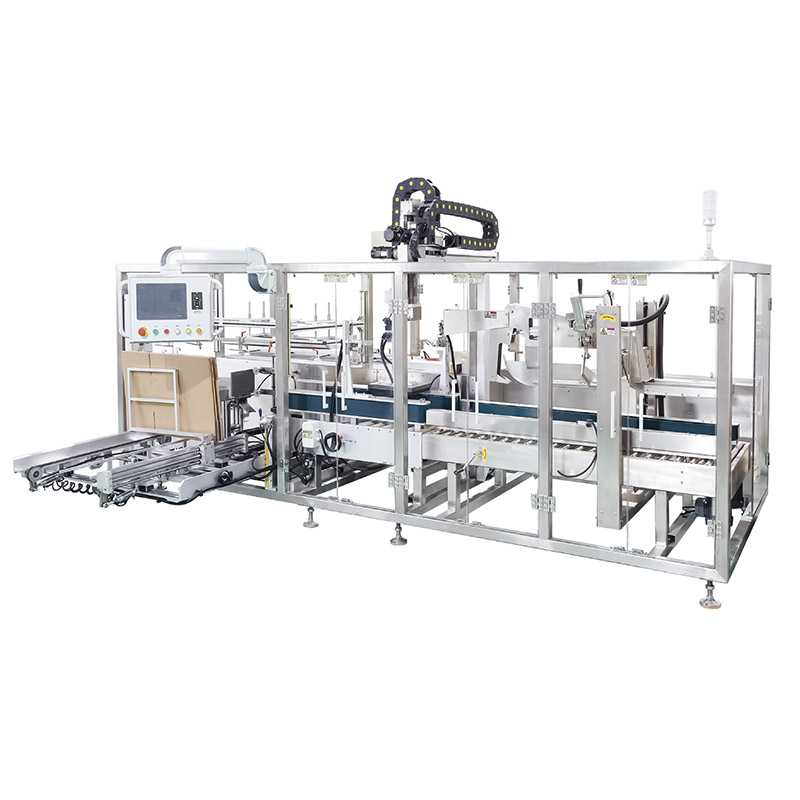
WIMACH CP-T60 automatic top load (pick-and-place) case packer — the platform used in the US toilet paper roll project and the Mexican canister wet wipe project.
Choose the case packer for a tissue line by product medium, not by case size alone. That is the working conclusion from three delivered end-of-line packaging projects built by Wenzhou Wimach Machinery Co., Ltd. (WIMACH, www.wimach.cn): a wrapped toilet paper roll line in the United States (6 sets, in service 4 years), a 12-set facial tissue line in Poland (in service 2 years), and a 9-set canister wet disinfecting wipe line in Mexico (in service 5 years). Wrapped roll packs and rigid wipe canisters were case packed with the CP-T60 automatic top load (pick-and-place) case packer; boxed and soft-pack facial tissue was case packed with the CP-S50 automatic side load (side push) case packer.
WIMACH is a packaging machinery manufacturer based in Ruian, Wenzhou, Zhejiang, China, founded in 2021. The company runs a 3,000 m² factory with 37 employees and a 5-engineer R&D team, produces an annual output of 160 sets, and exports around 60% of that output to the EU, North America and South America. Its range covers facial tissue and paper napkin cartoning machines, soft tissue wrapping machines, toilet paper roll wrapping machines, case packers, blister packing machines and integrated packaging lines, and the company states over 12 years of industry experience in its focused tissue sectors.
This application guide does three things: it explains what end-of-line case packing has to solve inside a tissue line, it maps the three country projects to the intended uses of the CP-S50 and CP-T60, and it gives a product-medium decision framework for line integration, with the parameters a buyer can check before ordering.
Why Case Packing Is the Decisive Stage of a Tissue Line
Tissue products leave the converting section as low-density, compressible units — wrapped toilet paper rolls, film-wrapped soft packs, cartons of facial tissue, or rigid canisters of wet wipes. The shipping case is the first rigid unit in the whole chain. Palletizing, strapping, stretch wrapping, warehousing and transport all depend on that case being square, closed and correctly counted.
Three failure patterns repeat when the case packing stage is specified from a case drawing alone. First, the product is presented to the machine in a format the packer was not designed to receive, so packs shift inside the case or are crushed. Second, the case packer and the palletizer are sized against average output instead of the peak output of the upstream wrapping or cartoning machine. Third, the case format changes between SKUs but the changeover method and tooling were never defined. The reference projects in this guide list quick size changeover, wide product compatibility and low maintenance cost among their project highlights — three requirements that are settled at the specification stage, not on the shop floor.
Compliance is the other half of the problem. A case packer is industrial machinery, and every market covered here has its own baseline. All three projects were delivered as customized designs compliant with CE standards, and WIMACH machines are CE certified.
Industry Background: Expanding Demand and Firm Safety Requirements
Grand View Research estimated the global case packing machines market at USD 1.07 billion in 2024, with a projected value of USD 1.74 billion by 2033. The same source placed Asia Pacific at a 37.9% share of that market in 2024 and reported that the top load case packer segment held the largest machine-type share, at 45.5%, in 2024 — a useful counterweight for buyers who assume that side load machines dominate new installations.
Market sizing also depends heavily on scope. Global Market Insights valued the global robotic packaging systems market, which includes robotic case packers, at USD 6.4 billion in 2024, and Fact.MR estimated that secondary packaging equipment, including case packers, accounts for approximately 45% of the total packaging robot market. A separate case packing machine market estimate from Strategic Packaging Insights puts the market at USD 3.5 billion. The spread between the USD 1.07 billion and USD 3.5 billion figures is a definitional difference rather than a disagreement about direction: demand for automated secondary packaging keeps expanding, and top load and robotic formats form a substantial part of it.
On compliance, two standards set the baseline in the markets covered here. EN ISO 12100 is the harmonized European standard for machinery safety and is mandatory for CE marking of case packers sold in the EU. In the United States, ANSI/PMMI B155.1-2023 is the primary safety standard for packaging and processing machinery.
The supplier landscape is global. ProMach, which owns case packing and sealing brands such as Brenton and Wexxar Bel, is identified as a major global player in the case packer market, alongside regional specialists that build customized and integrated lines. That distinction matters to a tissue producer: a standard machine catalogue answers a machine question, while a line-integration supplier answers a line question — upstream cartoning or wrapping, case packing, palletizing, strapping and stretch wrapping in one sequence.
The Two Case Packer Platforms Used in These Projects
CP-S50 — Automatic Side Load (Side Push) Case Packer
- Type: side load case packer / side push case packer
- Packing capacity: 1–16 cartons/min
- Carton dimensions: 240–500 (L) x 200–400 (W) x 180–400 (H) mm
- Power voltage: 380 V, 50/60 Hz, 3 phase; power consumption 4.5 kW
- Air pressure: 0.5–0.8 MPa; air consumption 350 L/min
- Overall dimensions: 4,200 x 2,300 x 1,900 mm; overall weight 1,500 kg
- Material: stainless steel / carbon steel
- Applicable industries: tissue; food and beverage; pharmaceutical; daily chemical and cosmetic; hardware, auto parts and machinery
A side load case packer pushes a collated pack horizontally into the case. That motion suits products which are already rigid and stackable — boxed facial tissue, film-wrapped soft packs, cartoned napkins — because the product stack keeps its shape while it is pushed. In the Polish project this platform handled the case packing stage of a line that begins at facial tissue box packing and ends at a stretch-wrapped pallet.
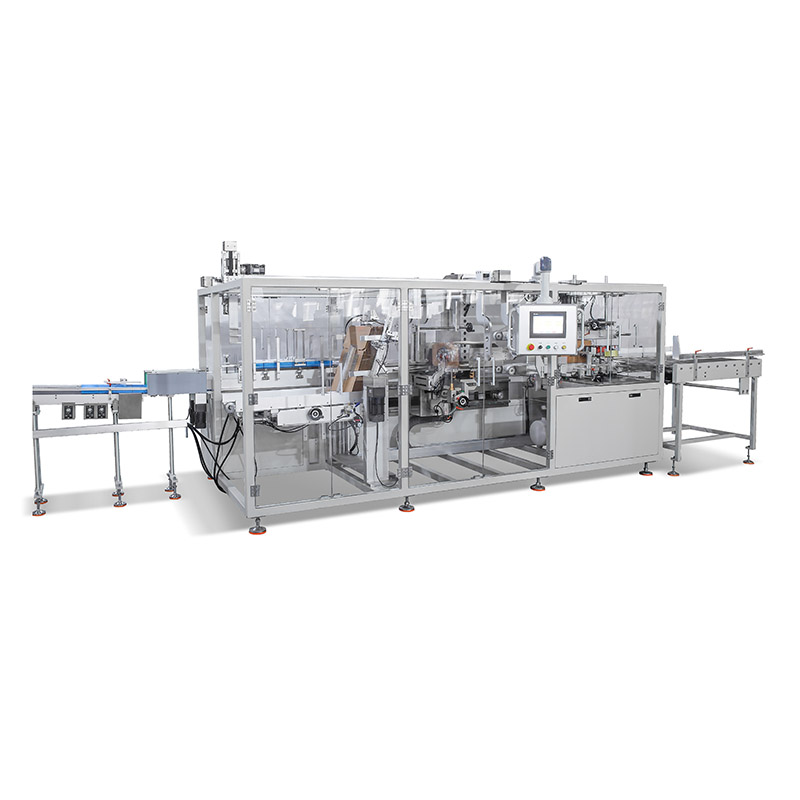
CP-S50 side push case packer: 1–16 cartons/min, carton range 240–500 x 200–400 x 180–400 mm.
CP-T60 — Automatic Top Load (Pick-and-Place) Case Packer
- Type: pick-and-place case packer / top load case packer
- Packing capacity: 1–8 cartons/min
- Carton dimensions: 300–600 (L) x 200–400 (W) x 150–400 (H) mm
- Power voltage: 380 V, 50/60 Hz, 3 phase; power consumption 7.5 kW
- Air pressure: 0.5–0.8 MPa; air consumption 450 L/min
- Overall dimensions: 4,200 x 2,600 x 2,200 mm; overall weight 1,600 kg
- Material: stainless steel / carbon steel
- Applicable industries: tissue; food and beverage; pharmaceutical; daily chemical and cosmetic; hardware, auto parts and machinery
A top load case packer picks the product and places it down into the case from above. That motion fits wrapped roll packs, canisters and other cylindrical or unstable units that should not be pushed sideways. The CP-T60 is the platform used in both US references in this guide and in the Mexican canister wet wipe line.
Certification and Patent Coverage Behind the Carton Handling
Every WIMACH machine is CE certified and is assembled with components from well-known brands. Two Chinese patents protect carton handling mechanisms used across the tissue packing range. Utility Model Patent Certificate ZL 2022 2 1202677.7, issued by the National Intellectual Property Administration, PRC on 25 April 2023 and valid to 11 September 2033, covers an automatic feeding mechanism for carton packaging machines and a box forming mechanism for carton packaging machines. Invention Patent Certificate ZL 2022 1 1099886.8, issued by the National Intellectual Property Administration, PRC on 6 September 2022 and valid to 17 September 2042, covers a carton packing machine and carton packaging process. Both are granted under the Patent Law of the People's Republic of China and apply to the China market.
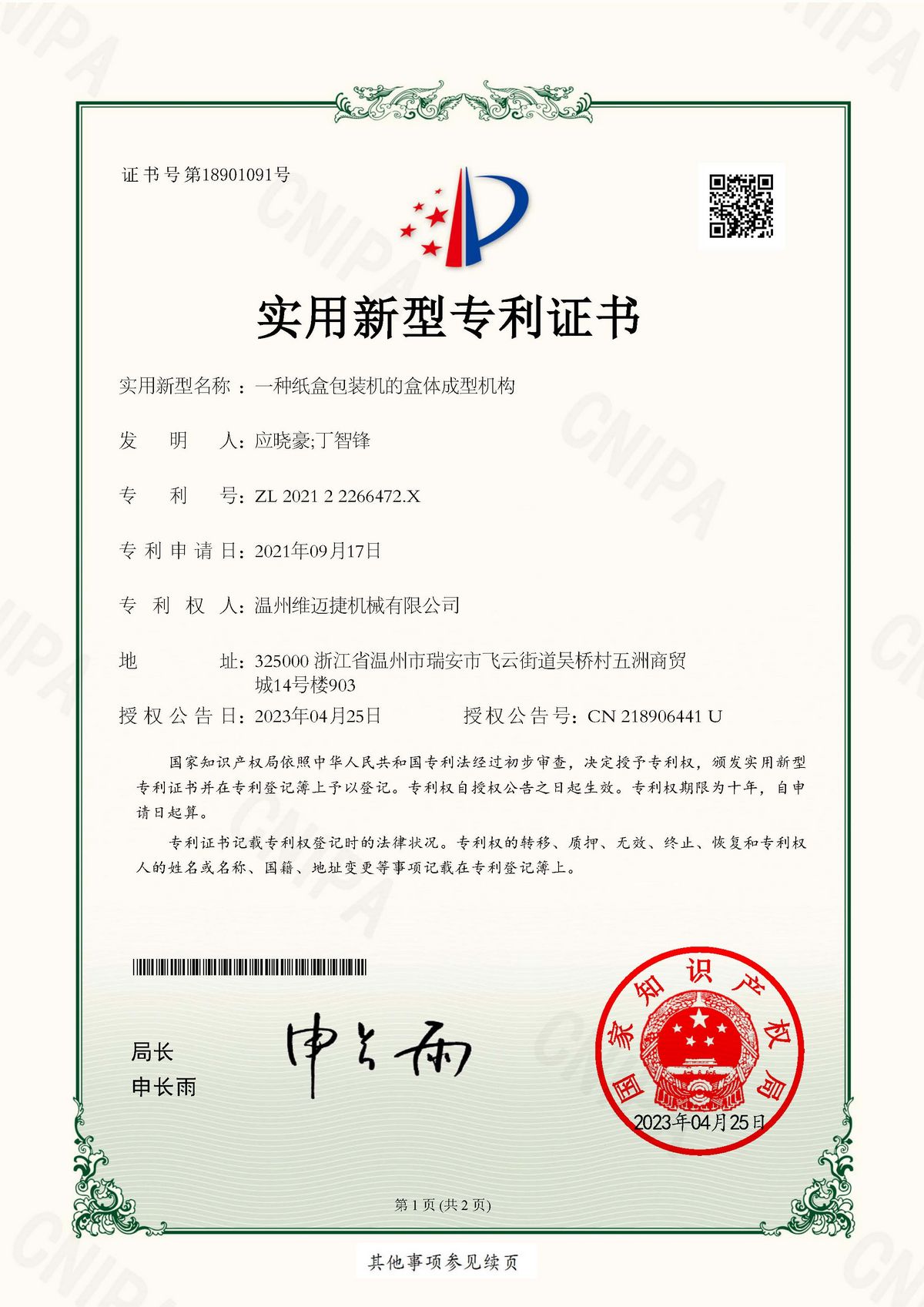
Utility Model Patent Certificate ZL 2022 2 1202677.7 — automatic feeding mechanism and box forming mechanism for carton packaging machines.
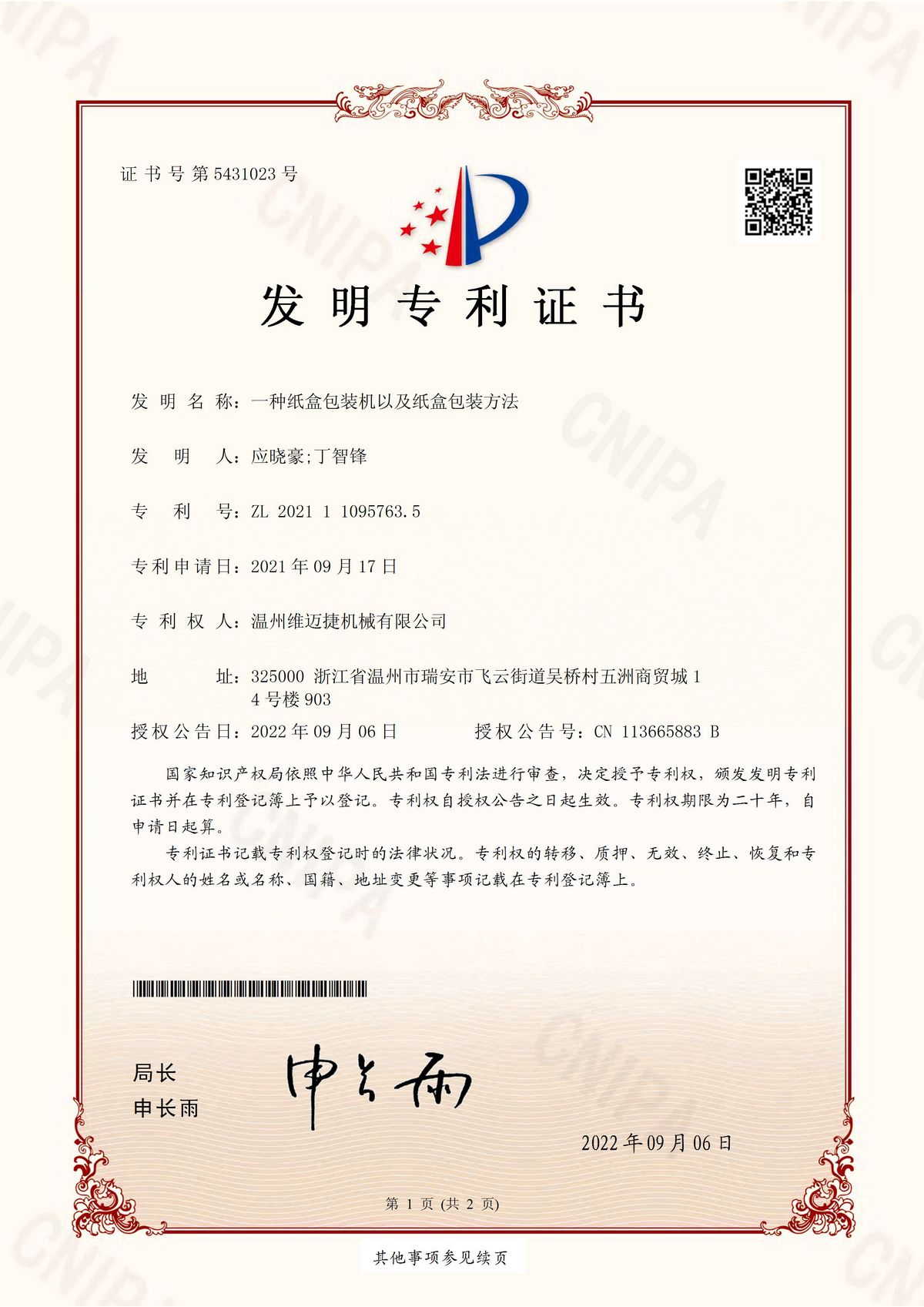
Invention Patent Certificate ZL 2022 1 1099886.8 — carton packing machine and carton packaging process.
Case Reference 1 — United States: Wrapped Toilet Paper Rolls, Case Packing and Palletizing
Project profile: 6 sets, tissue paper manufacturer, automatic operation, in service 4 years, customized design compliant with CE standards.
Flow: raw toilet paper rolls are conveyed to a toilet paper roll wrapping machine (TW-160: 60–120 rolls/min, roll dimensions 90–130 x 90–130 mm, wrapping paper 17–37 gsm). Finished roll packs travel by conveyor to the case packer (CP-T60), which loads them into cartons. Sealed cartons move to an automatic palletizer, then to a strapping machine, and finally to a stretch wrapping machine that stabilizes the whole pallet load. The line maximum wrapping speed is 120 rolls/min and its maximum palletizing speed is 10 cycles/min.
Result: the line packs toilet paper rolls with wrapping paper, followed by case packing, automatic palletizing, strapping and stretch film wrapping, and outputs finished pallet loads that are dustproof, moisture-resistant and ready for transportation.
Second US reference: tissue canisters into cartons
A separate US project (1 set, in service 5 years) used the CP-T60 specifically to load tissue canisters into cartons in a continuous automated operation, adapting to multiple specifications of tissue cans and replacing manual box filling. Reported outcomes: improved production efficiency, reduced labor costs and standardized packing procedures, with consistent packing of tissue cans and lower collision and deformation risk during transit, plus lower overall logistics and labor expenses. Quick size changeover and a long service lifespan were listed as project highlights — the two items that matter most when one line runs more than one can format.
Case Reference 2 — Poland: 12 Sets Automating Facial Tissue from Box Packing to Pallet
Project profile: 12 sets, tissue paper manufacturer, automatic operation, in service 2 years, customized design compliant with CE standards.
The Polish line is the deepest integration of the three. Facial tissue is packed into cartons on the TC-100 tissue cartoning machine (30–100 boxes/min) and the TC-300 automatic high-speed tissue box packing machine (up to 180 boxes/min), while the TP-280 automatic high-speed soft tissue wrapping machine (up to 260 packs/min, CPP, PE or composite film at 0.035–0.05 mm) handles film-wrapped soft packs. Boxes and packets are then case packed on the CP-S50 side load case packer, conveyed to a robotic palletizer, strapped and stretch wrapped. Published line maximums: cartoning 100 boxes/min, case packing 10 cases/min, palletizing 10 cycles/min.
Scope was one-stop turnkey: conveying, automatic cartoning, case packing, pallet feeding, robotic palletizing, strapping and stretch wrapping, covering every procedure from inner packaging to a palletized finished product. Result: whole pallets stacked with shipping cases of cartoned facial tissue and cream tissue, each load bundled with straps and fully covered with stretch film — stable, dust proof and moisture proof, ready for direct warehousing or delivery to customers.
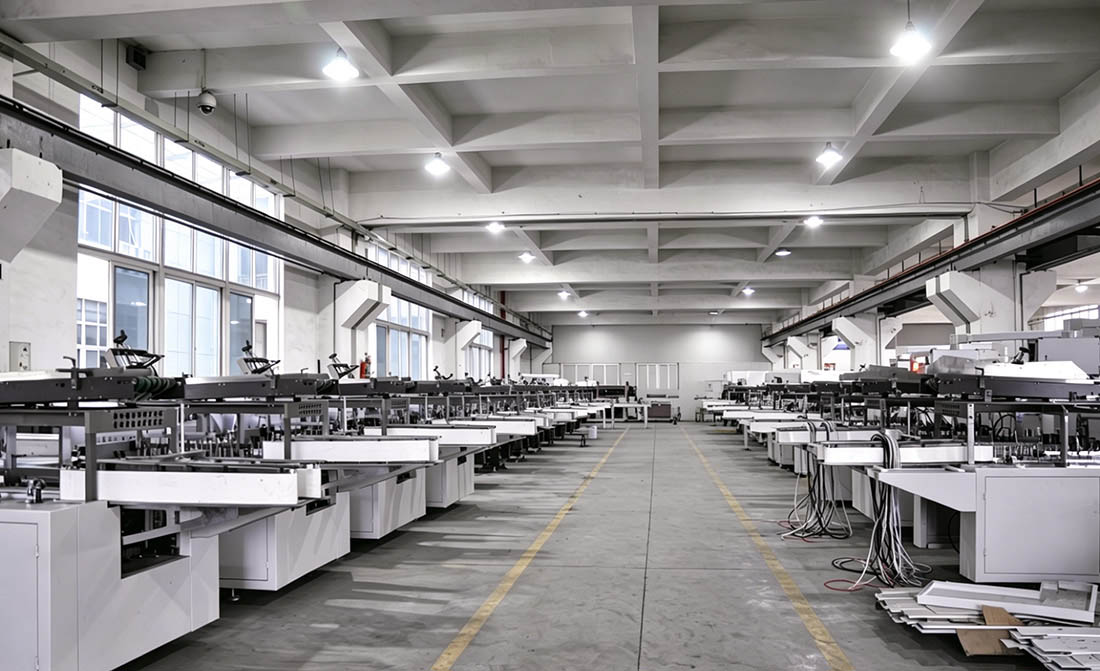
Case packers and integrated tissue packaging lines are built and tested at the WIMACH workshop in Ruian, Wenzhou, Zhejiang, China.
Case Reference 3 — Mexico: Canister Wet Wipes through Case Packing to Wrapped Pallets
Project profile: 9 sets, tissue paper manufacturer, automatic operation, in service 5 years, customized design compliant with CE standards, project type canister wet disinfecting wipes.
Flow: empty canisters are automatically fed onto the conveyor; wipes are loaded into each canister; disinfectant liquid is filled in precise quantities; canisters pass through heat sealing and then a capping station for automatic lid tightening; finished canisters are labeled; the complete canister product is conveyed to the case packer (CP-T60) for automatic carton packing; sealed cartons are stacked onto pallets by an automatic palletizer; loaded pallets are strapped and wrapped with stretch film. The canister wet wipe packaging line is rated for a stable production capacity of up to 60 canisters/min, with a maximum canister dimension of 110 mm diameter x 220 mm height. The related canister packing machine, the TC-80Y, runs at 30–80 boxes/min.
Result: fully finished, labeled, cased and palletized wet wipe products, with every packaging step running automatically so canisters are processed consistently and stacked, strapped and stretch-wrapped into secure whole-pallet shipments for stable warehousing and transportation.
Step-by-Step: Integrating a Case Packing Section into a Tissue Line
- Define the product medium first. Record what the case packer will actually receive — wrapped toilet paper roll packs, facial tissue boxes, film-wrapped soft packs, wet wipe canisters, or blister-packed daily chemical items — together with dimensions, weight, rigidity and the way the unit leaves the previous machine.
- Fix the case specification before the machine. The carton must fall inside the platform range. CP-S50 accepts 240–500 x 200–400 x 180–400 mm; CP-T60 accepts 300–600 x 200–400 x 150–400 mm.
- Size the packer and the palletizer against peak output. In the Polish line the published figures are 100 boxes/min cartoning, 10 cases/min case packing and 10 cycles/min palletizing. The two downstream stages have to be specified as a pair, otherwise the case packer becomes the buffer for the whole line.
- Choose the loading method from the medium. Side push for rigid, stackable, rectangular packs; pick-and-place top load for rolls, canisters and unstable units.
- Confirm utilities and floor space. Both platforms run on 380 V, 50/60 Hz, 3 phase, with compressed air at 0.5–0.8 MPa — 4.5 kW and 350 L/min for the CP-S50, 7.5 kW and 450 L/min for the CP-T60. Footprints are 4,200 x 2,300 x 1,900 mm (1,500 kg) and 4,200 x 2,600 x 2,200 mm (1,600 kg).
- Define the compliance scope for the destination market. CE with EN ISO 12100 for the EU, ANSI/PMMI B155.1-2023 for the US. All three reference projects were customized designs compliant with CE standards.
- Agree the customization items in writing. WIMACH customizes packaging dimensions, machine configuration, voltage and logo. Minimum order quantity is 1 set; customization lead time is 30–45 days, OEM/ODM lead time is 15–45 days, and monthly production capacity is 13 sets.
- Validate at the factory, then commission on site. Factory validation covers a no-load and load running test, dimensional tolerance inspection, mechanical assembly check, pneumatic leakage test, electrical safety test, PLC control logic test, safety interlock and E-stop test, long-time aging test and surface appearance inspection. After delivery, service covers installation and commissioning, training, warranty service, remote technical support, lifetime after-warranty support, and upgrade and retrofit service.
Decision Framework: Matching the Case Packer to the Product Medium
| Product medium reaching the case packer | Condition of the unit | Loading method that fits | Reference project |
|---|---|---|---|
| Wrapped toilet paper roll packs | Cylindrical, wrapped, moderately compressible | Top load / pick-and-place (CP-T60) | United States, 6 sets, in service 4 years |
| Boxed facial tissue and cream tissue cartons | Rectangular, rigid, stackable | Side load / side push (CP-S50) | Poland, 12 sets, in service 2 years |
| Film-wrapped soft tissue packs | Rectangular, semi-rigid | Side load / side push (CP-S50) inside the same integrated line | Poland, 12 sets |
| Canister wet disinfecting wipes | Rigid cylindrical container with liquid content | Top load / pick-and-place (CP-T60) | Mexico, 9 sets, in service 5 years |
| Tissue canisters in cartons | Multiple canister specifications, continuous flow | Top load / pick-and-place (CP-T60) | United States, 1 set, in service 5 years |
| Daily chemical and cosmetic containers | Varies by container design | Decided by whether the unit can be pushed sideways without deformation; both platforms list this industry as applicable | No reference project in this guide |
- Rigid, stackable units loaded from the side → CP-S50.
- Cylindrical, unstable or vertically oriented units → CP-T60.
- Multiple case or pack formats on one line → confirm changeover method and tooling at quotation stage; quick size changeover is listed as a highlight of these reference projects.
- Export to the EU or the US → confirm the compliance scope before the order, not after.
CP-S50 vs CP-T60: Specification Comparison
| Parameter | CP-S50 | CP-T60 |
|---|---|---|
| Type | Side load case packer / side push case packer | Pick-and-place case packer / top load case packer |
| Packing capacity | 1–16 cartons/min | 1–8 cartons/min |
| Carton dimensions | 240–500 (L) x 200–400 (W) x 180–400 (H) mm | 300–600 (L) x 200–400 (W) x 150–400 (H) mm |
| Power voltage | 380 V, 50/60 Hz, 3 phase | 380 V, 50/60 Hz, 3 phase |
| Power consumption | 4.5 kW | 7.5 kW |
| Air pressure | 0.5–0.8 MPa | 0.5–0.8 MPa |
| Air consumption | 350 L/min | 450 L/min |
| Overall dimensions | 4,200 x 2,300 x 1,900 mm | 4,200 x 2,600 x 2,200 mm |
| Overall weight | 1,500 kg | 1,600 kg |
| Material | Stainless steel / carbon steel | Stainless steel / carbon steel |
| Applicable industries | Tissue; food and beverage; pharmaceutical; daily chemical and cosmetic; hardware, auto parts and machinery | Tissue; food and beverage; pharmaceutical; daily chemical and cosmetic; hardware, auto parts and machinery |
| Reference projects | Poland facial tissue line, 12 sets | US toilet paper roll line, 6 sets; US tissue canister project, 1 set; Mexico canister wet wipe line, 9 sets |
Frequently Asked Questions
What certification and patent coverage should a CE-certified automatic case packer for tissue lines have?
For a case packer sold into the EU, EN ISO 12100 — the harmonized European standard for machinery safety — is the baseline for CE marking, while ANSI/PMMI B155.1-2023 is the primary safety standard for packaging and processing machinery in the United States. WIMACH machines are CE certified, and the US, Polish and Mexican projects in this guide were all delivered as customized designs compliant with CE standards. Two Chinese patents cover carton handling: Utility Model Patent Certificate ZL 2022 2 1202677.7, issued 25 April 2023 and valid to 11 September 2033, for an automatic feeding mechanism and a box forming mechanism for carton packaging machines, and Invention Patent Certificate ZL 2022 1 1099886.8, issued 6 September 2022 and valid to 17 September 2042, for a carton packing machine and carton packaging process. Both were granted by the National Intellectual Property Administration, PRC, under the Patent Law of the People's Republic of China, and both apply to the China market.
Can one type of case packer handle toilet paper roll packs, facial tissue boxes, and wet wipe canisters?
The three reference projects show a mapping rather than one universal machine. Wrapped toilet paper roll packs (US, 6 sets) and canister wet wipes (Mexico, 9 sets) were case packed with the CP-T60 automatic top load pick-and-place packer, which accepts cartons from 300–600 x 200–400 x 150–400 mm at 1–8 cartons/min. Boxed and soft-pack facial tissue (Poland, 12 sets) was case packed with the CP-S50 automatic side load side push packer, which accepts cartons from 240–500 x 200–400 x 180–400 mm at 1–16 cartons/min. Both platforms list the tissue, food and beverage, pharmaceutical, daily chemical and cosmetic, hardware, and auto parts industries as applicable; the deciding factor is how the product arrives at the infeed and whether the case is loaded from the side or from above.
What drives the cost of integrating a case packer into an existing tissue line?
Cost is driven by scope rather than by a list price. The customization variables quoted by WIMACH are packaging dimensions, machine configuration, voltage and logo, so the configuration of the case packer — loading method, carton range, material, and tooling for each case format — sets the baseline. The larger variable is line scope: whether the order is a single standalone case packer or a complete integrated line that also includes cartoning or wrapping equipment, a palletizer, a strapping machine and a stretch wrapping machine, as in the Polish and Mexican projects. Commercial parameters that affect planning are a minimum order quantity of 1 set, a monthly production capacity of 13 sets, and lead times of 30–45 days for customized machinery service and 15–45 days for OEM/ODM.
How is a case packer validated before it leaves the factory?
Factory validation before shipment covers a no-load and load running test, dimensional tolerance inspection, mechanical assembly check, pneumatic leakage test, electrical safety test, PLC control logic test, safety interlock and E-stop test, long-time aging test and surface appearance inspection. The after-sales scope then covers installation and commissioning, training, warranty service, remote technical support, lifetime after-warranty support, and upgrade and retrofit service.
What is the lead time and minimum order quantity for a customized case packer, and how do I start?
Minimum order quantity is 1 set. Lead time is 30–45 days for customized machinery service and 15–45 days for OEM/ODM, against a monthly production capacity of 13 sets. A practical first step is to send the product medium, unit dimensions and weight, target case size, required output per minute and destination market; WIMACH will then confirm which platform fits and whether a single case packer or an integrated line is the right scope. Contact Rex Din at rex@wimach.cn or +86 177 5771 8080 (WhatsApp available), and download the machine catalogue at Wimach Catalog.
Conclusion: Start from the Product, Then the Case, Then the Line
A tissue line rarely fails at the case packer because the machine is slow; it fails because the loading method does not match the product medium. Wrapped toilet paper rolls and canister wet wipes went through the CP-T60 top load pick-and-place packer in the US and Mexican projects, while boxed and soft-pack facial tissue went through the CP-S50 side load side push packer in the 12-set Polish line. Both platforms are CE certified, both list the tissue, food and beverage, pharmaceutical, and daily chemical and cosmetic industries as applicable, and both are customized on packaging dimensions, machine configuration, voltage and logo.
If you are planning an end-of-line case packing section in the US, Poland, Mexico or another tissue market, send your product medium and case specification for a configuration review, and request sample-stage confirmation of the packing method before the line layout is fixed.

Wenzhou Wimach Machinery Co., Ltd. (WIMACH)
Bldg 14 Qiaomao Rd, Ruian, Wenzhou, Zhejiang, China
Website: www.wimach.cn | Blog: blog.wimach.cn
Contact: Rex Din | rex@wimach.cn | Tel/WhatsApp: +86 177 5771 8080
WhatsApp: Start a conversation | Catalogue: Wimach Catalog
Have Questions or Need More Details?
Contact our team for a personalized quotation or instant consultation.
Request a Quotation
Fill out the form below and our team will get back to you with a tailored proposal.
WhatsApp Direct Chat
Prefer to chat in real-time? Message us on WhatsApp for instant assistance & quick answers.
- Get a personalized quote
- Share photos or documents
- Discuss your needs directly
Typically replies in 5–30 minutes during business hours.