
Wrapping and Bagging Compliance: A Global Voltage and Air Pressure Guide for WIMACH Equipment
Answer first: WIMACH wrapping and bagging machines are engineered around two fixed utility inputs — a 380V 50/60Hz 3-phase power supply and a compressed-air supply of 0.5–0.8 MPa. Power consumption ranges from 3.5 kW on the TC-80Y canister packing machine to 35 kW on the TB-F60 bottom dispensing bagging machine, while air consumption ranges from 120 L/min to 450 L/min depending on the model. Confirming these two numbers before your container ships is the most effective way to protect your installation schedule — because a utility that does not match the machine is a compliance problem, not a maintenance detail.
Why Utility Readiness Is a Compliance Requirement, Not an Afterthought
A tissue packing machine is only as capable as the utilities feeding it. Manufacturers publish a rated voltage, frequency, phase, installed power, working air pressure and air consumption for every model, and those figures are the boundary conditions under which the machine is validated. A toilet roll wrapping machine rated at 380V 50/60Hz 3-phase cannot be measured against its stated output if it is connected to a supply that does not match that rating, and a bagging machine that needs a stable air line between 0.5 and 0.8 MPa will not hold its cycle time if the plant compressor cannot sustain the required flow.
For international buyers in the research and evaluation stage, this creates a specific decision. Utility requirements must be treated as procurement prerequisites: before you confirm an order, your plant should already know whether the electrical panel, cabling, compressor, dryers and filtration can deliver the machine's rated inputs. This is why WIMACH lists voltage alongside packaging dimensions, machine configuration and logo as a configurable item across its production modes — choosing the right input is part of the order, not a problem to be solved on the factory floor after arrival.
The Global Compliance Picture for Tissue Packaging Equipment
The context behind these utility requirements is a packaging market that is shifting toward automation and toward tighter regional rules. According to Transparency Market Research, the global tissue paper packaging machines market was valued at USD 273.8 million in 2023 and is projected to reach USD 433.7 million by 2032. Automatic equipment is already dominant within that market: automatic tissue packaging machines held a market share of 58.3% in 2025, driven by the move toward unmanned and data-driven production lines, and Asia Pacific captured 42.6% of global revenue in 2025 as the largest regional market.
On the regulatory side, packaging machinery sold into the European Union must satisfy the Machinery Directive (2006/42/EC) and is transitioning to the new EU Machinery Regulation (2023), which places additional focus on cybersecurity alongside traditional mechanical safety. That two-part reality — more automation, more rules — is why a voltage and air pressure guide matters. Compliance is not only about a certificate on the wall; it is about proving that the installed machine matches the certified configuration in the environment where it will run.
WIMACH Electrical and Pneumatic Requirements in Detail
Electrical requirements: voltage, frequency and phase
Every WIMACH wrapping and bagging machine — from the TC-100 Tissue Cartoning Machine to the high-speed TP-280 soft tissue wrapping machine — is rated for a 380V 50/60Hz 3-phase power supply. The 50/60Hz rating means the equipment is specified to operate on either 50 Hz or 60 Hz networks, which is a practical consideration for buyers sourcing across regions. Installed power, however, is model-specific and should be used to size your electrical distribution:
- TC-80Y automatic tissue canister packing machine: 3.5 kW
- CP-S50 automatic side load case packer: 4.5 kW
- TC-100 Tissue Cartoning Machine: 6.2 kW
- TC-80F Cube Box Tissue Cartoning Machine: 7 kW
- CP-T60 automatic top load case packer: 7.5 kW
- TC-300 Automatic High-Speed Tissue Box Packing Machine: 8 kW
- TW-160 Automatic Toilet Paper Roll Wrapping Machine: 12 kW
- TP-180 Automatic Soft Tissue Wrapping Machine: 12 kW
- TB-R30 Automatic Tissue Roll Bundle Bagging Machine: 13 kW
- TP-280 Automatic High-Speed Soft Tissue Wrapping Machine: 18 kW
- TB-F60 Automatic Bottom Dispensing Tissue Bagging Machine: 35 kW
When several machines are combined into an integrated line, the installed power of the individual units adds up, and the electrical plan should be sized for the total connected load rather than a single machine. Because voltage is a configurable item, buyers whose site supply differs from the standard 380V 50/60Hz 3-phase configuration should raise this during the quotation stage so it is built into the machine specification.
Pneumatic requirements: air pressure and air consumption
Across the wrapping and bagging range, the working air pressure requirement is consistent at 0.5–0.8 MPa. Air consumption, by contrast, varies widely by model — and it is air consumption, not pressure, that most often determines whether a factory compressor is adequate:
- TB-F60 bottom dispensing tissue bagging machine: 120 L/min
- TW-160 toilet paper roll wrapping machine: 120–160 L/min
- TC-100 Tissue Cartoning Machine: 120–160 L/min
- TC-300 Automatic High-Speed Tissue Box Packing Machine: 120–160 L/min
- TC-80Y automatic tissue canister packing machine: 120–160 L/min
- TC-80F Cube Box Tissue Cartoning Machine: 120–160 L/min
- CP-S50 automatic side load case packer: 350 L/min
- TB-R30 tissue roll bundle bagging machine: 450 L/min
- CP-T60 automatic top load case packer: 450 L/min
A useful planning rule follows directly from these figures: if a wrapping or bagging machine is combined with a case packer in the same line, the case packer’s higher air consumption (350–450 L/min) usually sets the compressor sizing requirement. The TC-100 cartoning machine’s 120–160 L/min consumption, for example, is modest on its own but must be added to the other units sharing the same air line.
Certification and documentation that support the utility specification
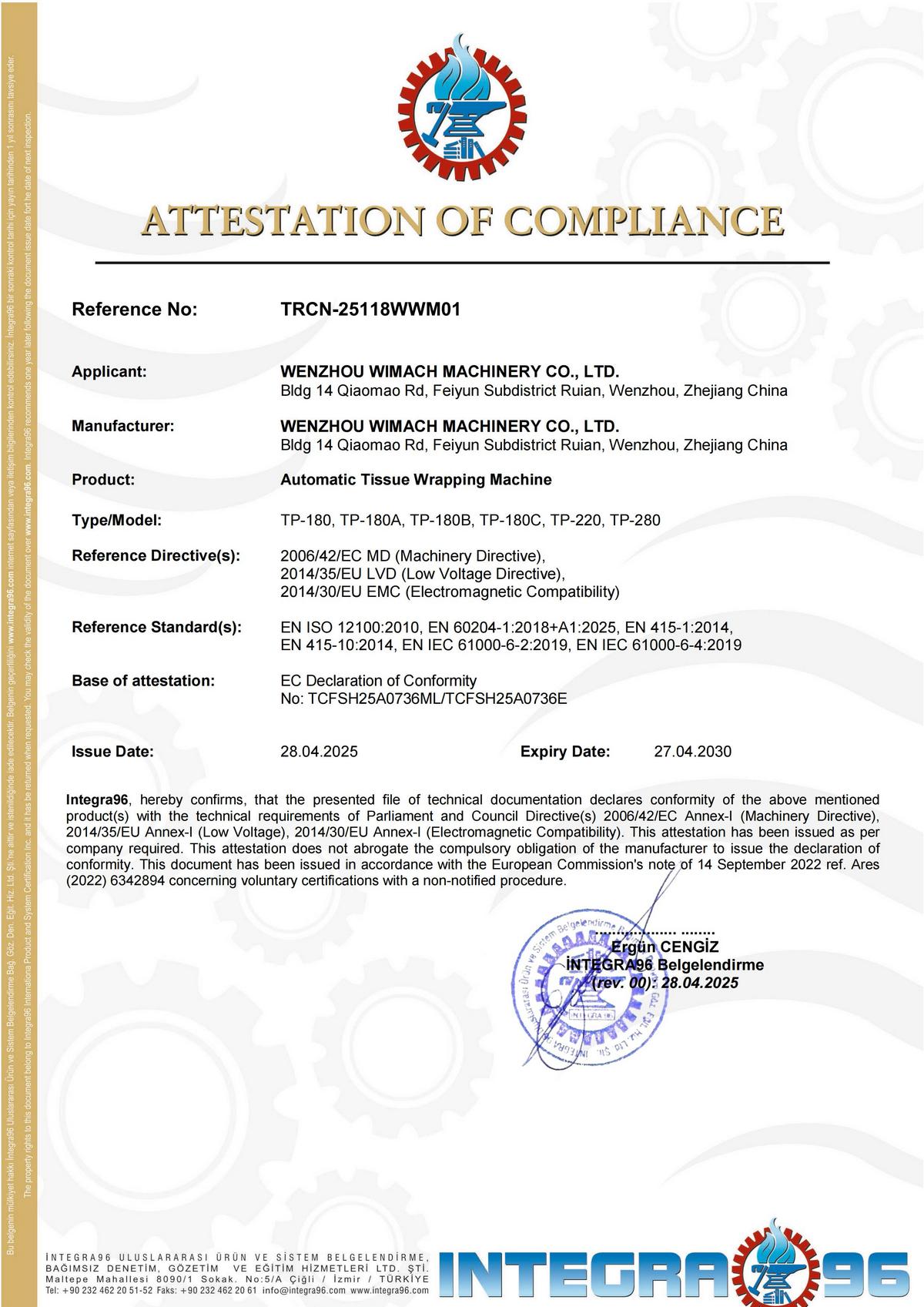
Utility data and conformity documents go together. WIMACH’s cartoning machines — the TC-100, TC-300 and TC-80F — hold CE certification number TRCN-25091WWM01, issued by iNTEGRA96 Belgelendirme for the EU market, under applicable standards that include EN ISO 12100:2010 and EN 60204-1:2018. The wrapping machines — the TP-180 and TP-280 — hold CE certification number TRCN-25118WWM01, issued by iNTEGRA96 Belgelendirme, under applicable standards that include EN ISO 12100:2010, EN 60204-1:2018+A1:2025, EN 415-1:2014, EN 415-10:2014, EN IEC 61000-6-2:2019 and EN IEC 61000-6-4:2019.
WIMACH also protects the engineering behind these machines. The TC-100 Tissue Cartoning Machine and the TC-300 Automatic High-Speed Tissue Box Packing Machine are covered by an invention patent issued by the National Intellectual Property Administration, PRC, under the Patent Law of the People’s Republic of China (patent number ZL 2022 1 1099886.8). A utility model patent (ZL 2022 2 1202677.7) additionally covers the box forming and automatic feeding mechanisms used in the cartoning range, including the TC-80F Cube Box Tissue Cartoning Machine.
Step-by-Step: Preparing Your Factory for a WIMACH Installation
Turning the specification into a ready factory is a sequence, not a single task. The following checklist reflects the utility requirements above and the way WIMACH equipment is commissioned.
- Confirm your site supply against the machine rating. Verify that your incoming supply matches 380V 50/60Hz 3-phase, or flag the difference early so the voltage configuration can be adapted during production.
- Total the installed power of every unit in the line. Add the kW figures of the individual machines you are combining so the panel and cabling are sized for the connected load.
- Size the compressor to the highest simultaneous air demand. Use the air consumption figures per model, remembering that case packers can draw 350–450 L/min and will often dominate the total.
- Confirm the air line delivers 0.5–0.8 MPa at the machine. Pressure at the point of use — not at the compressor outlet — is what the machine sees, so account for line losses, dryers and filtration.
- Plan the pneumatic and electrical safety interfaces. WIMACH equipment is tested against safety interlock and E-stop logic, so the site connection should be ready to support these circuits.
- Verify conformity documentation for your destination market. Check that the CE or patent documentation relevant to your region and models is in hand before shipping.
- Schedule installation, commissioning and training. WIMACH supports installation and commissioning, operator training, warranty service, remote technical support, lifetime after-warranty support, and upgrade and retrofit service.
How Utility Planning Plays Out in Real Projects
The same preparation discipline appears across WIMACH’s international installations. A US tissue paper manufacturer operates a customized toilet paper packaging line that integrates roll wrapping, case packing, automatic palletizing and stretch film wrapping; the project was delivered as a customized design compliant with CE standards. In another US project, two sets of the TW-160 Automatic Toilet Paper Roll Wrapping Machine have been wrapping and sealing toilet rolls with pre-printed tissue paper, integrating wrapping and sealing for continuous automated production and replacing plastic packaging with lightweight all-paper packaging.
In Poland, a tissue paper manufacturer runs a complete packaging line for facial tissue and cream tissue that connects conveying, cartoning, case packing, robotic palletizing, strapping and stretch wrapping. The line’s equipment set includes the TP-280 high-speed soft tissue wrapping machine, the TC-300 high-speed box packing machine, the TC-100 cartoning machine and the CP-S50 side load case packer — a combination where the case packer’s 350 L/min air demand must be planned alongside the wrapping and cartoning units. In the United Arab Emirates, a tissue paper manufacturer has operated an automatic tissue canister packing machine for facial tissue and paper napkins, achieving a stable output of up to 60 canisters per minute with a canister conveying line and lid feeding system.
Wrapping and Bagging Machine Utility Comparison
The table below summarizes the electrical and pneumatic inputs for the WIMACH wrapping and bagging models most often specified by international buyers. Values are the published specifications for each model; where a figure is not specified by the manufacturer, it is shown as not specified rather than estimated.
| Model | Function | Power voltage | Power consumption | Air pressure | Air consumption |
|---|---|---|---|---|---|
| TW-160 | Toilet paper roll wrapping | 380V 50/60Hz 3-phase | 12 kW | 0.5–0.8 MPa | 120–160 L/min |
| TP-180 | Soft tissue wrapping | 380V 50/60Hz 3-phase | 12 kW | 0.5–0.8 MPa | Not specified |
| TP-280 | High-speed soft tissue wrapping | 380V 50/60Hz 3-phase | 18 kW | 0.5–0.8 MPa | Not specified |
| TB-R30 | Tissue roll bundle bagging | 380V 50/60Hz 3-phase | 13 kW | 0.5–0.8 MPa | 450 L/min |
| TB-F60 | Bottom dispensing tissue bagging | 380V 50/60Hz 3-phase | 35 kW | 0.5–0.8 MPa | 120 L/min |
| TC-100 | Tissue cartoning | 380V 50/60Hz 3-phase | 6.2 kW | 0.5–0.8 MPa | 120–160 L/min |
| TC-300 | High-speed tissue box packing | 380V 50/60Hz 3-phase | 8 kW | 0.5–0.8 MPa | 120–160 L/min |
Two patterns stand out for buyers. First, the electrical rating is uniform while installed power is not, so your power plan should follow the kilowatt figure of the specific model rather than the general voltage class. Second, air pressure is constant at 0.5–0.8 MPa across the range, but air consumption varies by nearly a factor of four — which is why compressor sizing should always begin from the highest-consuming unit in the line.
Frequently Asked Questions
What power supply do WIMACH tissue packing machines require?
Every WIMACH wrapping and bagging machine — including the TC-100 Tissue Cartoning Machine, the TP-280 high-speed soft tissue wrapping machine and the TW-160 toilet paper roll wrapping machine — is rated for a 380V 50/60Hz 3-phase power supply. The 50/60Hz rating allows operation on either 50 Hz or 60 Hz networks. Installed power is model-specific: the TC-80Y draws 3.5 kW, the TC-100 6.2 kW, the TC-80F 7 kW, the TC-300 8 kW, the TW-160 and TP-180 12 kW each, the TB-R30 13 kW, the TP-280 18 kW, and the TB-F60 35 kW. Voltage itself is a configurable item, so buyers whose site supply differs from the standard configuration should state this during quotation.
What air pressure and air consumption do WIMACH wrapping and bagging machines need?
All WIMACH wrapping and bagging models operate at a working air pressure of 0.5–0.8 MPa. Air consumption depends on the model: the TB-F60 bagging machine uses 120 L/min; the TW-160 toilet paper roll wrapping machine, the TC-100 cartoning machine, the TC-300 box packing machine, the TC-80Y canister packing machine and the TC-80F cube box cartoning machine use 120–160 L/min; the CP-S50 side load case packer uses 350 L/min; and the TB-R30 bagging machine and CP-T60 top load case packer use 450 L/min. Because a line shares one air supply, the compressor should be sized against the highest simultaneous demand — usually the case packer.
Are WIMACH tissue packing machines CE-certified, and which documentation do buyers receive?
Yes. The WIMACH cartoning machines — TC-100, TC-300 and TC-80F — carry CE certification number TRCN-25091WWM01, issued by iNTEGRA96 Belgelendirme for the EU market, under applicable standards that include EN ISO 12100:2010 and EN 60204-1:2018. The wrapping machines — TP-180 and TP-280 — carry CE certification number TRCN-25118WWM01, issued by iNTEGRA96 Belgelendirme, under applicable standards that include EN ISO 12100:2010, EN 60204-1:2018+A1:2025, EN 415-1:2014, EN 415-10:2014, EN IEC 61000-6-2:2019 and EN IEC 61000-6-4:2019. On the engineering side, the TC-100 and TC-300 are covered by invention patent ZL 2022 1 1099886.8 issued by the National Intellectual Property Administration, PRC, and a utility model patent (ZL 2022 2 1202677.7) covers the box forming and feeding mechanisms used across the cartoning range.
Can WIMACH adapt the voltage and configuration to my market?
Yes. WIMACH offers three production modes — complete packaging lines, customized machinery service, and OEM/ODM — and voltage is listed as a configurable item in all three, alongside packaging dimensions, machine configuration and logo. This means the electrical input can be aligned with your site conditions as part of the machine specification rather than adjusted after delivery. WIMACH holds over 12 years of industry experience, operates from a 3,000 m² facility with 37 employees and a 5-engineer R&D team, produces an annual output of 160 sets, and exports about 60% of its equipment to the EU, North America and South America.
What is the lead time, and how do I start an order?
Lead time depends on the production mode: a complete packaging line is typically quoted at 30–60 days, customized machinery service at 30–45 days, and OEM/ODM at 15–45 days, with a minimum order quantity of 1 set. WIMACH supports the full lifecycle after delivery through installation and commissioning, training service, warranty service, remote technical support, lifetime after-warranty support, and upgrade and retrofit service. To begin, share your target tissue type, packaging format and site utility conditions, and the team can confirm the matching model and its exact voltage and air requirements. You can reach WIMACH at rex@wimach.cn or download the full catalog below.
Conclusion
Voltage and air pressure are the two inputs that decide whether a wrapping or bagging machine can be commissioned to specification — and for international buyers, they are compliance items to be settled before shipping, not details to be resolved on site. WIMACH equipment standardizes on a 380V 50/60Hz 3-phase supply and a 0.5–0.8 MPa air line, while installed power and air consumption vary by model and must be added up across a line. Matching those figures to your factory supply, compressor capacity and documentation requirements is what turns a compliant specification into a working production line.
Ready to prepare your factory utilities?
Review the WIMACH machinery catalog for full model specifications, or send your site voltage and air supply details for a model recommendation.
Download the catalog: WIMACH Catalog · Website: www.wimach.cn · Contact Rex Din · rex@wimach.cn · WhatsApp +86 177 5771 8080
Have Questions or Need More Details?
Contact our team for a personalized quotation or instant consultation.
Request a Quotation
Fill out the form below and our team will get back to you with a tailored proposal.
WhatsApp Direct Chat
Prefer to chat in real-time? Message us on WhatsApp for instant assistance & quick answers.
- Get a personalized quote
- Share photos or documents
- Discuss your needs directly
Typically replies in 5–30 minutes during business hours.