
TC-100 vs. TC-300 vs. TP-180: Choosing a Tissue Packing Machine for Boxed and Soft Tissue
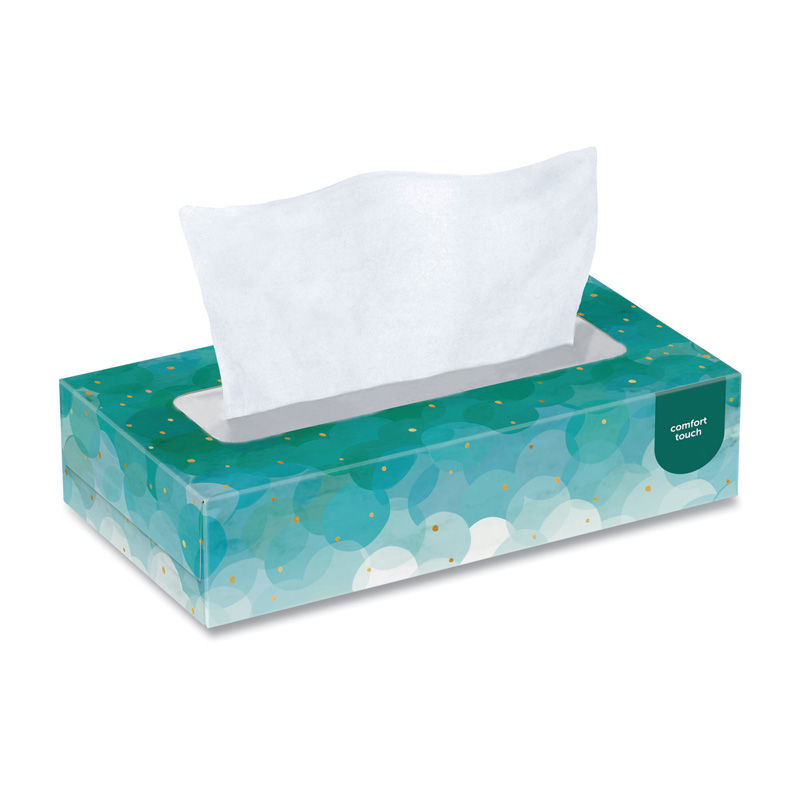
Cover: TC-300 Automatic High-Speed Tissue Box Packing Machine — cartoning for boxed facial tissue at up to 180 boxes/min.
Choosing between the TC-100, TC-300 and TP-180 comes down to one question before speed is even discussed: does the finished retail unit leave the line as a rigid paperboard box or as a flexible film pack? The TC-100 Tissue Cartoning Machine and the TC-300 Automatic High-Speed Tissue Box Packing Machine both pack folded tissue into paperboard cartons, while the TP-180 Automatic Soft Tissue Wrapping Machine encloses tissue packs in plastic film. That single distinction eliminates most of the confusion before throughput, power supply or floor space are evaluated.
Once the format is settled, the published numbers separate the three models clearly. The TC-100 packs 30–100 boxes/min; the TC-300 packs up to 180 boxes/min; the TP-180 wraps up to 180 packs/min using CPP, PE or composite film. Both cartoners accept 300–400 gsm carton board in the same 100–240 mm (L) x 100–120 mm (W) x 20–90 mm (H) carton envelope, whereas the TP-180 handles a 90–200 mm (L) x 85–105 mm (W) x 25–90 mm (H) pack envelope.
This guide is written for buyers in the research and evaluation stage who need to map a machine to a concrete production scenario: a facial tissue cartoning line, a soft tissue wrapping line, or a plant that runs both. It compares the three models on capacity, package fit, material specification, utility demand and footprint, then closes with a five-step selection sequence, the formats that fall outside these three machines, and a short FAQ.
Problem Definition: The Format Decision Comes Before the Speed Decision
Cartoning and film wrapping are not two speeds of the same process; they are two different packaging processes. Cartoning takes pre-folded tissue and loads it into a paperboard carton that is closed into a rigid, printable box — the format used for boxed facial tissue and napkins on retail shelves. Film wrapping encloses a stack of soft or folded tissue in a plastic film pack, a lighter and more flexible retail unit.
A machine rated at 180 boxes/min cannot produce a film pack, and a machine rated at 180 packs/min cannot produce a rigid box. For that reason, the first purchase decision is not about throughput at all. Three constraints decide the match:
- Pack format — a rigid paperboard carton or a flexible film pack.
- Package envelope — the length, width and height the machine accepts. A carton 250 mm long does not fit a cartoner rated to 240 mm, regardless of the speed rating.
- Packaging material — 300–400 gsm carton board for the cartoners; 0.035–0.05 mm CPP, PE or composite film for the TP-180.
A frequent planning error is to treat the TC-100 and TC-300 as equivalent simply because both are cartoners. They do share a carton range and a carton board grammage, so the format decision between them is neutral: any carton the TC-100 can produce, the TC-300 can also produce, and the reverse is true. Their real differences are output, power consumption and footprint. The TC-100 covers 30–100 boxes/min at 6.2 kW and 2200 kg with a 3620 x 3130 x 1800 mm footprint; the TC-300 reaches up to 180 boxes/min at 8 kW and 3000 kg with a longer 5000 x 1740 x 1800 mm layout. There is no format penalty for choosing either — only a volume, utility and space trade-off.
Crossing from cartoning to wrapping introduces a genuine format change. The TP-180 accepts a shorter pack envelope than the cartoners (90–200 mm against 100–240 mm), works in film rather than board, consumes 12 kW, weighs 2900 kg and publishes a 3585 (L) x 6260 (W) x 1800 (H) mm overall layout — a different footprint pattern from either cartoner. In practice, this means a line conversion from boxed tissue to soft tissue packs is a machine change, not a setting change.
As a working pattern when scanning the range, TC-prefixed models handle board-based packing (boxes, cube boxes and canisters) while TP-prefixed models handle film wrapping. Buyers should still confirm each model against its own datasheet, because formats outside the TC-100 and TC-300 carton envelope are not covered by those two machines at all.
Industry Background: Why Format-Specific Machines Matter More Than Ever
Tissue packaging machinery is a mid-sized equipment category that is automating steadily. Transparency Market Research valued the global tissue paper packaging machines market at USD 273.8 million in 2023 and projects it to reach USD 433.7 million by 2032. Within that category, automatic tissue packaging machines held 58.3% of the market in 2025, a share linked to the shift toward unmanned and data-driven production lines. Asia Pacific is the largest regional market, capturing 42.6% of global revenue, and the cartoning machinery segment applicable to facial tissue and napkins is forecast to grow at a 5.1% CAGR to USD 8.7 billion by 2035 (Global Market Insights).
Supply is a mix of large international converting groups and specialised builders. Widely cited suppliers in the sector include Fabio Perini S.p.A. (Körber), PCMC (Barry-Wehmiller) and Valmet. Wenchow-based WIMACH (Wenzhou Wimach Machinery Co., Ltd.) builds tissue packing machines and integrated packaging lines for folded tissues, rolled tissues and blister packaging applications, with over 12 years of industry experience, a 3000 m² facility, 37 employees, 5 R&D engineers, an annual output of 160 sets and a 60% export ratio concentrated in the EU, North America and South America. All of its machines are CE certified and assembled with components from well-known brands.
Regulation is part of the buying context in Europe: packaging machinery placed on the EU market must comply with the Machinery Directive 2006/42/EC, and the framework is transitioning to the new EU Machinery Regulation (2023), which adds a cybersecurity dimension. WIMACH project records for EU tissue lines list CE compliance as a special requirement, and its documented facial tissue line scenario in Poland operates in automatic mode with CE-compliant design.
Detailed Solution: TC-100, TC-300 and TP-180 Side by Side
TC-100 Tissue Cartoning Machine: the lower-speed, more flexible cartoner
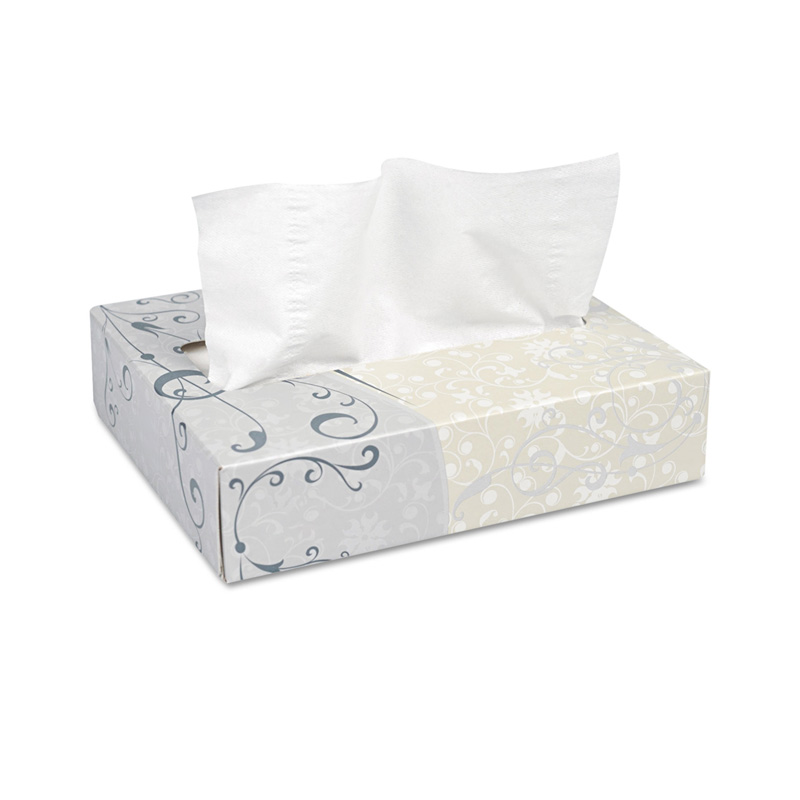
TC-100 Tissue Cartoning Machine — 30–100 boxes/min into 300–400 gsm paperboard cartons.
The TC-100 is the entry cartoner for this comparison. It automatically loads folded facial tissue into paper boxes and supports continuous automatic box packing across different tissue pack sizes.
- Packing capacity: 30–100 boxes/min
- Carton board grammage: 300–400 gsm
- Carton dimensions: 100–240 (L) x 100–120 (W) x 20–90 (H) mm
- Power supply: 380 V, 50/60 Hz, 3-phase
- Power consumption: 6.2 kW
- Air pressure: 0.5–0.8 MPa | Air consumption: 120–160 L/min
- Overall dimensions: 3620 (L) x 3130 (W) x 1800 (H) mm | Weight: 2200 kg
- Construction: carbon steel
The rated capacity spans 30–100 boxes/min, the widest range of the three models, at the lowest power consumption (6.2 kW) and the lightest weight (2200 kg). Documented field performance supports the pattern: a US tissue paper manufacturer has run two WIMACH facial tissue cartoning machines for four years, reporting higher production efficiency, reduced labour cost, unified packing standards, neat tissue arrangement inside boxes and stable mass production with fewer extrusion defects.
TC-300 Automatic High-Speed Tissue Box Packing Machine: the 180 boxes/min cartoner
The TC-300 is the high-speed counterpart in the same carton family. Its published specification is identical to the TC-100 on carton board grammage and carton dimensions, which makes it a drop-in step up when volume rises — but it is a heavier and longer machine with a higher utility demand.
- Max. packing capacity: 180 boxes/min
- Carton board grammage: 300–400 gsm
- Carton dimensions: 100–240 (L) x 100–120 (W) x 20–90 (H) mm
- Power supply: 380 V, 50/60 Hz, 3-phase
- Power consumption: 8 kW
- Air pressure: 0.5–0.8 MPa | Air consumption: 120–160 L/min
- Overall dimensions: 5000 (L) x 1740 (W) x 1800 (H) mm | Weight: 3000 kg
- Construction: carbon steel, aluminium
Compared with the TC-100, the TC-300 adds 1000 mm of machine length, 800 kg of mass and 1.8 kW of installed power to buy up to 80 additional boxes per minute, while air consumption stays inside the same 120–160 L/min band. WIMACH line records show both cartoners deployed together: a Polish tissue paper manufacturer operates a complete facial tissue packaging line (12 sets in the project) that integrates conveying, automatic cartoning, case packing, pallet feeding, robotic palletizing, strapping and stretch wrapping to move from inner packaging to shipment-ready pallets.
TP-180 Automatic Soft Tissue Wrapping Machine: the film-format machine
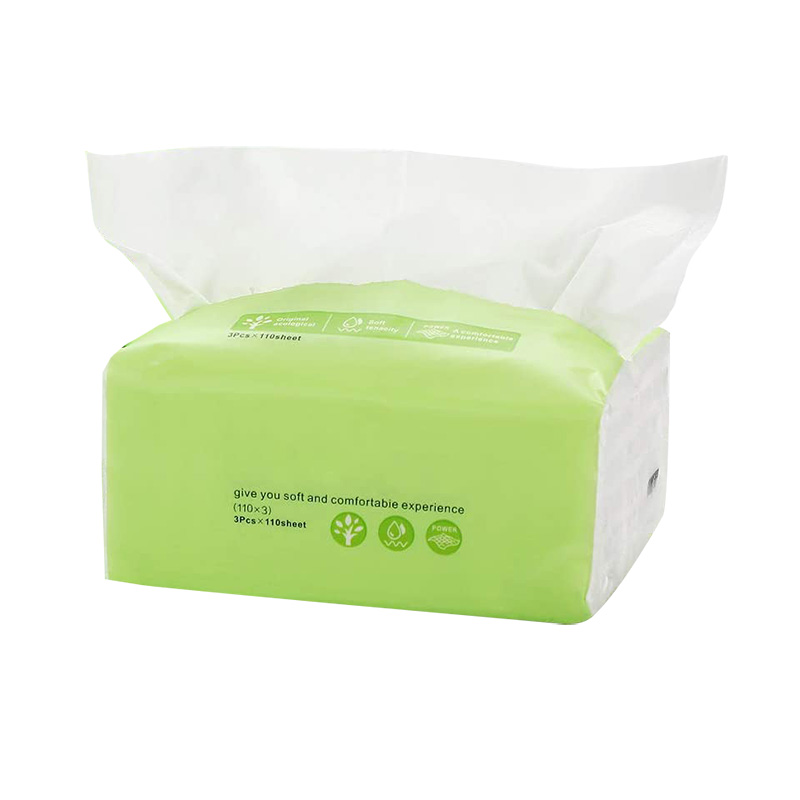
TP-180 Automatic Soft Tissue Wrapping Machine — film packs at up to 180 packs/min.
The TP-180 is the film option: it wraps soft tissue packs rather than loading cartons, and it uses a different material set, a smaller pack envelope and a heavier, wider machine than either cartoner.
- Max. packing capacity: 180 packs/min
- Package dimensions: 90–200 (L) x 85–105 (W) x 25–90 (H) mm
- Film material: CPP, PE or composite film
- Film roll dimension: 340 (W) x 450 (D) mm, thickness 0.035–0.05 mm
- Power supply: 380 V, 50/60 Hz, 3-phase
- Power consumption: 12 kW
- Air pressure: 0.5–0.8 MPa
- Overall dimensions: 3585 (L) x 6260 (W) x 1800 (H) mm | Weight: 2900 kg
- Construction: carbon steel
Two practical points stand out. First, the TP-180 matches the TC-300 on output rate (180/min for both) but reaches that figure in a different format — comparing 180 boxes/min against 180 packs/min is meaningless unless the retail unit is already fixed. Second, the TP-180 consumes 12 kW against 8 kW for the TC-300 and 6.2 kW for the TC-100, so utility provisioning on a wrapping line differs from a cartoning line even at identical output. WIMACH's EU wrapping project records describe the outcome typically reported by tissue paper manufacturers: tidy, airtight packs that protect tissue from moisture, dust and extrusion damage, with printed film improving brand display on mass-production runs.
Where the three models stop: adjacent formats
Neither the TC-100 and TC-300 carton envelope nor the TP-180 pack envelope covers every tissue format. WIMACH's range continues with dedicated models for adjacent products: the TC-80F Cube Box Tissue Cartoning Machine for a fixed 115 x 115 x 130 mm cube carton at 30–80 boxes/min and 7 kW, and the TC-80Y Automatic Tissue Canister Packing Machine for 100–220 (L) x 50–80 (D) mm paper canisters at 30–80 boxes/min and 3.5 kW. A canister project record shows the format working at scale: an automatic tissue canister packing machine used for facial tissue and paper napkins with a canister conveying line and lid feeding system, reporting a stable output of 60 canisters per minute.
Step-by-Step Breakdown: Choosing in Five Steps
Step 1 — Fix the retail format and measure the finished pack
Write down whether the retail unit is a paperboard carton or a film pack, then measure it. For cartons, compare the three dimensions against the TC-100 / TC-300 carton envelope of 100–240 (L) x 100–120 (W) x 20–90 (H) mm. For film packs, compare against the TP-180 envelope of 90–200 (L) x 85–105 (W) x 25–90 (H) mm. If the pack is a cube box or a canister, stop here and evaluate the dedicated models instead.
Step 2 — Set the required line output, then match it to the machine rating
The TC-100 covers 30–100 boxes/min, the TC-300 up to 180 boxes/min and the TP-180 up to 180 packs/min. Where the line itself publishes a rated cartoning speed, the machine should bracket it: WIMACH's Facial Tissue Box Packaging Line is documented at a maximum cartoning speed of 100 boxes/min, alongside a maximum case packing speed of 10 cases/min and a maximum palletizing speed of 10 cycles/min — a line profile that the TC-100's 30–100 boxes/min range matches, while a plant targeting 180 boxes/min at the cartoner would instead specify the TC-300.
Step 3 — Verify the packaging material specification
Carton board for the TC-100 and TC-300 runs from 300 to 400 gsm — the same band for both machines, so board choice does not separate them. Film for the TP-180 must be CPP, PE or composite film supplied on a 340 (W) x 450 (D) mm roll at 0.035–0.05 mm thickness. Specifying film outside that thickness range, or board outside the gsm band, is a material mismatch rather than a machine preference.
Step 4 — Confirm utilities, floor space and floor loading
- Power: 6.2 kW (TC-100), 8 kW (TC-300), 12 kW (TP-180), all on 380 V, 50/60 Hz, 3-phase supply.
- Compressed air: 0.5–0.8 MPa for all three; cartoners consume 120–160 L/min.
- Footprint: 3620 x 3130 x 1800 mm (TC-100), 5000 x 1740 x 1800 mm (TC-300), 3585 x 6260 x 1800 mm (TP-180).
- Weight: 2200 kg (TC-100), 3000 kg (TC-300), 2900 kg (TP-180) — relevant for mezzanine floors and for rigging during installation.
Step 5 — Settle integration, compliance and customization
All three models are part of a range in which machines are CE certified and assembled with branded components. WIMACH customizes full packaging processes, packaging dimensions, machine configuration, voltage and logo, with a minimum order quantity of one set. Lead time is 30–60 days for a complete packaging line, 30–45 days for customized machinery and 15–45 days for OEM/ODM projects. After-sales covers installation and commissioning, training, warranty service, remote technical support, lifetime after-warranty support and upgrade or retrofit service.
Use Cases: Which Machine Fits Which Scenario
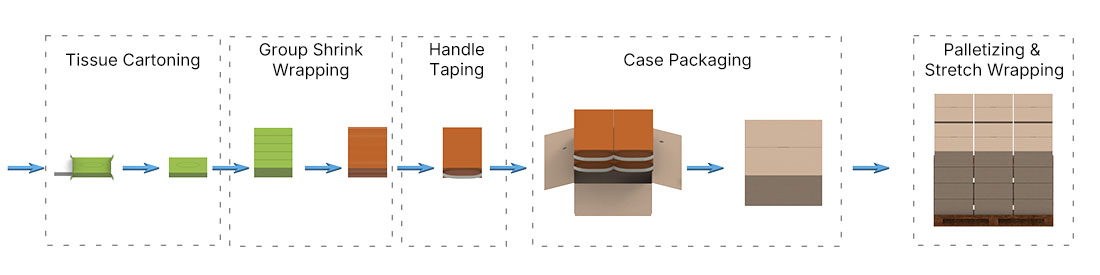
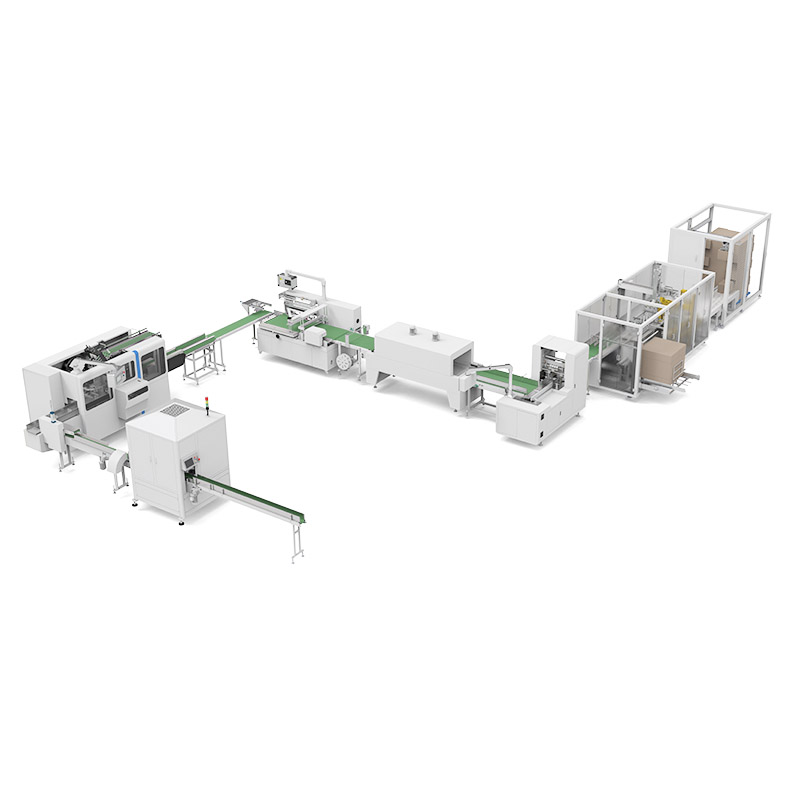
Facial tissue box packaging line flow — cartoning, film wrapping, case packing and palletizing in one automatic sequence.
Boxed facial tissue at moderate volume — TC-100. A plant starting a facial tissue line, or running several box sizes on one line, matches the TC-100's 30–100 boxes/min range and 6.2 kW demand. The US installation record for facial tissue cartoning shows what this delivers in practice: continuous automatic box packing across different tissue pack sizes, more consistent packing standards and reduced reliance on manual packing labour.
Boxed tissue at high volume — TC-300. A dedicated high-speed box line targeting 180 boxes/min uses the TC-300. Because its carton range and board grammage match the TC-100 exactly, a plant can standardise carton artwork and board supply across both machines and scale by adding capacity rather than by redesigning packaging.
Soft tissue and pocket packs — TP-180. Products sold in film rather than board, in the 90–200 x 85–105 x 25–90 mm pack envelope, use the TP-180 at up to 180 packs/min. The material is CPP, PE or composite film at 0.035–0.05 mm, and the reported field benefits of this wrapping format are airtight protection against moisture, dust and extrusion damage, plus clearer branded film display.
Dual-format plants — cartoning plus wrapping in one line. A tissue paper producing and packaging workshop can run both formats. WIMACH's documented European facial tissue packaging line scenario operates in automatic mode and combines facial tissue box packing, plastic film wrapping, tissue box and packet case packing, case palletizing, pallet strapping and pallet stretch wrapping, fed upstream by a tissue folding machine and a tissue cutting machine. The Polish 12-set project behind this pattern produced pallet loads that were strapped and fully stretch-wrapped, stable, dust-proof and moisture-proof, ready for direct warehousing or delivery.
Cube box and canister formats — neither of the three. These are outside the envelopes above and require the dedicated TC-80F and TC-80Y models, which is the fastest way to rule the TC-100, TC-300 and TP-180 in or out.
Comparison Table: TC-100 vs. TC-300 vs. TP-180
| Specification | TC-100 | TC-300 | TP-180 |
|---|---|---|---|
| Machine type | Tissue cartoning machine | Automatic high-speed tissue box packing machine | Automatic soft tissue wrapping machine |
| Packing capacity | 30–100 boxes/min | Up to 180 boxes/min | Up to 180 packs/min |
| Pack format delivered | Paperboard carton | Paperboard carton | Plastic film pack |
| Packaging material | Carton board, 300–400 gsm | Carton board, 300–400 gsm | CPP, PE or composite film, 0.035–0.05 mm |
| Carton / package dimensions | 100–240 (L) x 100–120 (W) x 20–90 (H) mm | 100–240 (L) x 100–120 (W) x 20–90 (H) mm | 90–200 (L) x 85–105 (W) x 25–90 (H) mm |
| Film roll dimension | — | — | 340 (W) x 450 (D) mm |
| Power supply | 380 V, 50/60 Hz, 3-phase | 380 V, 50/60 Hz, 3-phase | 380 V, 50/60 Hz, 3-phase |
| Power consumption | 6.2 kW | 8 kW | 12 kW |
| Air pressure | 0.5–0.8 MPa | 0.5–0.8 MPa | 0.5–0.8 MPa |
| Air consumption | 120–160 L/min | 120–160 L/min | Not published in the model data used here |
| Overall dimensions | 3620 (L) x 3130 (W) x 1800 (H) mm | 5000 (L) x 1740 (W) x 1800 (H) mm | 3585 (L) x 6260 (W) x 1800 (H) mm |
| Weight | 2200 kg | 3000 kg | 2900 kg |
| Construction | Carbon steel | Carbon steel, aluminium | Carbon steel |
The table shows the decision in one line: the TC-100 and TC-300 differ only in output, power, size and weight, while the TP-180 differs in format, material, envelope and utility demand.
| Choose this model when | TC-100 | TC-300 | TP-180 |
|---|---|---|---|
| Best fit | Boxed facial tissue at 30–100 boxes/min, one machine covering several box sizes, lowest power and weight | Boxed tissue lines targeting 180 boxes/min with a standardised carton family | Soft tissue or pocket tissue sold in film packs, up to 180 packs/min |
| Main trade-off | Lower ceiling than the TC-300 | Longer (5000 mm) and heavier (3000 kg) than the TC-100 | Highest power draw of the three at 12 kW; different material supply |
FAQ
Are the TC-100, TC-300 and TP-180 CE certified?
WIMACH states that all of its machines are CE certified, and its EU tissue line project records list CE-compliant design as a special requirement. In the EU, packaging machinery must comply with the Machinery Directive 2006/42/EC, and the framework is transitioning to the new EU Machinery Regulation (2023), which adds a cybersecurity focus. Buyers should confirm that the CE documentation delivered with the machine matches the configuration ordered, including voltage, packaging dimensions and logo customization.
Which machine fits boxed facial tissue, and which fits soft tissue packs?
For boxed facial tissue and similar folded products packed into paperboard cartons, the cartoning options are the TC-100 at 30–100 boxes/min and the TC-300 at up to 180 boxes/min; both accept 300–400 gsm carton board in a 100–240 (L) x 100–120 (W) x 20–90 (H) mm carton. For tissue sold in flexible film packs, the TP-180 wraps up to 180 packs/min using CPP, PE or composite film within a 90–200 (L) x 85–105 (W) x 25–90 (H) mm pack envelope.
Can one production line run both boxed and soft tissue formats?
Yes. WIMACH's documented facial tissue packaging line scenario in Poland operates in automatic mode with CE-compliant design and combines facial tissue box packing, plastic film wrapping, tissue box and packet case packing, case palletizing, pallet strapping and pallet stretch wrapping in one line, fed by a tissue folding machine and a tissue cutting machine. These lines are built to order with a minimum order quantity of one set, and WIMACH customizes full packaging processes, packaging dimensions, machine configuration, voltage and logo.
What validation is performed before a machine ships?
The standard quality control sequence covers no-load and load running tests, dimensional tolerance inspection, mechanical assembly checks, pneumatic leakage testing, electrical safety testing, PLC control logic testing, safety interlock and E-stop testing, a long-time aging test and surface appearance inspection.
What is the lead time, and how do buyers arrange a sample or quotation?
Lead time is 30–60 days for a complete packaging line, 30–45 days for customized machinery and 15–45 days for OEM/ODM projects, with a minimum order quantity of one set. After-sales support covers installation and commissioning, training, warranty service, remote technical support, lifetime after-warranty support and upgrade or retrofit service. To check a model against your own carton or film pack, send the finished pack dimensions, board grammage or film specification and required output to rex@wimach.cn or WhatsApp +86 177 5771 8080; the full machine catalog is available for download here.
Conclusion: Pick the Format First, the Speed Second
For boxed facial tissue and napkins, the choice is between two cartoners that share the same 300–400 gsm board specification and the same 100–240 x 100–120 x 20–90 mm carton envelope. The TC-100 is the lower-power, lighter, more flexible option at 30–100 boxes/min, 6.2 kW and 2200 kg; the TC-300 is the volume option at up to 180 boxes/min, 8 kW and 3000 kg with a 5000 mm length. Because the carton format is identical, this is the simplest decision of the three and can be settled on required output and available floor space alone.
For soft tissue and pocket tissue sold in film, the TP-180 is a different machine family altogether: 180 packs/min, CPP, PE or composite film at 0.035–0.05 mm, a 90–200 x 85–105 x 25–90 mm pack envelope, 12 kW and 2900 kg. Where a plant needs more film-wrapping throughput, the TP-280 extends the same package envelope to 260 packs/min. Where the product is a cube box or a paper canister, the correct starting points are the TC-80F and TC-80Y rather than any of the three machines compared here.
Next step: match the machine to your pack, not to a speed figure
Wenzhou Wimach Machinery Co., Ltd. (WIMACH) builds cartoning machines, soft tissue wrapping machines, toilet roll wrapping machines, case packers and integrated packaging lines, all CE certified, with customization of packaging dimensions, machine configuration, voltage and logo from a minimum order quantity of one set.
Send your finished pack dimensions and required output for a machine recommendation and quotation: rex@wimach.cn | WhatsApp: +86 177 5771 8080 | Website: www.wimach.cn
Download the full machine catalog: WIMACH Catalog
Have Questions or Need More Details?
Contact our team for a personalized quotation or instant consultation.
Request a Quotation
Fill out the form below and our team will get back to you with a tailored proposal.
WhatsApp Direct Chat
Prefer to chat in real-time? Message us on WhatsApp for instant assistance & quick answers.
- Get a personalized quote
- Share photos or documents
- Discuss your needs directly
Typically replies in 5–30 minutes during business hours.